
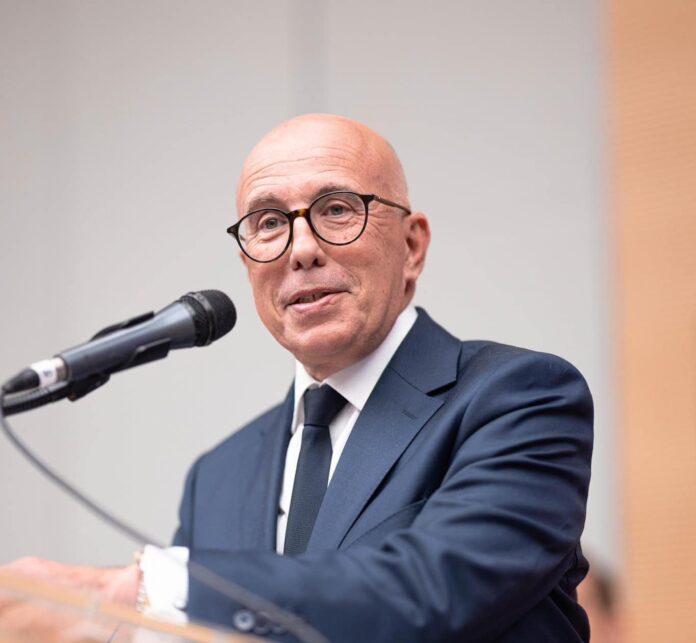
A new meeting on the organization of the 2030 Winter Olympics has rekindled tensions surrounding the Nice ice center. The mayor of Nice, Éric Ciotti, denounces a proposal deemed “unacceptable” and maintains his refusal to use the Allianz Riviera. The deadlock persists, while the timetable requires a quick decision.
A meeting was held yesterday bringing together the solideo, the cojop, state services, the South Region, the Alpes-Maritimes Department, and the City of Nice. The objective remained unchanged: to find a solution to the ice center issue for the 2030 Winter and Paralympic Games.
The Nice municipality expresses concern over the turn of the discussions. According to the city, discussions did not open up a compromise. A proposal was presented without thorough consultation. The city hall mentions a plan devised in just a few hours.
The point of contention once again concerns the use of the Allianz Riviera. Organizers indicate that any alternative would result in an estimated additional cost of 44 million euros, which would be borne by the community.
Éric Ciotti rejects this option. The municipality considers this position to have been predetermined.
A red line assumed by the municipality
The mayor of Nice has maintained a consistent position since the municipal campaign. The use of the stadium is a non-negotiable limit. This stance aligns with the intention to preserve local interests and public finances.
Éric Ciotti states: “I fear that purely political considerations have heavily influenced these choices against the interests of our city, our region, and our country. Nice is not an adjustment variable. We’re not reckless with the money of Nice’s citizens. The commitments I made to them will be respected.”
The municipality also criticizes the cost of the initial project. The temporary covering of the stadium for a few weeks is deemed disproportionate. The proposed amount of 90 million euros fuels criticism regarding financial management.
The alternative project advocated by the city relies on other infrastructures. The exhibition center could be transformed into an ice rink. The Jean-Bouin complex would be renovated. This strategy aims to create sustainable facilities.
The city hall indicates it remains open to an alternative solution, while specifying that if the Nice project is abandoned, the planned funds could be redirected towards local facilities and tax reductions.
This sequence is part of a series of meetings initiated after the election of Éric Ciotti. Technical teams from the cojop, solideo, and local authorities have tried to establish an inventory of solutions.
Renaud Muselier warns against calling Nice’s center into question
Faced with this situation, Renaud Muselier called for a quick decision. The regional leader emphasized the constraints of the timetable and the requirements of the project.
Renaud Muselier stated: “initiator of the 2030 Winter Games bid, after fighting to ensure event and medal parity with our northern partners, I note that the current blockages directly threaten the Nice center. They could lead to its being questioned. A decision must now be made. I remain committed and hope, until the end, to find a solution.”
The president of the South Region also mentioned a “real problem.” A reassessment of the project was no longer excluded. Several scenarios circulated, including redeploying events to other sites.
An organization under strain and a pressured timetable
The Nice case arises in an already tense context. The 2030 Games organizing committee is going through a fragile period. Internal tensions and questions about governance are slowing preparation.
In this context, the Nice ice center becomes a focal point. Political differences, technical constraints, and financial issues intersect. The timetable requires a quick decision.
The 2030 Winter Games remain a shared goal. Nice’s place in the setup now depends on a decision expected in the coming days.
NicePremium is a free, independent local news outlet.
Help us keep going by supporting our work from €5 per month.


