
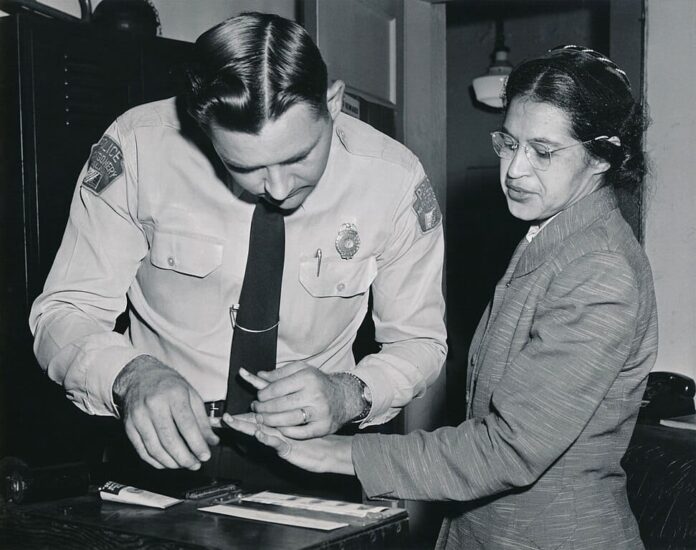
On December 1, 1955, Rosa Parks refused to give up her seat on a Montgomery bus. Seventy years later, this emblematic episode continues to fuel reflections on equality, citizenship, and everyone’s place in public space.
But beyond American history, what does Rosa Parks truly mean for France today? Why does this gesture, made thousands of kilometers away, still resonate in our society?
A Universal Symbol Beyond the United States
In France, where debates on equality, discrimination, and violence in public space are ongoing, Rosa Parks has become a cultural reference. Her name is associated with various transport stations, schools, and civic initiatives.
This appropriation is not insignificant: it reveals how her gesture goes beyond the fight against American racial segregation.
Rosa Parks embodies the ability of an individual to challenge a system, whichever it may be. And this ability remains central to many contemporary French movements.
France: The “Living Together” Put to the Test
In French cities, issues of equality and peaceful coexistence occupy a central place:
- equitable access to education,
- representation in public space,
- real or perceived discrimination,
- tensions in transport and shared spaces.
In this respect, Rosa Parks’ story resonates like a mirror: how do we ensure today that everyone can “sit in their place,” both literally and figuratively?
A Legacy Mobilized by New Generations
Contrary to the fixed image of a past icon, Rosa Parks still inspires current movements:
- student initiatives against discrimination,
- civic actions for equal access to services,
- educational projects focused on memory and human rights.
Her name regularly appears in the educational projects of French schools, where the importance of civic courage and individual responsibility is taught.
What Her “No” Tells Us in 2025
In an era marked by debates on inclusion, identities, and social cohesion, Rosa Parks’ gesture remains highly relevant.
It reminds us of a simple truth:
justice progresses only if everyone agrees to question rules that are no longer fair.
In a diverse, dynamic, and sometimes fractured French society, this message retains its undiminished power.
Conclusion: An Anniversary That Speaks Directly to Us
Commemorating December 1, 1955, is not just about looking back at the past.
It is also an opportunity to reflect on our present:
- how do we address inequalities today?
- how do we respond to everyday injustices?
- how do we perpetuate, each at our level, the spirit of Rosa Parks?
Seventy years later, her gesture reminds us that civil courage has no age, no borders, and no nationality.
To Go Further
To delve deeper into the issues of equality, the fight against discrimination, and social justice evoked through Rosa Parks’ figure, you can consult the resources of several French organizations committed to these themes:
- SOS Racisme – Campaigns, news, and actions against racism and discrimination:
- Ligue des droits de l’Homme (LDH) – Analyses, reports, and interventions on the defense of rights and freedoms in France:
- La Cimade – Publications and reports on the rights of foreign persons, welcoming, and inclusion:
- Amnesty International France – Thematic files and reports on human rights and the fight against inequalities:
NicePremium is a free, independent local news outlet.
Help us keep going by supporting our work from €5 per month.


