
Solly is a secure donation card that allows helping homeless people even without having cash. It ensures a strictly regulated use to cover only essential needs.
On the streets, fewer and fewer passersby have cash, while requests for help remain numerous. The Solly device was imagined to respond to this new reality. Designed as a secure bank card, this solution allows homeless people to receive donations directly by scanning a simple QR code, while ensuring that the money is used only for essential needs. With Solly, the goal is clear: modernize the act of solidarity while enhancing the dignity of those being helped.
Solly works like a payment card whose use is strictly regulated. Beneficiaries can buy food, clothing, hygiene products, or even pay for transportation, but access to alcohol, tobacco, or addictive products is automatically blocked.
Its creator, Tim Deguette, explains the origin of the project: “The idea came to me in high school and during my third year of higher education, I met a boy my age who was begging, and I thought something needed to be done.”
Beyond the technical aspect, Solly mainly aims to solve a problem that has become daily on the street: the impossibility for passersby to help due to a lack of coins. Thanks to the card, anyone can make a donation instantly, even without any cash on them. Donations can range from 2 to 100€.
A campaign closer to the needs
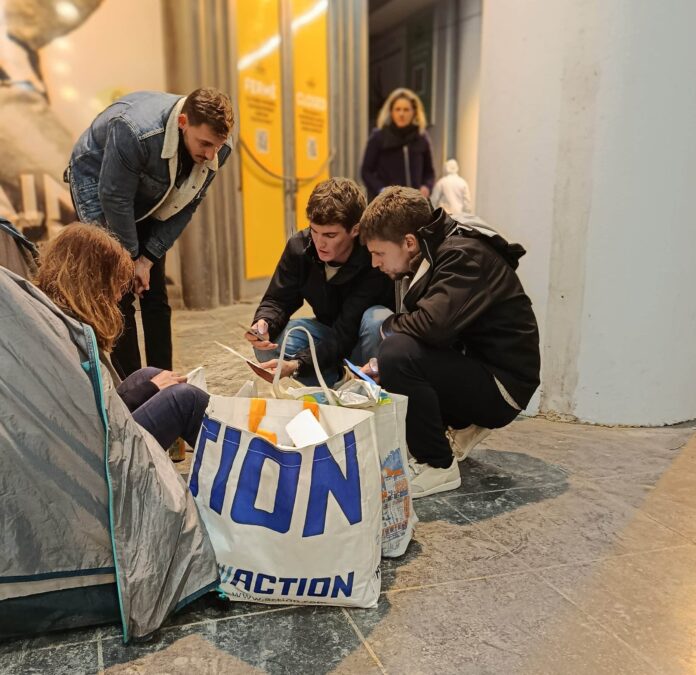
During one of the first campaigns using Solly, volunteers accompanied by Tim Deguette introduced the card to people they met. The approach often evokes surprise and then interest. “Everyone pays by card now… so if it can help me, I’m willing to try it,” explains a woman we met living outside for several months.
Volunteers patiently explain how it works, cards in hand. Some beneficiaries see it as an opportunity to regain a little autonomy, while others simply appreciate not having to rely entirely on evening food distributions.
Creating a financial device intended for homeless people was not a simple path. Between regulatory constraints, banking requirements, and the need for credibility with associations, Solly had to overcome several stages.
Tim Deguette reflects on this journey: “The main obstacles were initially financial: we needed to raise €170,000, and we were determined to pursue private funding, without public subsidies. Then, we had to overcome the legal constraints: how to create a payment card without requiring an ID or proof of residency, which are normally essential prerequisites. Finally, another challenge was to find the right partners, whether at the banking, associative, or legal level, to make Solly possible.”
A strictly regulated use to prevent misuse
One of the arguments often addressed to digital donation devices concerns the fear of misuse. At Solly, this issue was anticipated from the design stage. The card’s operation relies on a secure framework that prevents any misuse, ensuring that each donation truly serves the daily life of the beneficiary. Tim Deguette emphasizes this principle of protection in its very operation: “The card was designed for a very specific use: to collect donations. It does not work at ATMs and thus does not allow cash withdrawal. Nor can it be used online or to buy any products. Finally, we have set a collection cap at €500 per month, so that the donation is never considered an income and Solly does not become, in a certain way, a paid activity.”
At a time when physical money is gradually disappearing, precarity is intensifying, and emergency solutions are often saturated, Solly provides a concrete response to a problem that has become structural: allowing the act of solidarity to continue to exist.
“It’s not a miracle solution, but it’s a real support,” confides a volunteer after the campaign. This solution will be distributed to all associations working in support of homeless people in the coming months.
Malorie Aime
NicePremium is a free, independent local news outlet.
Help us keep going by supporting our work from €5 per month.


