
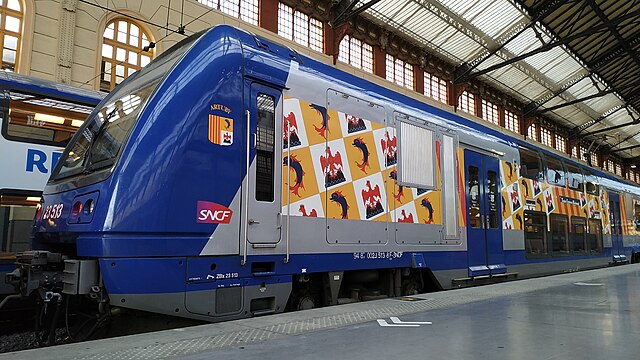
The South Region is investing nearly 250 million euros to renew a significant part of its rolling stock. Twenty-two Régiolis Coradia Polyvalent trains will soon join the East Provence and Alps lines. This decision aims to improve travel conditions and support the French railway industry.
SNCF
An important step is on the horizon for daily travel in Provence-Alpes-Côte d’Azur. The South Region has approved an order for 22 new trains as part of the operating contract for lot 3, awarded to SNCF Voyageurs. The goal is to strengthen and modernize the services in East Provence and the Alps. This order complements a fleet already in transition, with 17 trainsets previously purchased.
The investment amounts to nearly 250 million euros, entirely financed by the Region. This direction reflects a desire to focus on renewing trains and improving regional travel. Public announcements highlight a firm commitment to a rail offer more adapted to travelers’ needs. Renaud Muselier, President of the Region, emphasizes: “We are very concretely meeting the expectations of residents and travelers who are asking for more modern, reliable, and comfortable trains.”
The choice of equipment is the Régiolis Coradia Polyvalent model. This train, well-known in many French regions, will be delivered by the CAF-Alstom consortium. The 22 trains will be 100% electric. Each train will offer 310 seats spread over six cars. The specifications developed by the Region emphasize daily use and operation in mountainous terrain.
Onboard, travelers will find a redesigned environment for more peaceful travel. Large windows will provide substantial views of the landscapes. Indirect LED lighting will create a softer ambiance. The seats will have armrests, reading lights, and power outlets. Coat hooks will be installed. Two areas will be accessible for people with reduced mobility. The Region has also requested an arrangement favoring a larger number of seats facing the direction of travel, often appreciated on medium and long-distance journeys.
This modernization concerns not only comfort. The trainsets will comply with STI 2023 standards, particularly in terms of fire safety and the use of specific materials. Compliance with these regulations is one of the priorities of the European rail market.
An order that boosts the French industry
The production of the 22 trains will take place at CAF’s Reichshoffen site in Bas-Rhin. This location plays a central role in the French production of the rolling stock manufacturer. The announcement is good news for the local industrial ecosystem. It adds to other contracts that contribute to stabilizing the site’s prospects.
The project will also involve five Alstom industrial sites located in various territories: Le Creusot, Ornans, Tarbes, Villeurbanne, and Saint-Ouen. This production network will ensure the supply of numerous components. This distribution responds to an organization already tested on other projects. The railway-linked industrial fabric thus benefits from a continuity of workload. Alain Picard, General Director of CAF France, welcomes this prospect: “This order contributes to consolidating the workload of the CAF site in Reichshoffen.”
Beyond this announcement, the Region highlights a broader strategy. The political direction aims to support French manufacturing while strengthening daily rail transport. Renaud Muselier insists: “This is a new massive order, fully financed by the Region, for trains that will be built in France.” The message conveys a desire to combine public service improvement and support for industrial jobs.
The CAF group, an international player in rolling stock, recalls its presence in several countries and its commitment to decarbonized mobility. Its expertise covers construction, maintenance, and renovation. Its subsidiary Solaris is among the European references for decarbonized buses. In France, its Reichshoffen and Bagnères-de-Bigorre sites bring together a thousand employees.
This order marks a new step in regional rail renewal. It is part of a trajectory initiated several years ago. Expectations for daily transport are central to both regional and national priorities. The gradual replacement of old train sets paves the way for an operation more suited to contemporary use. Travelers on the Provence and Alps lines should notice this evolution in the coming years as the deliveries come into service.
NicePremium is a free, independent local news outlet.
Help us keep going by supporting our work from €5 per month.


