
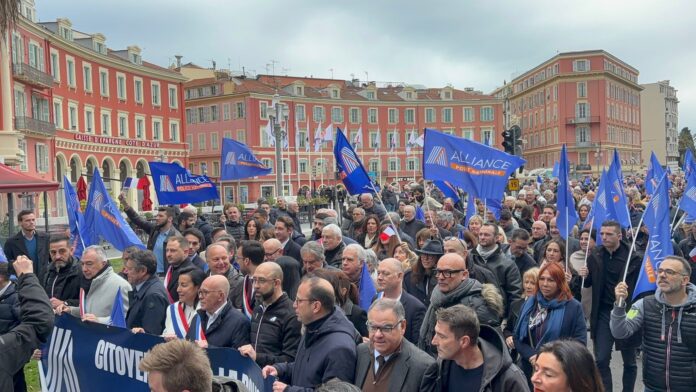
More than 2,000 people gathered at Place Masséna at the call of the Alliance Police Nationale union to raise awareness about police working conditions and advocate for demands deemed urgent by the profession.
A significant mobilization took place this Saturday morning in Nice. More than 2,000 people, according to the police, came to support the law enforcement officers at the call of the Alliance Police Nationale union. The gathering took the form of a citizen march organized in the city center, starting from Place Masséna. The expressed goal was to raise an alert regarding police working conditions, described as critical by the organizing union.
At 11 a.m., a citizen procession set off from Place Masséna. Plainclothes police officers were present, alongside many citizens who came to express support for the law enforcement. Political leaders also attended, resulting in a strong turnout of elected officials and party representatives. This mobilization occurred in a particular context, marked by strict rules imposed on on-duty police officers. These officers were not allowed to participate in the demonstration in their work attire. Nevertheless, they were present to ensure the safety of their colleagues.
An alert on working conditions and the loss of meaning
Asked about the reasons for this mobilization, Julien Hausknecht, departmental secretary of the Alliance Police Nationale 06 union, explained the engaged approach. “The police officers are at their wit’s end. We are asking for a shock of authority and for the government to become aware of the exhaustion due to the conditions in which we work. We want to do our job.”
The union representative mentioned an increasing difficulty in performing the fundamental missions of the police. “We are here to protect and serve. Today, we no longer have those means. And it is time to take the big turn.” Alliance Police Nationale justified this mobilization by a national stance. “If Alliance Police Nationale made this decision, it is because we are still the largest police union. We need to restore meaning and heart. We want a peaceful society.”
The issue of resources and work organization took a central place in the speech. “We want colleagues who can work properly. In reality, we are in 2026 and everything is deteriorating.” Statistics were provided to illustrate this situation. To date, about three million procedures are reportedly pending while 1.5 million procedures are drafted each year.
The link between police and justice was also addressed. “The police cannot work alone, we are linked with justice. But there is really a need for reform.” A critique of “reporting everything” was made. “If it’s just to reclassify afterward, it doesn’t make sense anymore. There is a loss of meaning.”
Several recent incidents in Nice were cited to underscore the importance of the core role of the police.
A claimed citizen march and a controlled political presence
The chosen form for this mobilization was explained as a deliberate choice. “Security is everyone’s business. If we want a peaceful society, all the actors in society must be active.” The role of the citizen was asserted by the union. “For us, it’s the population. It’s not statistics.”
As the municipal elections approached, the question of political exploitation was raised. Julien Hausknecht responded by affirming a line of neutrality: “for Alliance Police Nationale, it’s a citizen march. There is no label.” Several political leaders were present or represented, including Eric Ciotti, Christian Estrosi, Anthony Borré, Dominique Estrosi Sassone, Alexandra Masson, Louis Nègre, and Jean Léonetti.
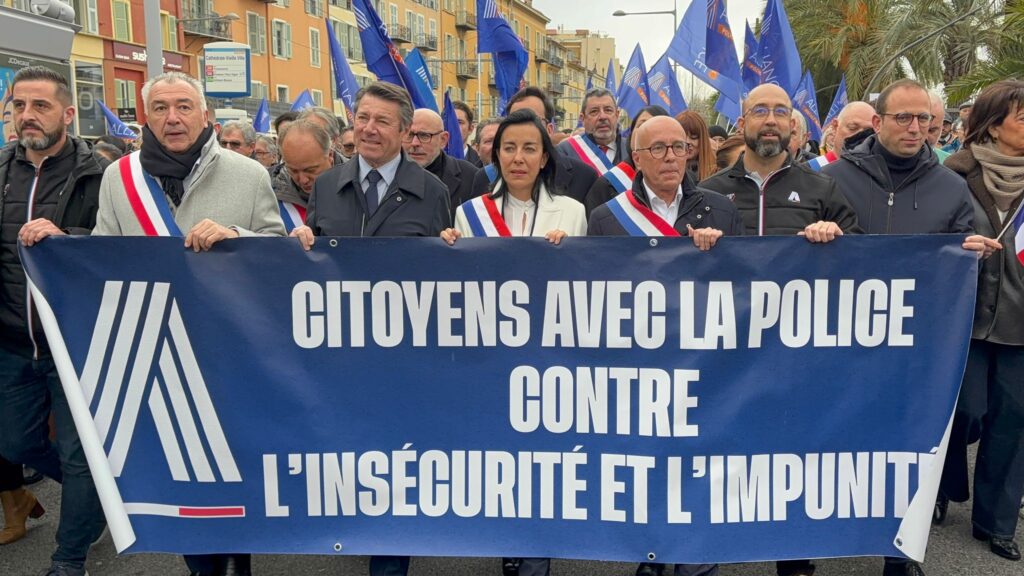
The speech concluded with a call to action addressed to the State and the government: “we are in Nice, 1,000 km from Paris, it’s time for change, enough is enough,” added Julien Hausknecht before touching on the material working conditions: “we have outdated software from the Middle Ages, and we work in run-down buildings.”
When asked about the profession’s perceived respect, Julien Hausknecht provided a nuanced response. “Today, we lack confidence, we have lost trust, and we lack meaning as well.” A clear expectation was formulated. “The profession needs to regain the primary sense of its mission, the full trust of a government, and the full trust of our citizens.”
K.S and Théo.G
NicePremium is a free, independent local news outlet.
Help us keep going by supporting our work from €5 per month.


