
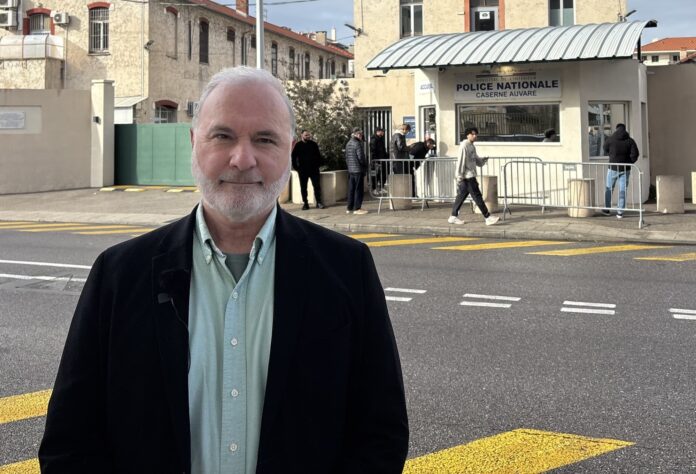
The centrist environmental candidate for the 2026 municipal elections detailed his plan today for the rehabilitation of the Auvare barracks. He advocates an alternative based on renovation, housing, and energy autonomy.
Jean-Marc Governatori, municipal councilor and opposition metropolitan, presented the main outlines of his program focused around the Auvare barracks site, located in the Saint-Roch district. A declared candidate for the 2026 municipal election, he intends to propose a different project from those supported by the main lists.
At the heart of his approach: preserving the existing buildings and renovating them. “The foundation of the foundation, above all, is that we don’t destroy, we repair.” He criticizes projects that rely on demolition, which he considers costly and polluting. “Demolishing is polluting. Rebuilding is polluting.”
A project based on renovation and autonomy
The candidate estimates that the transformation of the site can be done at a limited cost. “The 100 homes will cost 5 million,” specifies the opposition councilor. In total, the entire project would remain under 10 million euros.
The housing, with an area between 20 and 40 m², would be intended primarily for students, retirees, and workers. The site would be equipped with solar panels, connected to geothermal energy, and entirely thermal renovated.
“Food autonomy and energy autonomy are crucial,” insists Jean-Marc Governatori. Vegetable gardens would be installed around the buildings, alongside a local organic production.
A Seed House is also part of the project. “I want us to have a Seed House in the metropolis,” explains the candidate, referring to the challenges of agricultural preservation.
Financially, the candidate relies on a model based on rents and energy savings. “It’s almost a break-even operation,” claims the national co-secretary of Ecology at the center. The revenue generated would allow for gradually repaying the investments without massive recourse to public debt.
Housing, public facilities, and citizen participation
The project, named “Petit Nice Autonome”, also includes several facilities open to the public. An ecclesia would be created to host “debates for citizens.”
A school of ecological transition would be set up in another building, intended for youth and adults in retraining. “It’s a real school,” he emphasizes, noting the lack of similar structures in Nice.
A cultural space, a store selling local products, and housing reserved for police officers complete the facility. The rents would remain affordable, “a few hundred euros,” according to the candidate.
Politically, Jean-Marc Governatori positions himself as a centrist environmentalist. “What counts is the program and the project,” he emphasizes. He highlights that his electorate could influence the final choice, depending on the commitments made by the other candidates.
NicePremium is a free, independent local news outlet.
Help us keep going by supporting our work from €5 per month.


