
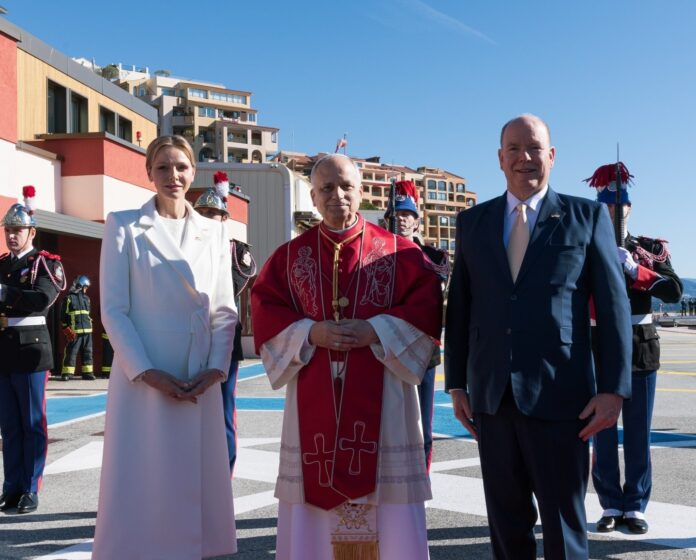
Pope Leo XIV arrived this Saturday, March 28, 2026, in the Principality of Monaco. This visit, unprecedented in modern times, surprises with its swiftness and prompts questions about its motivations. At the Prince’s Palace, the first words of the pontiff illuminate the purpose of this visit.
The announcement of Pope Leo XIV’s visit to the Principality of Monaco has sparked numerous reactions. The trip, presented as a pastoral journey, intrigues as much by its destination as by its timing. The question of the reasons for this visit circulates among diplomatic and religious circles, without an obvious answer at this stage. In an interview with the newspaper La Croix, the Monegasque ruler emphasized that the invitation extended during an audience at the Vatican on January 17 received an almost immediate response. This unusually short timeframe contrasts with customary practices for such visits.
This visit also has a historical dimension, as the pope himself highlights the singularity of this event. “I am the first of Peter’s successors, in modern times, to visit the Principality of Monaco, a city-state marked by deep ties with the Catholic Church.” With this statement, the pontiff places his presence in continuity while emphasizing a break.
A message focused on the role of the “small” in the world
From the beginning of his speech delivered at the Prince’s Palace, Pope Leo XIV develops a reflection on Monaco’s place within a tense international context. The territory is described as a unique space, both independent and embedded in a European environment.
“Located on the Mediterranean coast and surrounded by countries that founded European unity, your country finds in its independence a special vocation: to foster encounter and promote social friendship.” This definition of Monaco’s role is accompanied by a broader observation on the world situation.
“While the world is threatened by a widespread climate of closure and self-sufficiency, the gift of smallness, supported by a living spiritual heritage, engages your nation to put its wealth at the service of law and justice.” The idea of “smallness” serves as a leitmotif in the address, linked to a biblical tradition.
The pope extends this reflection by directly referring to the Scriptures. “In the Bible, as you know, it is the small who make history. True spirituality maintains this awareness.” This statement is accompanied by a call to trust: “we must have faith in God’s providence, even when feeling powerless or inadequate.”
A social interpretation of Monegasque reality
The speech then addresses the composition of Monegasque society, described as pluralistic and structured by different dynamics. The pope emphasizes the balance between nationals and foreign residents, as well as the diversity of economic activities.
“The plural composition of your community makes this country a microcosm whose well-being depends both on a dynamic minority of local nationals and a majority of citizens from other countries worldwide.” This observation is part of a broader analysis of the responsibilities tied to this situation.
The pontiff references the various profiles present in the territory. “Many occupy influential positions in the economic and financial sectors. A large number work in services. Visitors and tourists are also numerous.” This description leads to a more personal questioning.
“Living here is a privilege for some and a call for each to question their place in the world.” This statement establishes a link between material status and individual responsibility.
An explicit call to the circulation of wealth
The issue of the use of goods occupies a central place in the speech. The pope uses a Gospel reference to develop this idea. “In God’s eyes, nothing should be received in vain, as Jesus suggests in the parable of the talents.” This quotation introduces a concrete requirement.
“What has been entrusted to us must not be buried in the ground but put into circulation and multiplied for the Kingdom of God.” This notion of circulation goes beyond the religious framework and refers to a social and economic vision of sharing.
The pope emphasizes the universal scope of this responsibility. “Every talent, every opportunity, every asset placed in our hands has a universal destination: it bears the duty not to be retained but redistributed so that everyone’s life may be better.” This statement is part of an implicit critique of inequalities.
The address continues with a direct reference to Christian prayer. “That is why Jesus taught us to pray: ‘Give us today our daily bread.’ And at the same time, he says: ‘Seek first the Kingdom of God and its righteousness.’”
A particular responsibility for a Catholic state
The pope then mentions the religious status of Monaco, which constitutes a unique element in the international landscape. “You are among the few countries in the world to have the Catholic faith as a state religion.” This situation implies, according to him, a specific commitment.
“This highlights the sovereignty of Christ and commits Christians to bring forth in the world a kingdom of brothers and sisters: a presence that does not create divisions, that does not separate but connects.” This vision emphasizes unity and the protection of every person.
“A presence always ready to protect with love every human life, at all times and under any circumstances, so that no one is excluded from the table of fraternity.” The message here takes on both a spiritual and social dimension.
A mission oriented towards the future
In the final part of the speech, the pope entrusts the Principality with a specific mission. “I entrust the Principality of Monaco, by virtue of the deep bonds that unite it to the Church of Rome, with a particular mission: to deepen the social doctrine of the Church and develop both local and international practices.”
This directive is part of a broader reflection on the contemporary world. “We suffer by chasing temporary goods, novelties that last only a season, while the unprecedented challenges of our time can only be faced with a free heart and enlightened mind.”
The speech concludes with a reference to Paul VI, followed by a spiritual invocation. “Pax vobis: may peace be with you. And with your society.” A phrase that sums up the intention of this visit, which continunues throughout the day, between religious message and call for collective responsibility.
Remarks collected by Diane Roustan
NicePremium is a free, independent local news outlet.
Help us keep going by supporting our work from €5 per month.


