
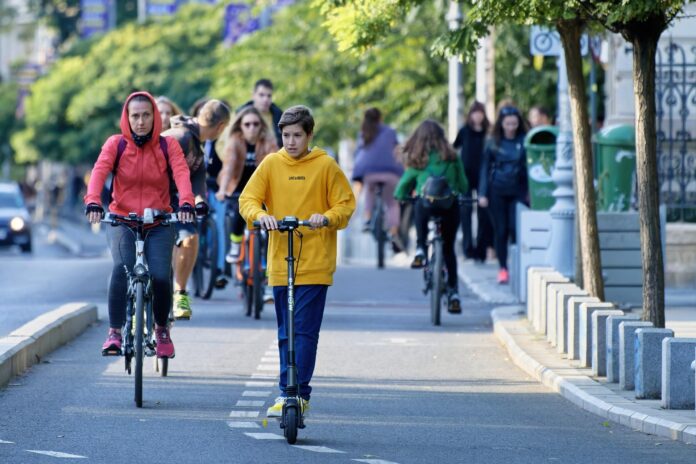
The traffic rules for electric scooters are being strengthened in the Alpes-Maritimes with the mandatory use of helmets and reflective vests from April 2, 2026. This decision comes after a notable increase in accidents involving motorized personal transport devices.
Starting April 2, 2026, traveling by electric scooter and other motorized personal transport devices will change framework in the Alpes-Maritimes. The decision comes from the prefect Laurent Hottiaux, who introduces a requirement for an approved helmet and reflective vest for each journey, “both day and night.” This measure is part of a context of increased accidents and aims to reduce severe injuries observed in recent years.
Motorized personal transport devices are now occupying an important place in the mobility of the department. Their use includes both daily commutes and leisure travel. The coastal area, cycling infrastructure, and dense road traffic promote this development. However, this trend also comes with an increasing number of emergency interventions.
In 2025, firefighters carried out 710 interventions involving a Personal Transport Device (EDPM), compared to 468 in 2023, representing a 51% increase, according to data presented by the prefecture: “this represents a daily average of two accidents.” Individual falls and collisions constitute the majority of situations encountered. The consequences are often severe, with serious and sometimes fatal injuries. Two users lost their lives in 2025, compared to one in 2024. Since 2020, nine deaths have been recorded.
These figures have led authorities to strengthen the regulation of a practice already governed by several provisions of the highway code. The prefect considers it necessary to go further to improve safety and limit risky behaviors.
Helmet, reflective vest, and educational checks: a new step in regulation
The announced measure now imposes two mandatory items: an approved helmet, properly fastened, and a reflective vest. The prefect specifies that “every user of a motorized personal transport device must wear a certified protective helmet.” Failing to comply with this requirement exposes one to a fine of €35, which corresponds to a second-class penalty.
Security forces will initially conduct educational checks. The goal is to give users time to acquire the necessary equipment. This transitional phase is intended to allow progressive adoption of the new rules, without immediate penalties for initial infractions.
The announcement also recalls the obligations already in place. The use of a Personal Transport Device (EDPM) is permitted from age 14 and requires insurance covering civil liability. The device must be equipped with front and rear lights, reflectors, effective brakes, and a sound signal. These elements are included in the list of mandatory equipment mentioned in the document: “front and rear lights in working condition; reflectors; effective brakes; sound signal.”
Traffic rules remain unchanged. The maximum speed remains set at 25 km/h, and any tampering is prohibited. Users must use cycling infrastructure within towns when available. Otherwise, traffic is allowed on roads limited to 50 km/h. Outside urban areas, traffic is prohibited in the absence of a bike path or green lane, unless specifically authorized. Parking on sidewalks remains possible only if it does not obstruct pedestrians and in the absence of contrary municipal regulations.
The penalties associated with infractions are detailed in the table provided by the state services. They range from €11 for a lack of equipment to €1,500 for tampering, with possible immobilization or confiscation. Using earphones or a handheld phone incurs a fine of €135, as does carrying a passenger or riding on a sidewalk without authorization.
This new step demonstrates a willingness to adapt regulations to the rapidly evolving usage. Authorities rely on a combination of material obligations, controls, and reminders of existing rules to reduce accidents. The prefect emphasizes the need for safe driving and strict compliance with mandatory equipment to mitigate risks.
The implementation of these measures across all communes of the department should allow for the harmonization of practices and better clarity of obligations for users. The stated objective remains the reduction of accidents and the protection of all road users, in a context where EDPMs hold an increasing place in daily mobility.
NicePremium is a free, independent local news outlet.
Help us keep going by supporting our work from €5 per month.


