
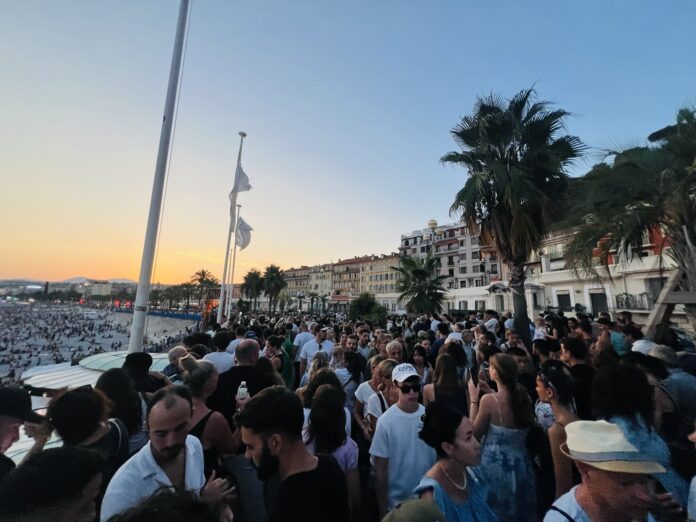
Nice, Wednesday, August 12, 2026 in the evening, thousands of Nice residents, French and foreign tourists gathered on Castle Hill and along the Promenade des Anglais to observe a partial solar eclipse, obscuring 95% of the sun above the city. The event, unprecedented in Europe since 1999, took place between 7:31 p.m. and 9:14 p.m., with a maximum reached at 8:24 p.m. While some spectators experienced a moment they describe as unforgettable, others left frustrated, due to excessive crowds or terrain that obscured part of the phenomenon.
In France, this partial eclipse drew crowds in several regions, as everyone sought the best position to observe this rare astronomical event. In Nice, the city council had anticipated the event by adjusting the city’s organization. To allow as many people as possible to enjoy it, the municipality decided to exceptionally extend the opening of Castle Hill Park until 9 p.m. Prevention messages had also been circulated, reminding that one must “never observe the Sun with the naked eye”, only certified glasses meeting the ISO 12312-2 standard effectively protect the eyes.
A “magical” spectacle for some…
For some spectators, the evening lived up to all expectations. Installed on the Promenade des Anglais, considered one of the best unobstructed viewpoints in the city, Courtney was delighted: “It was cool, it was spectacular, and I’m glad I witnessed that.” She hopes to experience such a moment again in the future.
Similar enthusiasm from Sory, a project management student, who followed the phenomenon from the heights of the city. He describes a particular atmosphere, with a crowd from everywhere: “Really a magical spectacle, seeing all those people who were on the edge of the beach and wanted to enjoy this unique moment, which we haven’t seen in 27 years.” He recounts observing “the Moon that came, little by little, obscuring the Sun, a moment he describes as an extraordinary spectacle.”
…an eclipse missed by others
Not all testimonies are as positive. Going to the beach to observe the phenomenon, Dina said she was disappointed: “I only saw a crescent of sun, and it was orange with the glasses but we could barely see anything, because it was hidden by the mountains.“ She regrets the lack of unobstructed viewpoints in the city: “You had to go up, but there weren’t many places where you could enjoy the spectacle from Nice.”
The large crowds also spoiled the evening for some spectators. Julien, a student in Nice for five years, recounts a complicated evening: “There were way too many people, so we didn’t manage to see much.” After catching the beginning of the phenomenon from the beach, he and his group of friends attempted to climb Castle Hill, without more success: “There were too many people, we didn’t manage to see anything in the end.”
His classmate Diego shares this mixed feeling: “Impressions are divided, we couldn’t see much. The lighting decreased slightly, everyone applauded, and we didn’t see much more than that, unfortunately.”
A historic appointment
Between the wonder of some and the frustration of others, this partial eclipse of August 12, 2026 will remain a contrasting memory for Nice residents. While the municipality views it as a popular success and a moment of collective memory, several spectators point to the crowds and the city’s terrain, which limited the experience for part of the public.
The next partial solar eclipse will be visible from France on August 2, 2027, however with an obscuration around 50%, significantly lower than that observed today. To witness a total eclipse visible from mainland France, you will need to schedule it for 2081, September 3 precisely.
Adama Sanogo
NicePremium is a free, independent local news outlet.
Help us keep going by supporting our work from €5 per month.


