
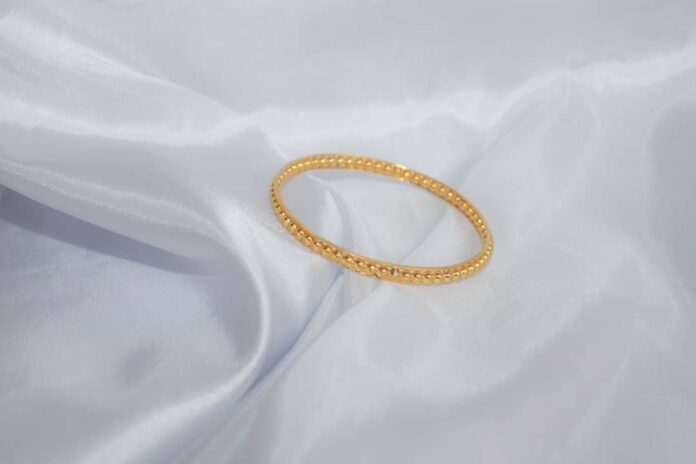
Simple, graphic and capable of transforming an outfit without overloading it, the bangle bracelet is one of those jewels that traverse decades without truly disappearing.
But in 2026, it finds particular visibility. On the runways as well as in the accessories selections for the season, rigid bracelets, bangles and cuffs are gaining volume. Very thin silhouettes now sit alongside more sculptural pieces, sometimes worn alone, sometimes accumulated on the wrist. Vogue even identifies bangles and cuffs among the striking accessories of this late summer 2026.
A trend that seems particularly at ease under the light of the Côte d’Azur, where a few well-chosen pieces are often enough to accompany a light dress, a linen shirt or an evening outfit.
From discreet bracelet to sculptural cuff
The bangle is obviously nothing new.
What changes this season has more to do with how you wear it than the jewelry itself.
After several years dominated by particularly fine and discreet jewelry, recent collections allow more room for volumes, graphic shapes and freer associations.
The bangle can thus remain very minimalist: a simple gold ring worn alone on the wrist.
But it can also take on more presence and approach the cuff, with hammered surfaces, irregular volumes or almost sculptural shapes.
The trend is part of a more general movement observed in the Spring 2026 collections: jewelry becomes more personal, mixing precious pieces, more modest materials, artisanal forms and sometimes unexpected associations.
Layering, always present
Another possibility: don’t choose.
Wearing several bracelets together remains a very current way to compose your style.
Bangles of different thicknesses can be layered, possibly with a watch or more flexible bracelet. The objective is not necessarily to achieve a spectacular accumulation: two or three pieces are already enough to create rhythm.
The 2026 collections continue to play largely with jewelry layering. At Chanel in particular, layering remains very present, with a maximalist approach updated in recent collections.
For a more Mediterranean style, you can stick to a fairly simple palette: a smooth bangle, another slightly hammered and possibly a finer piece.
With a white shirt or a linen dress, the contrast works almost immediately.
Gold and silver: why choose?
The old rule of avoiding mixing gold and silver jewelry has largely lost its importance.
Mixed metals are now used both by designers and in the way people compose their own jewelry. Vogue already noted this shift in recent seasons, and the principle remains particularly suited to stacking: silver, yellow gold and sometimes rose gold can coexist on the same wrist.
It’s also good news for those who own jewelry accumulated over time.
Everything no longer needs to be perfectly matched.
A steel watch can accompany a gold bangle; a silver bracelet can be paired with a yellow gold piece; an antique jewelry can sit alongside a contemporary creation.
The result often appears more personal precisely because it’s not overly coordinated.
How to wear the bangle this summer on the Côte d’Azur?
With linen: playing it simple
A loose linen shirt, fluid pants or a white dress probably constitute the ideal setting for a gold bangle.
With a very streamlined outfit, a single slightly wider piece can suffice.
Mediterranean light does the rest.
The idea is not to systematically accumulate accessories, but to give the jewelry enough space to become an element of the silhouette.
For an evening: daring more
In the evening, you can instead play with layering.
Two or three thin bangles paired with a more structured cuff give more presence to the wrist without requiring other particularly imposing jewelry.
With a black dress, navy blue or natural tones, the metals become almost a graphic element of the outfit.
During the day: mixing precious and casual
The bangle works just as well with a much simpler outfit: jeans, white t-shirt, sandals or mules.
It’s even one of its main interests.
A relatively classic piece of jewelry can create an interesting contrast with very casual clothing. On the Côte d’Azur, where outfits easily transition from the beach to a terrace or from the market to lunch, this versatility is particularly appreciated.
Solid gold, silver, vermeil or gold-plated: what do we really choose?
Behind sometimes similar appearances lie very different materials.
A solid gold bracelet is obviously not comparable to a gold-plated piece, either in terms of price or durability.
For silver, French regulations notably allow the name “silver jewelry” for legal standards of 999, 925 and 800 thousandths. 925 silver, often called sterling silver in English-speaking countries, therefore contains 92.5% silver.
One must also distinguish gold-plated, gilded and vermeil.
In France, to be sold under the designation “gold-plated,” a piece of jewelry — excluding watches — must notably have a gold layer of at least 3 microns. Below this thickness, it can only be marketed as “gilded” jewelry.
Vermeil has a different definition: it is silver covered with a gold layer. To benefit from this designation in France, this layer must reach 5 microns, with gold meeting the required legal standard.
These differences are useful to know when comparing two pieces of jewelry whose prices can be very far apart.
Be mindful of Mediterranean living
A nice summer bracelet is not necessarily one with which you need to swim.
This is particularly true for jewelry with a surface coating.
Sea, swimming pool, cosmetics, perfume and repeated friction can gradually alter certain finishes. The wise approach is therefore to remove the most delicate pieces before swimming and to follow the maintenance recommendations given by their manufacturer.
And above all, the regulatory thickness of 3 microns allowing the “gold-plated” designation does not mean that a piece of jewelry becomes insensitive to seawater or intensive use. It’s a product definition, not a guarantee of indestructibility.
On the Côte d’Azur, where a day can easily go from the beach to a restaurant, it’s better to take a few seconds to remove your bracelet before diving.
Jewelry as souvenir rather than simple trend
The current success of bangles and cuffs also joins a deeper evolution in jewelry.
Jewelry is increasingly seen as a piece that you keep, associate with others and gradually enrich. Vogue even noted at the beginning of 2026 growing interest in certain pieces of jewelry as durable objects and, in the high-end market, as assets likely to retain value over time.
This obviously doesn’t mean that any bracelet constitutes a financial investment.
But the idea of buying fewer pieces and keeping them longer aligns quite well with the very nature of the bangle.
You can wear a bracelet purchased twenty years ago today without it necessarily appearing dated. You can mix an inherited piece with a recent creation. And you can gradually add new bracelets to a collection without starting from scratch with each trend change.
On the Côte d’Azur, let the light speak
The bangle ultimately possesses a quality perfectly suited to Mediterranean summer: it doesn’t need to do much.
A simple shape, metal that catches the light, exposed skin and a few light garments are enough.
In 2026, trends simply allow it more freedom: wider or thinner, alone or accumulated, gold or silver, perfectly smooth or intentionally irregular.
On the Promenade des Anglais, at the Cours Saleya or for an evening facing the Mediterranean, there’s no need to look for an absolute rule.
The most contemporary approach is perhaps precisely to mix the jewelry you already love, add a new piece to it and gradually build a collection that resembles the person wearing it more than a fleeting trend.
NicePremium is a free, independent local news outlet.
Help us keep going by supporting our work from €5 per month.


