
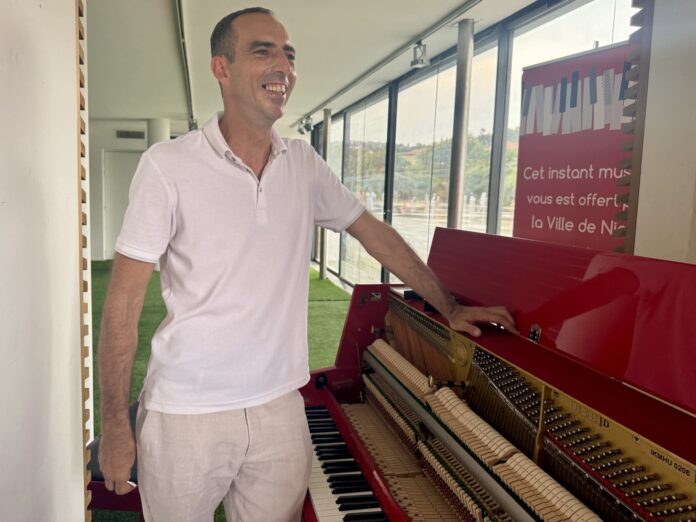
Steve Villa-Massone received, on Friday, August 14, the keys to the premises so he could store his mythical red piano. The unique Nice composer opens up, revealing his career and the person behind it who have elevated his works to the status of Nice’s cultural heritage.
Steve Villa-Massone is often recognized as the artist with the red piano. We cannot miss him in every iconic place in Nice. Now he can play without problems since the City of Nice has provided him with a space to store his mythical instrument.
“I have always been passionate about music and my city” confesses the pianist. His childhood was built between the sea and the colorful buildings of Nice’s port, on Avenue Jeanne Marlin. He grew up in a family of artists, like him. His father painted and his brother, a pianist, was the musical driving force for Steve, igniting his passion for the keyboard instrument.
His father instilled a passion for piano in his two children, having been unable to play it himself. He created the unique Nice composer: Steve Villa-Massone, and a DJ, Jerôme Villa-Massone, who just obtained his first gold record.
From revelation to playing piano in Nice’s streets
Before becoming a composer of over 200 recognized pieces, he studied sales and worked in the restaurant industry. Destiny then showed him a more than explicit sign: a street pianist in front of his workplace. A shiver overwhelmed him and, on a whim, he decided to learn all aspects of the street pianist profession.
Thus began his period of artistic clandestinity in 1999. His family piano, which he transported from Boulevard Stalingrad to the Old Town each evening, needed to find a place to rest. Steve lists his storage spots with an amused tone, such as apartment courtyards, parking spaces for rented scooters—having lied to the agencies—a van that cost him countless fines—he had to protect his precious instrument. Each one had its own story and mishaps, and every emotion of the romantic pianist was relived again.
This is precisely what distinguishes him from other composers; he brings the Romantic period to life with a contemporary flair. Red, “the color of passion” is what made his heart vibrate when a Paris-based company offered him multiple pianos, including one covered with Dali’s paint. Always enthusiastic, he exclaims: “These are the colors of love, these are the colors of Nice, that’s the one I need!”
Because Nice for him is what allows him to play fully and freely. His interpretations and compositions make him “the last romantic composer.” He brings each of his emotions to life through the music he performs, inevitably leading the street audience to experience their own. It is moreover these streets that bring him his inspiration, where the public offers him recognition and he offers them his talent.
“Being a composer is complicated. There are no formal training programs. You can learn harmony, counterpoint… But not musical creation. Chopin said that “composition cannot be taught.” However, every time you listen to music, it’s a composition lesson,” adds Steve.
This living cultural heritage of Nice did not acquire his knowledge from just anyone. It was Richard Rességuier who detected his potential, who is the heir of Magda Brahar, a close friend of Ravel and Rachmaninov. For him, composing is “mathematics and geometry” arranged according to his emotions and the colors he perceives.
The art of composing in Nice’s colors
His genius can therefore be explained by his synesthesia. He not only hears music, he perceives it internally through colors. Each note has a hue, everything is a visual texture. When he plays and composes, it is not just music, but a journey through multiple colors that he offers to his listeners.
Philippe Zana, piano tuning craftsman, knew it from the beginning. “I realized right away that he was already an artist, but he wasn’t really known yet. He has great talent and does everything to exploit it,” emphasizes his friend who maintains the well-known red piano. Steve Villa-Massone reminds us that without his friends, he would not have become the artist he is today. His friend Gérome, who follows and supports him in every endeavor, describes his playing as “a pearl of nacre.” Steve even gave him a piano without a lid to overcome his fear, allowing anyone who wishes to play to have the ability to do so.
His talent allowed him to travel and share his knowledge beyond European borders, playing his compositions in the United States. He was also offered an elite internship in Flaine and a grant of 15,000 francs, making him “a star” during that stay. Yet, it is on Nice’s streets that he feels best. “I feel very good at home with the people of Nice. It’s my universe. That’s it, this is where everything happens,” Steve shares, moved by what he has been able to accomplish so far.
The shelter offered by Nice’s city hall for his red varnished piano is for him the strongest moment of his career. It is not just the end of wandering, but above all a recognition of everything he has been able to accomplish. This small key, accompanied by a keychain with a golden coin, is his new treasure that he intends to use every day.
This heir of Romanticism, eyes sparkling, affirms he wants to leave “a cultural heritage before I go. [I] want to be one of those on this earth who have contributed to what we can see when we look at cultural and human heritage. […] It is our role to beautify this world before we leave it.”
So, to leave a mark beyond Nice’s Opera House, he plans to create a gold-bound collection of his 200 works to offer to the ten greatest pianists of our time. His dream: that one of his melodies pleased one of them enough to be performed.
NicePremium is a free, independent local news outlet.
Help us keep going by supporting our work from €5 per month.


