
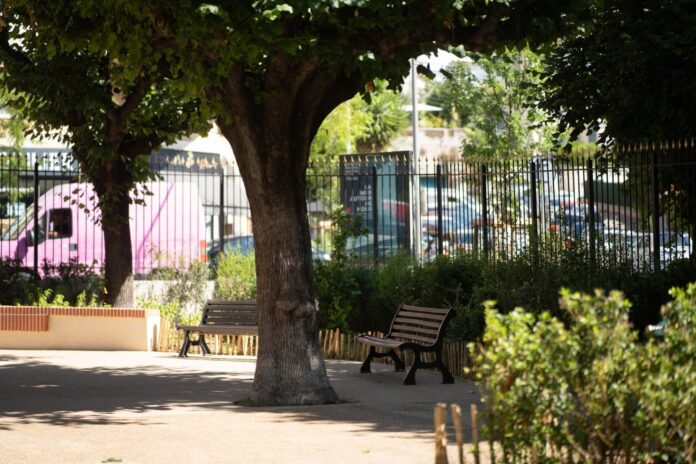
Nice’s hypercentre, highly mineralized, remains exposed to extreme heat despite an essential canopy for cooling the air. The metropolis nevertheless exceeds the 3-30-300 rule thanks to extensive tree cover, even if water stress weakens these trees.
Tree cover in Alpes-Maritimes exceeds the 30% objective of the 3-30-300 rule. Mediterranean vegetation allows it to have 44.2% canopy on average at the departmental level. This rule, formulated by researcher Cecil Konijnendijk, aims, through these 30%, to act on microclimate and residents’ health.
Nice manages to serve as a model, since the city of 340,000 inhabitants validates these three green urban planning rules. 94.8% of homes have at least three trees visible from their windows, 38.2% of the city’s neighborhoods benefit from 30% canopy (the vegetation surface formed by trees, editor’s note) and 77% of homes have a green space of at least 0.5 hectares within 300 meters nearby.
Weak canopy in the hypercentre
Only 59 neighborhoods (IRIS) in Nice out of 146 actually reach the protective canopy threshold. The Vinaigrer sector has 63% green coverage, while the neighborhoods of the hypercentre and the port remain highly mineral and pale. Even though those in Mont-Boron and Cimiez extend down to the waterfront.
This mineralization is all the more concerning, as the city center suffers from a stronger urban heat island compared to its surrounding areas, according to data published by Cerema. A phenomenon obviously amplified by its 2,800 hours of sunshine per year, a six-month warm season and very powerful direct solar radiation.
Trees are the best ally for cooling the air. Tree cover makes it possible to gain up to 1.5 °C thanks to a 30% canopy. The heat wave and predicted droughts are not a good omen for the latter. Trees cannot fully perform their evapotranspiration. They stop their growth and interrupt this thermal process, causing leaves to fall prematurely.
This natural self-defense mechanism temporarily deprives the city of natural air conditioning, even as the heat dries out the tree’s fibers. Pierre-Louis Guhur, co-chairman of Argile, warns: “All trees are flammable. However, under water stress, they become even more flammable than usual.”
Practical constraints
The energy renovation specialist points out that a tree does not need particular outside help for its regeneration. The problems are the physical constraints of city centers and their asphalt, since the volume of the canopy is equivalent, in the soil, to that of its roots.
Pierre-Louis Guhur points out that the roots of young trees are still short and can survive with regular watering, which is necessary despite water restrictions. However, he points out that “the smaller it is, the fewer defense mechanisms it has. Its roots are smaller and cannot draw as much moisture from the soil.”
In addition to the cooling provided by the soil directly, alternatives on rooftops are often proposed. Yet, as the energy renovation specialist points out, “a roof should have four to five meters of depth, which would condemn the last two floors.” Alternatives for cooling apartments are nonetheless possible. Pierre-Louis Guhur proposes green walls, which would help maintain coolness in homes.
This distribution of vegetation is not merely practical. The most mineralized neighborhoods are naturally more exposed to high temperatures. The homes in these neighborhoods are often poorly insulated due to their age. Similarly, the most vulnerable people are more sensitive to extreme heat. The greenery of cities is therefore not merely a matter of aesthetics. Canopy, and more broadly vegetation, contribute to protecting public health.
NicePremium is a free, independent local news outlet.
Help us keep going by supporting our work from €5 per month.


