

A march was organized to denounce the proposed law on “the presumption of legitimate self-defense for law enforcement,” this Saturday, September 19. Leading the procession in Nice, the anti-racist counter-attack collective preceded a crowd of protesters opposed to what they call the “license to kill” law in the face of risks of police violence.
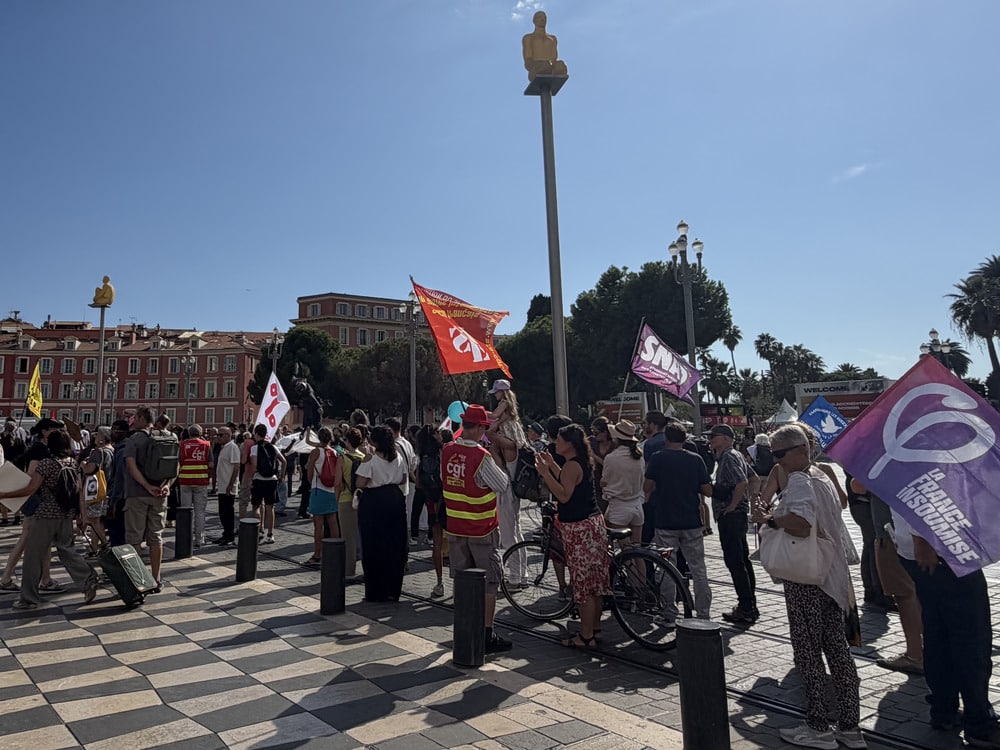
From Nice-Ville train station, more than 400 protesters walked along Avenue Jean-Médecin against the adoption of this text, aimed at recognizing a presumption of legitimate self-defense for law enforcement. The procession was accompanied by local collectives and unions, such as France Unbowed (LFI) 06, the CGT Nice Métropole Côte d’Azur, the FNEC FP-FO*, and the anti-racist counter-attack collective 06.
Carried by the deputy The Republicans, Éric Pauget, this proposed law aims to establish a presumption of legitimate self-defense for law enforcement in the exercise of their duties. The text more specifically mentions “an absolutely necessary and strictly proportionate use of their weapon for the sole purpose of preventing the reiteration” of a crime or attempted crime. This proposal refers to articles L.435-1 and L.511-5-1 of the internal security code. They define the situations in which police officers and gendarmes can use their weapons.
On June 26, 2026, a petition calling on members of the National Assembly to vote against it gathered more than 732,086 signatures. This should have led to a debate but it was dismissed by deputies on the legal affairs committee in July. The text was ultimately adopted in first reading in the National Assembly on July 7th.
Called for in several cities in France, this mobilization comes a few weeks before the Senate examines the proposed law. During the back-to-school evening of the Young Unbowed, Allan Clerc declared “that there is still hope because this text is not yet law.” Its adoption raises serious concerns because it would represent a risk to the rule of law, that is, a system guaranteeing respect for fundamental rights and democracy.
A normalization of police violence feared
“From yellow vests to working-class neighborhoods, everyone hates police violence,” chanted the protesters. Portraits of victims were displayed on the vehicle that opened the march.
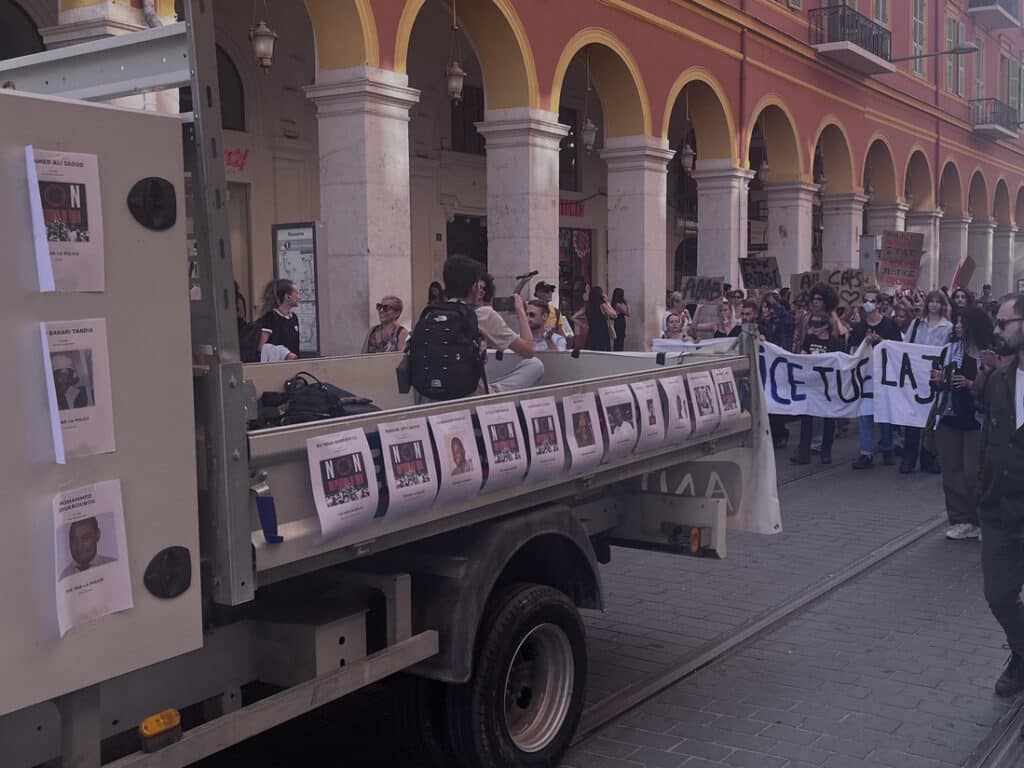
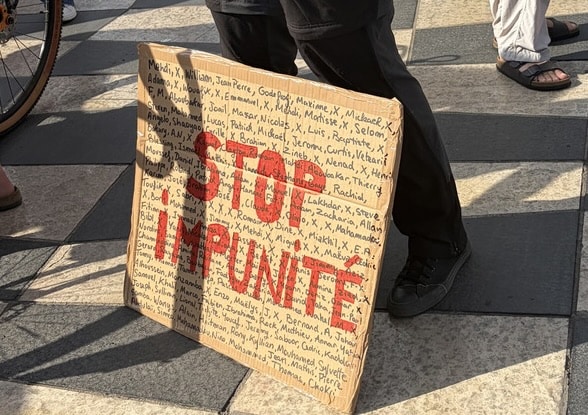
This proposed law is directly associated with a police state. “Enough, enough impunity, no, no to the police state!,” the activists exclaimed. This regime is characterized by the adoption of rules offering no guarantee for individual rights and fundamental freedoms.
Olivier Salerno, the co-referent for unitary relations of LFI 06 stated on his X account: “Young people are determined not to let this text from the RN program pass.” The one called the “license to kill” law is criticized for having appeared in the speech of the 2007 presidential candidate, Jean-Marie Le Pen. Thus, beyond the fight against police violence, this mobilization also shows the determination of left-wing parties to block the far right as the 2027 presidential election approaches.
Moreover, this text is criticized for establishing a break in equality among citizens before the law. It should be noted that all parties to legal proceedings may benefit from the state of legitimate self-defense, nevertheless, it is up to the person invoking it to provide the proof. However, the presumption provided for by this proposal means that officers are presumed to have acted in one of the authorized cases. For activists, this would represent a risk of increased police misconduct since they would no longer be subject to the same obligations.
Present to oversee and secure the mobilization, law enforcement also received support from passersby, directly or indirectly on the basis of fleeting “long live the police” remarks. An officer questioned about the numerous more or less pointed slogans against law enforcement confided that it was necessary to “rise above it, we must not take everything personally.”
A shift in the burden of proof unfavorable to victims
The text specifies that the presumption can be rebutted “by any evidence to the contrary.” In other words, the judicial investigation or preliminary inquiry must demonstrate a use of weapons that is “manifestly disproportionate or contrary to the principle of absolute necessity established by law.”
Activists do not view this simple presumption favorably. “This law would mean that a shot would be presumed legal and it would be up to families, to the mother, to the brother, to prove otherwise,” lamented Allan Clerc in his speech. However, it is important to clarify that in this situation, the burden of proof would not fall on the victim. It is up to the Public Prosecutor’s Office to provide proof of the reality of the offense.
Nevertheless, the Defender of Rights issued an opinion on this text in an opinion of June 26, 2026. The latter notably highlighted the risk that such a presumption “influences the behavior of officers” but also “the conduct and the intensity of investigative acts performed to verify the circumstances of a shooting.”
Conversely, Rosie, a Nice resident out strolling in the city center, said she understood this mobilization: “I fully understand that people might be afraid of this presumption because of police brutality.”
*The National Federation of Education, Culture and Vocational Training Force Ouvrière
NicePremium is a free, independent local news outlet.
Help us keep going by supporting our work from €5 per month.


