

The Charles Nègre Photography Museum unveiled “A Photographer’s Life” dedicated to Sabine Weiss on Thursday, October 15. In this retrospective of the artist’s work, visitors will have the opportunity to discover the poetry of everyday life depicted and its breath of humanity. Available until January 31, 2027, this exhibition is part of a dynamic of transmission for future generations.
The former industrial building hosts Sabine Weiss’s first exhibition in France, since her death in 2021. “A Photographer’s Life” is a retrospective of the work of this humanist artist, produced by the Sabine Weiss Studio and the Photo Elysée Museum in Lausanne.
Pierre Gautier Square celebrated, last Thursday, the opening of this exhibition, in the presence of Éric Ciotti, Mayor of Nice and President of the Nice Côte d’Azur Metropolis, Virginie Chardin, exhibition curator, and Fanny Brülhart, head of the collections department at the Lausanne museum.
This inauguration took on a whole different dimension in the presence of the photographer’s daughter, Marion Weiss. “Sabine Weiss worked until her last breath and we will discover tonight with pride and honor her works that she desired until the end of her life. Seeing you among us tonight dear Marion, it is a little of your mother’s light that accompanies us in this museum“, declared solemnly Éric Ciotti. The emotion of Marion Weiss upon hearing these words was at its peak.
Virginie Chardin shared that “Sabine Weiss was an extremely joyful woman who had a passion for photography in her very being“. In France, she was one of the rare women to take up the profession of independent photographer in the aftermath of the war. Of Swiss origin, Sabine Weiss collaborated with the international press as an illustrative photographer for nearly seventy years.
This exhibition includes 165 photographs and original documents on the themes that inspired her, from childhood to Parisian streets, to her travels throughout Europe and the Middle East. This retrospective of Sabine Weiss is unique in that it presents original silver prints made under the artist’s supervision during her lifetime.
Accessible until January 31, 2027, “A Photographer’s Life” reflects “an important moment in the cultural life of our city that we want to be increasingly intense and eclectic“, declared Éric Ciotti.
For the director of the Charles Nègre Photography Museum, Stéphane Tallon, the work of Sabine Weiss “is a suspended interlude that reminds us as René Char indicated, that the essential is constantly threatened by the insignificant.” This exhibition immerses visitors in the poetry of the most ordinary everyday life, which must be preserved. “A Photographer’s Life” transmits the human values dear to its author and recalls the importance of cultural transmission.
A humanist photographer, witness to her era
Sabine Weiss was not confined to a single register. She could photograph fashion figures, capture scenes of Parisian streets, immortalize childhood memories and more.
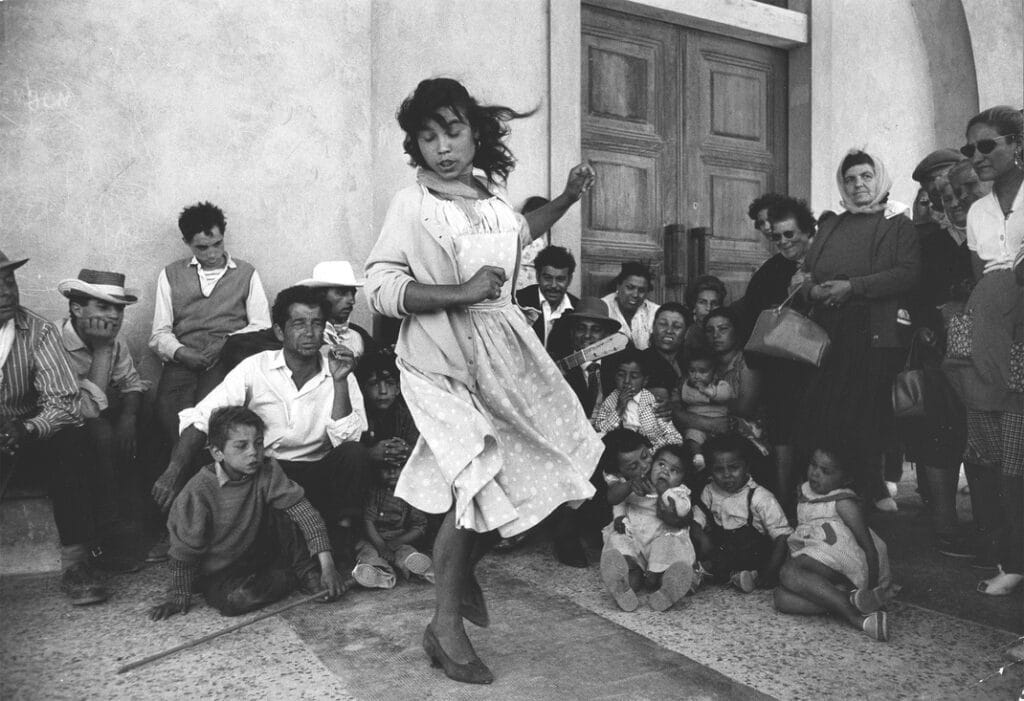
Her work is characterized by an appetite for detail. This artist lingered over the expression of a body, a gesture, or an emotion. In her conception of photography, the image must “tell an aspect of the human condition” (Intimate Convictions, 1989). This is why Sabine Weiss was associated with the humanist school alongside Robert Doisneau and Willy Ronis. Virginie Chardin clarified the artist’s thinking by stating that a photograph must be able to convey the emotion felt by the photographer when confronted with the subject.
The entirety of what those close to Sabine Weiss said reveals an intensely human personality. “It is true that my mother was someone who deeply loved humanity and meeting people. She knew how to look at them with tenderness and compassion, it was never pity“, confided Marion Weiss.
The choice of this museum for this exhibition is not insignificant. Éric Ciotti mentioned the connection between the Swiss photographer and Charles Nègre: “both sought art in the things of everyday life, in the thousand and one movements that make the beauty of life. She enters today in the house of he who opened the way.”
As a precursor to humanist photography, Charles Nègre distinguished himself by capturing images of the working classes. In the early days of photography, only stiff portraits of the bourgeoisie indoors and images of cold monuments were popular. This 19th-century artist was interested in scenes of Parisian streets. In the series of photographs “The Chimney Sweeps on the March” (1851), the artist evokes the harsh social reality affecting some of the seasonal migrants who came from Savoy, embodying a particularly precarious social class.
A century later, the exhibition “A Photographer’s Life“ reflects the testimony of an era, of everyday life and many memories. Both in her practice and in the perception of her subjects, the Swiss photographer explored the human condition in its simplest expression. “This woman knew better than anyone how to capture truth in its simplest form. Sabine Weiss photographed to keep in images what was about to disappear“, declared the mayor of the city of Nice in his speech.
Cultural transmission at the heart of ambitions
For the exhibition curator, Virginie Chardin, “museums participate in the transmission of knowledge and values that were Sabine Weiss’s.”
The azure city is committed to this desire for transmission by offering a rich cultural program. For Éric Ciotti, the history of the city of Nice is intimately linked to culture, the source of its radiance. The mayor believes that “this cultural legacy {must be} continued, so that we are the transmitters to future generations.” The opening of the exhibition “A Photographer’s Life“ was an opportunity for the municipality to reaffirm its commitment to making culture one of its priorities.
Furthermore, Éric Ciotti mentioned their ambition to undertake a renovation of the Nice Opera: “it almost closed a few days ago due to some falling stones from the building, it was quickly protected and safety is guaranteed. We need an auditorium.” The mayor of the city also announced the reopening of the Museum of Modern and Contemporary Art (MAMAC) by the end of the year, citing a closure sustained on “false arguments” by the previous municipal administration.
Of course, cultural policy would be nothing without the action of its many stakeholders. At the opening of the exhibition “A Photographer’s Life“, Éric Ciotti took time to greet them for their contribution to the “national and international radiance” of the city of Nice.
NicePremium is a free, independent local news outlet.
Help us keep going by supporting our work from €5 per month.


