
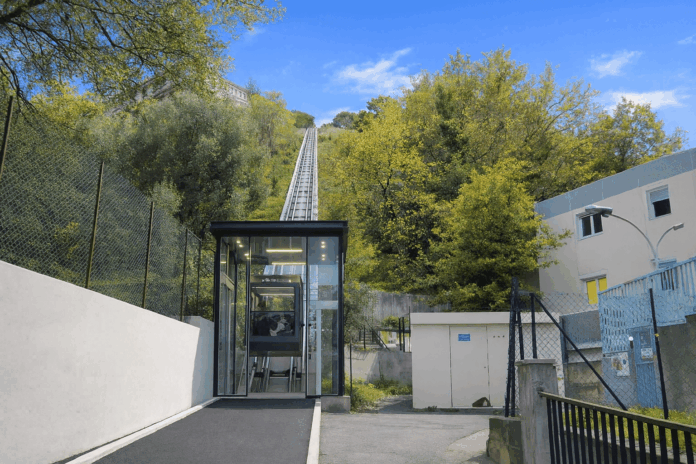
In Nice, an urban lift project was announced by Christian Estrosi in the Las Planas neighborhood. The stated goal is simple: to allow direct access to the tramway and services, despite a challenging terrain with a sixty-meter elevation difference.
“Nice for all,” is also a project for “all neighborhoods of Nice,” explained Christian Estrosi. In Las Planas, in the heights of the city, the topography impacts everyday life. The neighborhood has about 2,200 residents affected. Sixty meters of elevation separate the homes from the tramway, the shops, the middle school, and several public services.
Today, making the journey on foot is not easy for residents, especially for those with disabilities. The travel time can be around fifteen minutes to cover a few meters. The alternative often involves the car. Elderly people, families with children, people with reduced mobility, and those carrying loads face the same difficulties. Cyclists are also affected.
The bus lines do not fully address the situation. Capacity remains limited. The operating cost is high. Line 8 was removed from the area. Its 18-meter size no longer allowed it to climb up to Las Planas. The underlying problem therefore remains unchanged.
A vertical public transport integrated into the neighborhood
In light of this situation, a solution is highlighted. The urban lift is presented as an appropriate response to the terrain. The principle is based on a vertical public transportation system, free, automatic, and paced like the tramway. The facility would operate over a wide time range, equivalent to that of the tramway network.
In terms of technical features, this lift would reduce the travel time by a factor of five. Less than three minutes would be required, compared to fifteen today on foot. The cabin could accommodate up to twenty people.
The lift would create a pedestrian continuity where the terrain hinders movement. The neighborhood would be directly and visibly connected to several hubs such as Henri Sappia tramway, educational facilities, Rouret’s shops, or even neighboring districts. The stated vision is that of a more fluid linkage among living spaces.
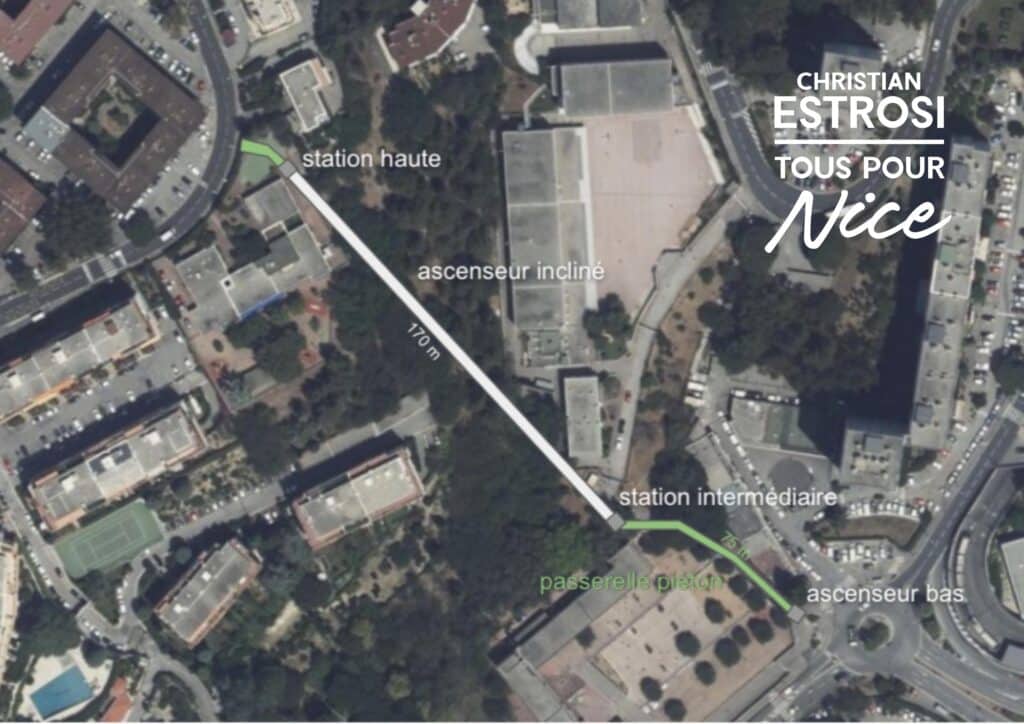
The project is not limited to technical infrastructure. The lift is presented as a tool for breaking down barriers.
An economical and replicable response
The economic argument accompanies the presentation of the project. The operating costs announced would be five to six times lower than those of an equivalent bus line. The investment is estimated at 5 million euros excluding taxes. Profitability is discussed over a period of less than eight years.
The urban lift is also presented as a possible model for other sectors. Steep neighborhoods exist elsewhere in Nice. The Saint-Barthélemy hill is cited as an example. The objective would be to duplicate a solution adapted to the terrain, rather than forcing classic transport models.
The work carried out at Las Planas is part of a broader approach. Residents, associations, and the neighborhood committee have been involved. Several field walks have taken place.
Removing barriers between neighborhoods echoes initiatives carried out in Moulins or l’Ariane with the arrival of the tramway. A subject of debate, especially with the opposition. Parallel efforts are announced regarding the issue of security. The urban lift project is thus part of a comprehensive approach to the neighborhood, including mobility, services, public spaces, and access to rights.
In Las Planas, mobility becomes a central issue of equal access. The terrain is no longer merely a geographical constraint. It becomes a starting point for rethinking daily mobility. The urban lift embodies this approach: a targeted solution, a concrete tool, a vertical connection to reconnect the neighborhood to the rest of the city.


