
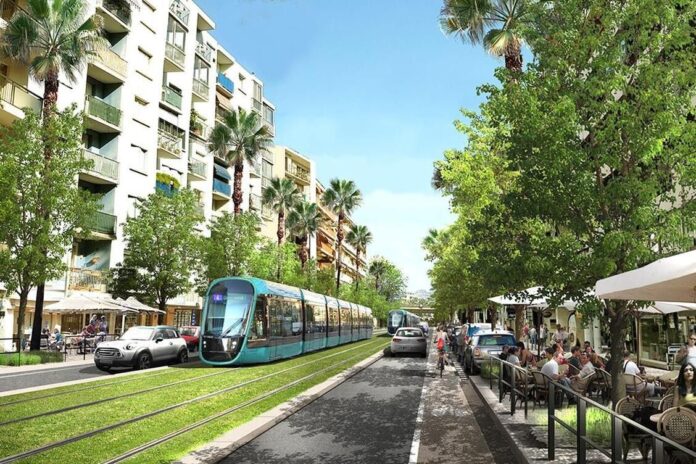
The new mayor of Cagnes-sur-Mer has announced the termination of the T4 tramway project between Nice and his town. The municipality has decided to redirect its mobility policy towards an enhanced bus network and the redevelopment of major roads. The debates around transportation and connections with Nice have intensified in a significantly altered political context since the 2026 municipal elections.
The election of Bryan Masson in Cagnes-sur-Mer marked a turning point in the issue of the T4 tram line. The project was supposed to connect Nice to Cagnes-sur-Mer, with an estimated investment of 320 million euros. A public utility declaration had been filed and preliminary work had begun. However, the main construction had not yet started.
Upon taking office, Bryan Masson confirmed the abandonment of the project. The new municipal team chose a different direction. The implementation of a high-level service bus became the priority. In an interview, the mayor explained: «We are going to install a high-level service bus, meaning a dedicated bus lane. » This announcement marked a break from the decisions made by the previous metropolitan majority.
No new consultation was considered. « No, I don’t think there is a need for a new consultation or referendum », declared Bryan Masson. The new mayor of Cagnes-sur-Mer, who succeeded Louis Nègre, however, stated his intention to share the data provided by the Nice Côte d’Azur Metropolis.
The mayor also expressed doubts about the estimated ridership. « I am not convinced by the main argument of 40,000 daily visitors supposedly using this tramway », he stated. To illustrate these reservations, Bryan Masson cited Antibes’ BRT (Bus Rapid Transit) linking Sophia Antipolis, highlighting a basin of 15,000 workers. This comparison fueled his desire to verify the numbers provided for the T4.
The decision was confirmed without ambiguity. « One thing is sure, there will be no tramway in Cagnes-sur-Mer, there will be a BRT », he assured. The municipality announced a redevelopment of main roads, a doubling of bus lines, and the creation of neighborhood shuttles. Several areas of the town remain under-served. The new team aimed to address these gaps and quickly launch a comprehensive transport project.
A political debate broadened to mobility and territorial cohesion issues
The abandonment of the T4 occurred in a transformed political context. The election of Éric Ciotti in Nice and Bryan Masson in Cagnes-sur-Mer redefined metropolitan priorities. During the campaign, the new mayor of Nice had linked the future of the T4 to the result of the Cagnes election. The victory of Bryan Masson removed the last uncertainties.
The T5 line, intended to serve Ariane, remains a priority for now with the new metropolitan majority taking office this week. The project’s level of advancement, less progressed than that of the T4, allows for some room for discussion with the town of La Trinité. Technical and financial decisions still need to be clarified.
Bryan Masson also revived a broader debate about mobility between Nice and Cagnes-sur-Mer. One sequence, in particular, captured attention. When asked about concerns expressed during the campaign regarding residents of the Moulins district, the mayor responded: « Not at all, but it is often minorities who behave poorly, and we are not ready until the Moulins district is safe. » The mayor then mentioned « a relentless battle against drug traffickers. »
These statements prompted a reaction from Nice elected representative Juliette Chesnel-Le Roux. « It is indeed territorial discrimination advocated by the National Rally to stigmatize populations », she stated. The representative recalled the effects of the line 1 tramway on the mobility of Moulins’ residents, notably access to education, shopping, and culture.
Bryan Masson stood by his position: « I prefer to be cautious. I prefer to be pragmatic », he stated. The mayor then referred Juliette Chesnel-Le Roux to her responsibilities in Nice: « She is from Nice, let her take care of Nice, and I will strive to take care of Cagnes-sur-Mer. »
In this new political landscape, the issue of mobility between Nice and Cagnes-sur-Mer remains central. Choosing the BRT, redeveloping main roads, and reorganizing the bus network open a new phase. The municipality has announced a rapid implementation. « There is a project on transportation, a project on which we will work hard for the benefit of the residents of Cagnes », concluded Bryan Masson.
The abandonment of the T4 thus marks a major shift in the western metropolis’s mobility policy. The Lignes d’Azur network will need to integrate this new direction. The initial schedule, which aimed at commissioning in 2030, is no longer relevant. A new strategy is being implemented, focused on buses and the transformation of urban spaces.


