
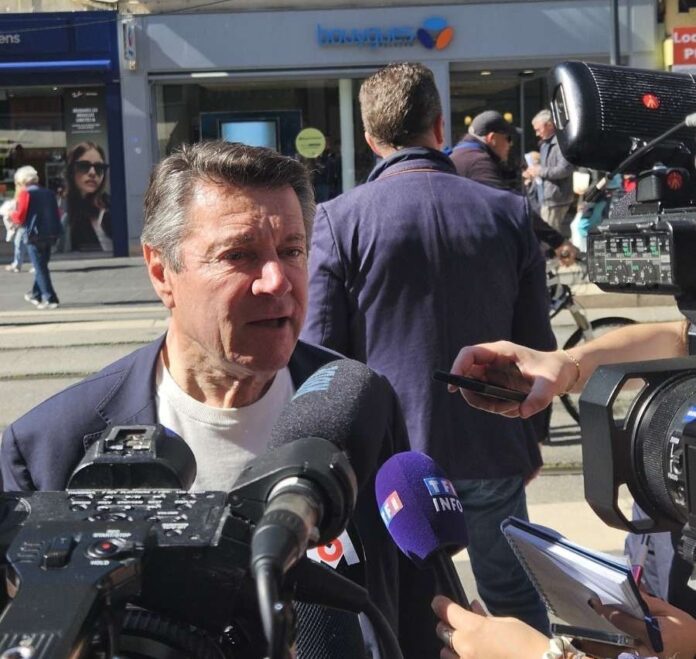
The election night on March 22, 2026, in Nice was marked by a tense exchange between Christian Estrosi and a team from the show Quotidien. Beyond the incident, the sequence questions the relationship between public officials and journalists, as well as the respect for the right to inform.
The defeat of Christian Estrosi against Éric Ciotti during the municipal elections on March 22, 2026, marks the end of a local political cycle. After three terms, the mayor is set to leave the city hall on Friday at the end of the municipal council and the handover ceremony. After concluding his speech on Sunday evening at his campaign office, Christian Estrosi joined a restaurant with his close ones and supporters.
At the same time, several newsrooms were following the event. Among them, a team from Quotidien, which came to cover the second round for TMC. After visiting Éric Ciotti’s headquarters, the journalists joined Christian Estrosi’s office and then went to the location of the last campaign meal.
It was on a street in the center that the situation escalated. A journalist asked a simple question to the outgoing mayor: “Hello Mr. Estrosi, how are you?” No response was given. Christian Estrosi changed direction. The team followed for a few meters before the situation became tense.
“We just want to be left alone; that would be nice,” said Laura Tenoudji, Christian Estrosi’s wife. The journalist’s attempt to continue was interrupted. The outgoing mayor then responded: “You stop, you stop, you stop, you respect my private life. I am not a politician tonight.” The gesture accompanying the phrase, a hand placed on the camera, heightened the tension. Supporters intervened immediately.
A request for deletion that raises questions
A few minutes after the altercation, a campaign team close associate addressed the journalists. The request was made bluntly: “Of course, with all due respect for the profession, you delete what you filmed outside.” The immediate refusal came from the journalist and the crew. A second request followed: “But you don’t publish anything.” The request was again rejected. The journalist was then accused of “helping with the nonsense that is happening.”
This sequence goes beyond a mere clash. The request for deletion or non-publication raises a clear question. Can a political actor demand the removal of images shot in public space? French law has long governed these situations. The law of July 29, 1881, on the freedom of the press, forms a base. This text recognizes the role of the press in democratic debate. It protects the dissemination of information, provided it respects the law.
The scene observed in Nice recalls that the tension between political communication and journalistic work remains constant. Election campaigns exacerbate this phenomenon. Fatigue, media pressure, and electoral stakes create a climate prone to verbal slip-ups. But these elements do not alter the legal framework.
Another episode related to this campaign also illustrates this complex relationship. Our editorial team at Nice Premium was questioned about publications dating back to 2011 regarding one of Christian Estrosi’s deputies: Gaël Nofri. At the time, he had made critical remarks about the mayor of Nice when he was in the opposition, within the National Front.
As some of these articles resurfaced inexplicably, Christian Estrosi’s campaign team then asked us “if something could be done” about these publications. The insinuations were numerous, and we are not seeking to accuse anyone of anything, especially since our relations with the municipal services have always been very cordial.
The response was to divert the request. This situation reveals a common practice in politics, aiming to control a personality’s public image in the digital age where things can quickly become uncontrollable and where our past can catch up with us at great speed.
A tense end to the campaign
The sequence of March 22 is not an isolated case in this campaign. During the interval between rounds, Christian Estrosi had already confronted a journalist from BFM TV. The question was about his perceived limited presence on the streets of Nice during his term.
The reply was direct: “You know nothing about the city of Nice. It’s not true. We can’t say that to you. You have the recordings of all the meetings, every month over the past six years where I faced hundreds of residents. It’s totally false. At least I asked you the question and caught you in the act.”
These exchanges reflect a growing rift. The relationship with the media became more confrontational as the campaign progressed.
One element remains central. The press plays a role in the circulation of information and the control of public action. Journalists question, film, and broadcast. Political leaders can contest or refuse to respond. But requesting image deletion or preventing their distribution poses a democratic problem. Especially when one is committed to respecting a code of conduct between candidates and journalists…
These new “sequences”, whether in Nice or elsewhere, remind us of a simple reality. Press freedom does not only rely on texts. It also depends on practices. Each interaction between journalists and public officials contributes to defining its limits.


