
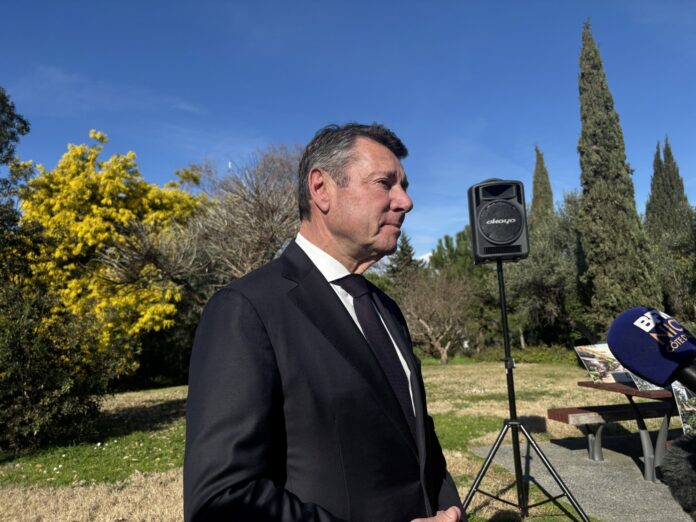
Already committed for more than fifteen years to an extensive ecological transformation, the City of Nice plans to step up its efforts. During a highly anticipated presentation, Christian Estrosi detailed his vision for the next mandate: accelerating greening, combating heat islands, and adapting the city sustainably to the climate challenge. A structured, massive project claimed as a deliberate continuation.
“Currently, we are facing a reality: the red alert is in effect.” Right from the start, Christian Estrosi sets the tone. Climate change is no longer a distant theory but a tangible reality to which Mediterranean cities are particularly sensitive. According to the Mayor of Nice, the intuition from 2008 has now been validated by events: “The events have proven us right.” Nice adopts a broader strategy compared to other major French cities. Since 2020, a total of 280,000 trees have been planted, bringing the total number of trees to 360,000. The increase in vegetation cover from 14% to 33% in five years, confirmed by an independent entity, demonstrates the successful evolution. “It’s of great magnitude, and this is what positions us in 2026 as the first ecological city in France,” he states.
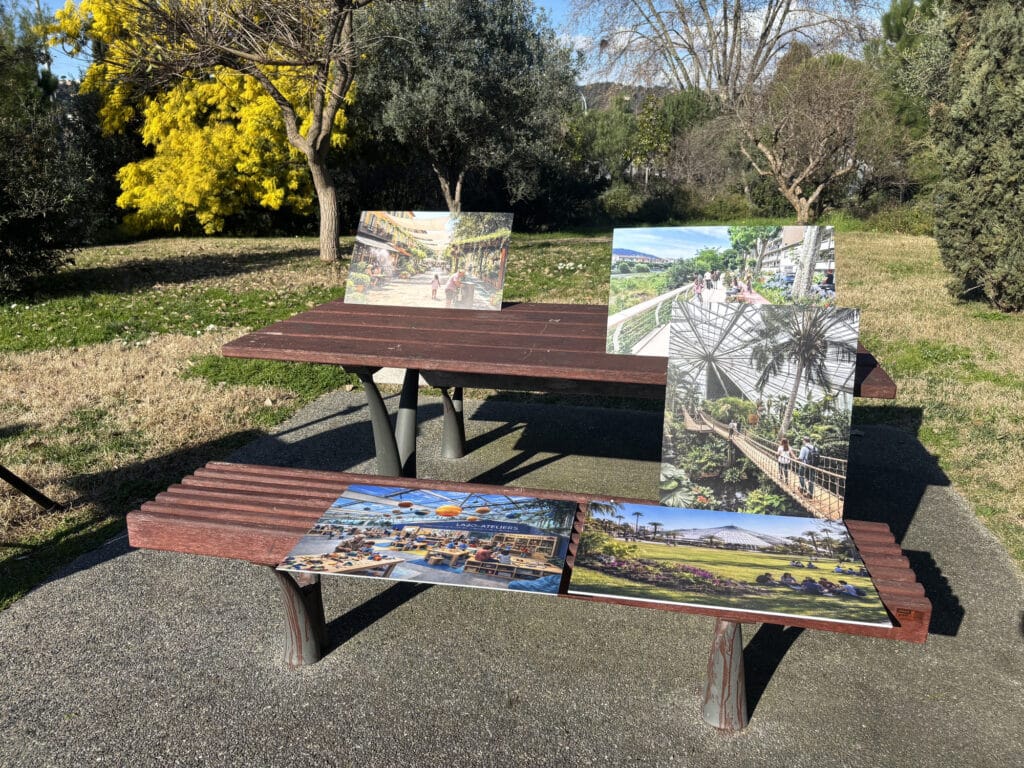
The Grand Parc de la Plaine du Varr, which is the centerpiece of the project, represents the goal of the future mandate. Ultimately, 70 hectares will be reserved for nature, in a location that Christian Estrosi eagerly compares to significant world references: “In terms of configuration, it’s somewhat like Hyde Park in London and Central Park in New York.” Designed as an active park, it will incorporate biodiversity, urban agriculture, educational gardens, sports areas, and walking trails, while taking into account housing and transportation needs. “I demand to be judged on the actions,” emphasizes the Mayor, highlighting that the project is already included in urban planning schemes. His candidacy is also aimed at ensuring the sustainability of this program: “The goal is to prevent this program from being interrupted.” Another highlight: the expansion of green corridors in the city center. Having already covered six kilometers, another 40 kilometers are planned over the next six years. Among the priorities are Gioffredo, l’Hôtel des Postes, Verdi, and Dubouchage.
However, greening is not limited to trees. The city will implement a plan to combat heat based on a simple idea: “Shade remains the best remedy against heat.” Anti-heat streets, equipped with shade sails, mist fountains, permeable surfaces, and lush trees, will ensure connectivity between schools, daycare centers, hospitals, and transport to protect residents during periods of intense heat.
A committed long-term vision
Christian Estrosi also intends to directly involve residents in the “city of ten thousand gardens” project. Evaluating building surfaces, balconies, roofs: every private space is considered an asset in the fight against heat islands. “Every courtyard, every balcony, every rooftop can turn into a cool spot,” he highlights.
“Through subsidies, a co-ownership greening contest, and the ‘Nice Green City’ project, we will support citizen actions by promoting plant species adapted to the Mediterranean climate, and a rational watering strategy.” The project also includes setting up dog areas, renovating the Cedars and Vinaigrier parks, as well as an ambitious fire safety and prevention program in surrounding forest massifs, supported by monitoring technologies using artificial intelligence.
Another iconic site, the Phoenix Park, will be the subject of a 25 million euro investment to transform it into a City of Sciences and Nature, while preserving its essence: “The entry to the park will remain free to ensure access to a wide audience.”
Christian Estrosi affirms the coherence of his actions: “We have established a guiding principle. We have never abandoned it.” According to him, the ecological transition is a long-term approach that cannot be reconciled with abrupt changes. With an investment of more than 20 million euros per year, the municipality plans to continue this gradual transformation. Declared ambition: transform Nice into a city “cooler, more breathable, more livable,” capable of protecting its residents from future climate challenges.


