
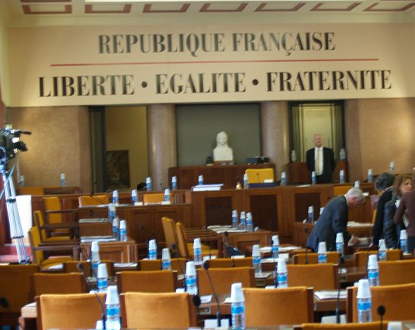
The Municipal Council approved yesterday the deliberation proposed by Christian Estrosi and his majority, granting the Mayor the authorization to appeal to the judicial authority for any dissemination of false information, today regarding the finances and debt of the municipality (but tomorrow?), which could cause (no less?) disturbances to public peace.
This first decision, which will probably amuse more than a few, will be a central element of public life in Nice in the near future.
And for good reason: Imagine a city aiming for international recognition where a public critique of the municipality, for any reason, justified or not, becomes sufficient grounds for being taken to court?
How can we envision a magistrate having to judge the legitimacy, origin, and cause of this “disturbance of the public peace”?
And what image might be projected of the people of Nice, transformed into Lansky figures ready to stir up disputes just because a Patrick Allemand or a Robert Injey (or their successors…) have disclosed true or false information about public management of the city or any other subject? We know people are very protective of their interests, but to transform them into hooligans is a step one should be careful not to take.
In a democracy, the sanction comes from the ballot box, not judicial rulings.
In fact, it is quite difficult to understand the true reason behind Christian Estrosi’s action: Firstly, it is unnecessary (so many controversies without reason), then ineffective (How many times will it be applied? What procedures will it entail?), and, finally, counterproductive (Expression of weakness instead of strength).
We do not know who might have advised Christian Estrosi to commit what strongly resembles a major blunder. The plot is so complex that one might almost believe that a Jago, one of the most evil and Machiavellian characters in Shakespeare’s work, had insinuated himself into the Mayor-Othello’s entourage.
Why define oneself as an autocrat without any need when aspiring to be a popular mayor? Why, then, complicate life if it is not strictly necessary?
Beyond all this, the day was most difficult for the municipal majority, which, beyond the minimal result, went from one mistake to another.
The first mistake was the presentation of the deliberation, done by a municipal councilor! But how is it that, knowing well in advance that this deliberation would be delicate and strongly contested, the president of the municipal group did not step up to demonstrate, even figuratively, all the conviction, unity, and strength of his colleagues, in support of this same deliberation?
Another mistake was when, clinging to the session rules, the secret ballot requested by Benoît Kandel, now an opposition councilor, was refused. Again, what an admission of weakness! A majority of more than 50 councilors “afraid” to confront a minority that barely exceeds fifteen members? Unless…
Afraid of what? A few blank ballots? But this majority is one, with the necessary cohesion and certainty of adherence to a political line and the actions that define it, or is it merely a troop of “yes-men”?
Between these two events, the opposition naturally had a field day…
For Patrick Allemand: “The truth is, this is a legal façade. You try to intimidate me with threats of legal action because you cannot accept that I denounce the level of debt, with phrases that strike public opinion.” And resorting to justice in this specific case is a terrible admission of failure.”
From Jean Icart, one of those expelled for insubordination to the directives of the majority group and a candidate for mayor in union with Jacques Peyrat: “You demonstrate once again through the action you initiate today that you do not allow any expression of a position different from yours and your sectarianism.”
The same sentiment from Robert Injey, newly declared candidate for mayor for the Left Front: “This municipal council session is quite surreal: ‘disturb the public peace’…No less than that! To read your words one might think a deliberation taken in wartime to uncover the fifth column.
It’s not the first time you accuse your opposition of lying. But every time, it turns out that the lie is yours! You want to take legal action against those who disseminate false information? Then Mr. Mayor, start by taking action against yourself! In the end, with this deliberation, you try to intimidate your opposition in the period to come. This type of intimidation is not worthy of our democracy.”
This municipal council meeting was also the occasion of Benoît Kandel’s debut, former first deputy, as an independent municipal councilor following his exclusion from the majority group Nice Ensemble.
In a speech clearly oriented towards right-wing values, he nevertheless strongly criticized his former colleagues: “Your desire to transfer debates from the political arena to the judiciary arena completely contradicts the democratic spirit that should normally animate the first magistrate of our city.
Freedom of opinion and freedom of expression are indeed the very first political liberties. They are legally protected and, as such, know only rare restrictions: Defamation, slander, incitement to violence, or incitement to hatred. All other prohibitions clearly resemble, the law says so, censorship.
This evocation of public disorder to justify your approach is, I say, totally insignificant, it is fantasized, and frankly, laughable. The judicialization of political debate that you establish today is very grave, especially since it poses ethical and philosophical problems that it is difficult to ignore.
In Nice, as everywhere in France, political debate is free, and the only one authorized to decide is not the judicial judge but the voting citizen, to whom we all, my dear colleagues, owe the privilege of sitting in this chamber and to whom alone we must account.”
As you can see, we have deliberately not referred to the main reason for this deliberation, the supposed truth about the city’s and metropolis’s debt, the two being interlinked.
The reason is simple, and we express it freely again: It is not the amount of the debt that matters but the ability to manage it, which becomes clear in the relationship of trust between the debtor and the creditors and in the ability to repay.
In fact, this debate between the municipal majority and its opposition sounds quite false if it is confined to this unnecessary quarrel over numbers. Much more important is the affirmation of the values of liberty, which need no adjective and must answer, as Emmanuel Kant so aptly put it, to just one imperative: The conscience within oneself.
The rest are just often sterile and short-lived polemics, acts of righteousness that, when played out repeatedly, turn into farce.
What a sad day for politics yesterday in the Nice Municipal Council.


