
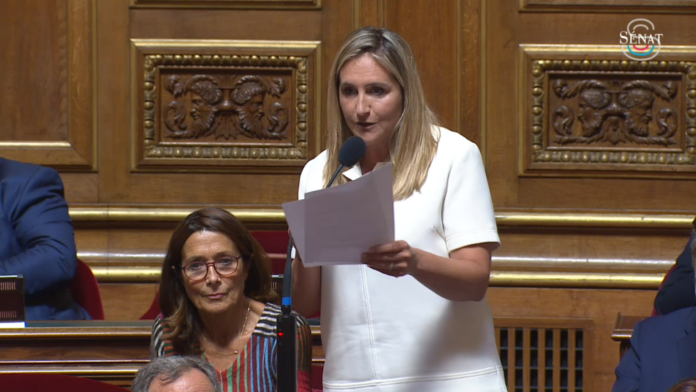
**The Senator of Alpes-Maritimes, Alexandra Borchio Fontimp, has alerted the Minister of Territorial Development and Decentralization to the financial difficulties faced by several rural municipalities. She uses the example of Aiglun, a village hit by a significant drop in state funding. A situation she considers incompatible with the principle of free administration of local authorities.**
The Senator of Alpes-Maritimes, **Alexandra Borchio Fontimp**, says she observes the **effects of budgetary constraints** imposed on the municipalities in her department weekly. In a letter addressed to the Minister of Territorial Development and Decentralization, **Françoise Gatel**, she highlights the case of Aiglun, a village of 100 inhabitants. The mayor alerted her about the significant decrease in state funding. According to the senator, the municipality has lost **nearly 28% of its funding in four years**, which is more than its self-financing capacity.
This marked decrease poses several difficulties for local elected officials. First, the question of **respecting the principle of free administration of local authorities**, enshrined in Article 72 of the Constitution. The senator believes that this principle is weakened when **municipalities no longer have sufficient means** to exercise their powers. The successive reductions in funding diminish their leeway and limit their budgetary choices.
The issue of the ability to respond to calls for projects is also mentioned in her letter. She explains: _“This reduction directly compromises the municipalities’ ability to respond to calls for projects and state directives, which are essential to tackle the challenges of our time. These repeated cuts strip decentralization of its meaning and threaten social cohesion. Especially since many mayors refuse to opt for the easy route of increasing local taxes, as such a variation would impose an excessive burden on taxpayers in relation to their contributory capacity.”_
For many small municipalities, **increasing local taxes** **is not an option**. Some are already at the departmental fiscal median level. Any increase would be deemed too burdensome for residents. This fiscal limit reinforces **the dependency on state funding** and creates a deadlock situation for rural municipalities with limited resources.
**A reform of the DGF demanded**
The Government has announced it is working on **a draft law on decentralization**, which could be presented to the Council of Ministers before Christmas. The senator wishes for this text to be accompanied by **broad consultation and reflection on the General Functional Allocation** (DGF). According to her, this reform has become urgent to adapt financial resources to local realities: _“Decentralization cannot be genuine without adapted financial resources.”_
**Alexandra Borchio Fontimp** also mentions **actions already undertaken in the Alpes-Maritimes** department, recalling the university training dedicated to town hall secretaries and the seminar aimed at mayors affected by the new voting method in municipalities with fewer than 1,000 inhabitants. She believes that **these initiatives contribute to a better consideration of rurality** within a budgetary framework she deems too constrained.
These actions are carried out in a context where the State is asking for an additional effort from local authorities. The Government has estimated this effort at **5.3 billion euros**. **The senator** expresses a critical position on this point. “This effort must be reduced, as local authorities are not responsible for the situation,” she states.
The example of Aiglun, according to her, illustrates **the current tensions between rural municipalities and the State**. The village finds itself with decreased funding, strong budget pressure, and an inability to adjust local taxation. For local elected officials, this situation undermines the ability to maintain public services and social cohesion.
In her letter, the senator emphasizes a common observation: **rural municipalities cannot adapt alone to new budgetary requirements**. She requests that the upcoming decentralization reform takes these difficulties into account and provides sustainable financial solutions. For her, **the survival of the smallest municipalities** depends on **a rethought model**.


