
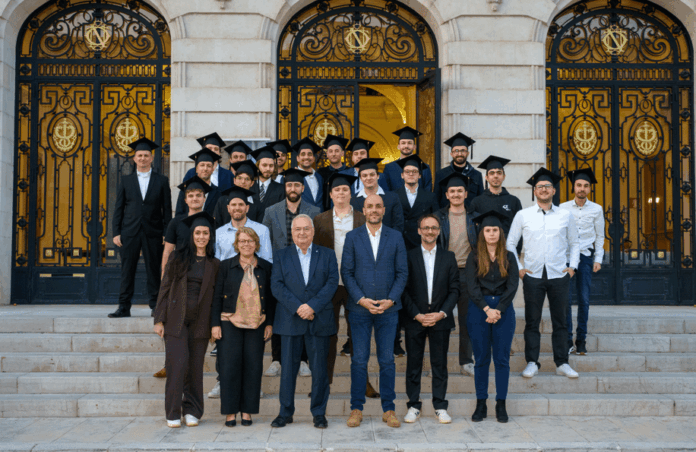
42 Nice School celebrated the awarding of forty degrees during a ceremony that highlights an education based on autonomy and projects. The institution continues its development, strengthens its openness to digital technology, and prepares new admission sessions.
The distribution of forty diplomas marked the completion of a training cycle based on practice and autonomy. The graduates now join a constantly transforming sector. Digital technology evolves quickly and the demand for technical skills remains high. This reality gives a special significance to this graduating class, which enters the job market with a skill set built through projects, daily exercises, and complete immersion in a collaborative environment.
During the ceremony, Emmanuel Souraud, president of 42 Nice and co-chair of the Digital Commission of the Nice Côte d’Azur Chamber of Commerce, reiterated the school’s ambition: “42 Nice is entering a new phase of acceleration today. As artificial intelligence profoundly transforms all professions, our ambition is clear: to make digital technology an opportunity for everyone, everywhere in the region. Thanks to a unique educational model based on autonomy, peer-to-peer, and project-based learning, we train profiles that are immediately operational and ready to evolve in a constantly changing technological environment. Our priority now is to sustainably establish the ’42 reflex’ in the Maralpian basin and beyond.”
This speech set the tone for an evening oriented towards the future. It also emphasized the desire to strengthen the school’s local roots, which has been open for several years in Nice and is now well recognized by local businesses.
Diverse Profiles and Adaptable Pedagogy to Changing Needs
42 Nice currently hosts nearly 450 students. The pathways are varied and reflect the accessibility of the model. A third come from the high school level, a third from a period of job searching, and a third from professional retraining. The average age is around 26 years. This diversity creates an environment where experiences intersect and mutual support structures daily life.
The issue of gender balance remains an important challenge. Women currently represent only 14% of the student body, with a goal of reaching 20% in the next two years. This expected progress is part of a broader approach to awareness and openness.
Professional integration is another key indicator. The employability rate reaches 92%. The results of certified titles confirm this dynamic. The title of “Software Solution Developer” has a success rate of 90%. That of “Expert in Computer Architecture” reaches 100%. These figures reflect a match between the skills developed and business needs, particularly in cybersecurity, data science, or video games.
The pedagogy is based on active learning. In this training, there are no lectures, no degree prerequisites; students progress through projects, experiment, test, and correct. Modules pace the progression. Rush periods impose collective work under constraint with weekly exams assessing the ability to solve problems in a limited time. This approach develops technical skills, but also cross-disciplinary qualities like rigor and adaptability.
The school obtained the Qualiopi certification in 2025. This label validates the structuring of pathways, the quality of support, and the transparency of information. It also allows the collection of the Apprenticeship Tax, an essential resource for maintaining free education and funding new modules.
A Surge in Artificial Intelligence in Learning
The gradual integration of artificial intelligence plays an increasing role in the training. Dedicated modules allow specialization in data science, algorithm design, or application development integrating AI practices. This evolution responds to a strong demand from companies seeking profiles capable of understanding and utilizing these tools.
The next admission sessions will take place from July 6 to 31, 2026, and from October 7 to 2, 2026. Candidates will have to pass the “Piscine” stage. A month of intensive tests during which modules follow one another every day and rush periods require group work. The admission rate varies between 45 and 60%. Successful candidates then join a curriculum based on Peer Learning and project-based learning.
This new cohort illustrates the rise of 42 Nice in the regional digital landscape. The school continues its development, adapts its content, and prepares profiles capable of evolving in a constantly moving sector.


