
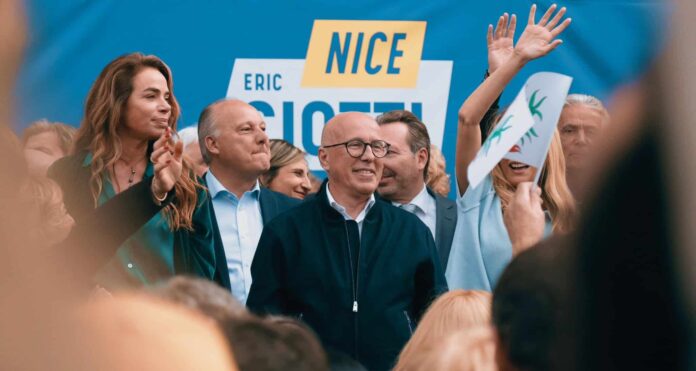
The second round of the municipal elections in Nice confirmed a shift that began in the first round, with the list led by Eric Ciotti coming in first with 48.54% of the votes cast, while Christian Estrosi received 37.20% and Juliette Chesnel-Le Roux obtained 14.26%, leading to numerous reactions in the local political landscape.
The complete counting of the votes confirmed a trend already visible in the first round, with Eric Ciotti’s list The Best is Yet to Come garnering 61,009 votes, corresponding to 48.54% of the votes cast, while the list All for Nice led by Christian Estrosi reached 46,753 votes, or 37.20%, and the list United for Nice led by Juliette Chesnel-Le Roux received 17,926 votes, or 14.26%, placing the latter in third position with a notable gap.
This result confirms a dynamic established from the first round, with the gap between the top two lists exceeding 11 points, which alters the local political balance and opens a new chapter in Nice.
Political reactions illustrating lines of division
The reactions following the announcement of the results reflect different interpretations, and Hélène Granouillac, a member of Ecolocratie XXI, expresses concern linked to the national and local context while recalling fundamental political principles: “In a context marked by the troubling rise of extremes, notably the far-right in our country, we note with worried reservation the victory of the list led by Eric Ciotti in Nice and strongly remind that the values of solidarity, social justice, and respect for all remain the essential foundation of our civic engagement.”
This reaction also highlights the setback for ecological forces and underscores a score deemed insufficient to convince, leading to a declaration of vigilance for the remainder of the municipal mandate.
Conversely, Jean-Marc Governatori praises a political victory and insists on a realignment in progress by stating: “We first want to congratulate the people of Nice for their awareness; they have freed Nice from the Estrosi hold. They have also proven to France that the combination of thoughtful and action-oriented right-wing with informed and explanatory political ecology is the winning formula for everyone.”
This stance highlights an alliance presented as effective and emphasizes a national interpretation of the Nice election.
Meanwhile, Renaud Muselier expresses regret over Christian Estrosi’s defeat and highlights the role of internal divisions by stating, “I regret Christian Estrosi’s defeat. In this very specific area, the battle between rival factions was unfavorable for the incumbent.” This analysis highlights a confrontation between figures from the same camp and underscores the consequences of this strife on the election outcome.
On his part, Charles Ange Ginésy welcomed the result achieved by his former finance head in the Alpes-Maritimes department: “What a campaign, what a brilliant election at the helm of the city of Nice. The people of Nice have chosen to trust you tonight. I already know you will be worthy. Your candor and attachment to this city and its history made the difference.”
The left analyzes the election and announces resistance
On the side of the United For Nice list, which finished third, reactions are part of a broader political analysis, and Julien Picot speaks of an important political moment while calling for a nuanced interpretation of the vote: “The second round of municipal elections in Nice marks a significant political turning point. We must be clear-eyed: the rejection of the ‘Estrosi clan’ expressed by a significant part of the people of Nice should not be reduced to an overwhelming endorsement of the far-right.”
In his statement, the leader of the PCF 06 branch emphasizes the diversity of voters’ motivations and develops an overall critique of the local right, while affirming a commitment to continue political engagement on the city council with four elected members, ensuring an institutional presence.
The issue of results is also addressed through the margin of 18 votes for an additional seat, which is presented as an element to be analyzed for future strategic construction.
Meanwhile, Juliette Chesnel-Le Roux offers a direct interpretation of the election and blames the previous management by stating: “It’s a dark day for Nice and France. The election result is the consequence of years, decades of compromises. It’s the result of Christian Estrosi’s policies: under his mandates, the far-right has continuously progressed.”
This statement also develops an analysis of vote transfers and opposes the idea that maintaining the list in the second round influenced the final outcome while affirming a commitment to continue political work within the city council.
The day after the election, Nice enters a new political phase, and Eric Ciotti’s victory is accompanied by contrasting reactions reflecting opposing interpretations of the election, revealing a fragmented political landscape and announcing upcoming debates within the city council and in local public life.


