
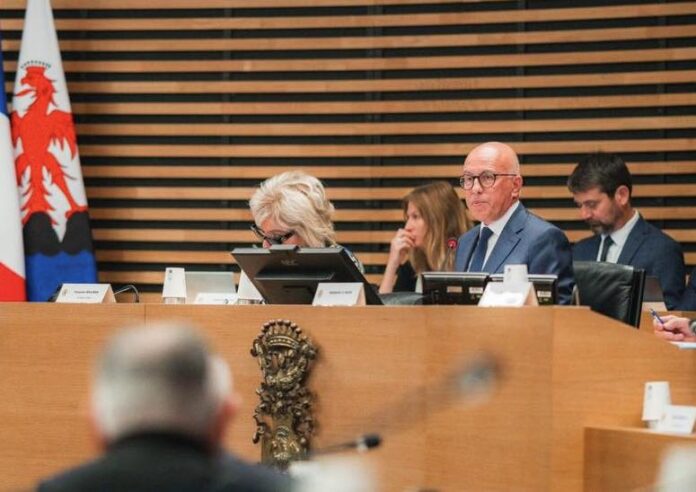
The city of Nice is among the first major municipalities to implement a decrease in the allowances of its municipal officials. This decision is presented as a budgetary and political signal, in a context where practices vary depending on territories and majorities.
Nice is undertaking a reduction in the allowances of municipal officials. The decision was voted at the municipal council meeting on Monday, April 13, 2026. The mayor, Eric Ciotti, announced an overall reduction of 12.7% in the allowance volume. The measure concerns all deputies and municipal councilors.
In detail, the reduction reaches 10% for the majority of officials. A more significant reduction affects the first deputy, Françoise Souliman, “since the first deputy had a higher salary in the previous term,” specifies Eric Ciotti. This plan would allow for an annual saving of 200,000 euros on municipal allowances.
This saving is complemented by another reduction voted at the metropolitan level. The metropolitan council approved a reduction representing 700,000 euros per year. The total thus approaches one million euros in savings. The mayor states: “this corresponds to a 12.7% decrease in the allowance volume, allowing for a reduction of 200,000 euros per year in officials’ allowances.” He adds: “we are approaching 1 million euros in savings. This is a strong expression of our commitment to showing respect to our taxpayer-citizens.”
This approach positions Nice among the leading major cities to adopt such a structured reduction. The decision comes amidst a national debate on the allowances of local officials.
Political choices vary by municipality
The issue of allowances does not follow a single political line. Increases as well as decreases appear in municipalities led by different majorities. Municipal councils must set these allowances in the weeks following the elections. This obligation explains a series of recent decisions across the country.
Some municipalities have chosen to increase allowances. Côme Dunis, the National Rally mayor of Montargis, has thus raised his allowances by 80%. In Perpignan, Louis Aliot also implemented an increase, after a previous rise during the past term. Similar decisions exist in Carcassonne, La Flèche, Moissac, or Harnes, in municipalities led by the same political current.
Other examples concern different majorities. In Bordeaux, the allowances of mayor Thomas Cazenave show a 14% increase compared to his predecessor. In Avignon, a decrease concerns mayor Olivier Galzi, but this reduction is accompanied by a revaluation of deputies’ allowances, including that of his partner.
Some increases are due to automatic mechanisms. The level of allowances depends partly on the civil service index. A change in this index leads to mechanical adjustments. In other cases, an increase corresponds to a deliberate political choice.
The reduction in allowances is not limited to a single political family. In Héricourt, a Communist mayor reduced his allowances by 1,800 euros monthly to support food aid structures. In Pamiers, a center-right mayor chose not to receive any allowance. In Montauban, a UDR-RN mayor decreased his allowances by 10%.
These examples show a diversity of practices. No uniform trend emerges at the national level. Each municipality makes decisions according to its financial situation and political priorities.
A budgetary argument invoked in Nice
In Nice, the decision is based on a financial argument. The mayor mentions a worrying situation for the city and the metropolis: “the gravity of the financial situation of the city and the metropolis has been hidden from the people of Nice.” This statement is accompanied by a reference to a prefectoral letter that was not publicly released: “the financial situation is such that it could bring the metropolis into the alert network of Public Finances.”
The reduction in allowances is thus part of a broader strategy. The stated goal consists of reducing certain expenditures and sending a signal to taxpayers. The measure also has a political reach. It comes in a context of criticism of previous executives’ practices.
The debate over allowances remains sensitive. Social media amplifies certain decisions, often in a partial manner. Some accounts highlight decreases or renunciations in some municipalities while pointing out increases elsewhere. This selective reading does not reflect the diversity of situations.
Thus, Nice becomes a case study in this debate. The voted reduction indicates a clear direction. Other municipalities could follow or adopt different choices. The topic of local allowances remains linked to political, budgetary, and symbolic decisions.
The decision in Nice opens a new phase. A comparison between municipalities is inevitable in the forthcoming months. Municipal councils will continue to adjust these allowances, balancing legal constraints and political choices.


