
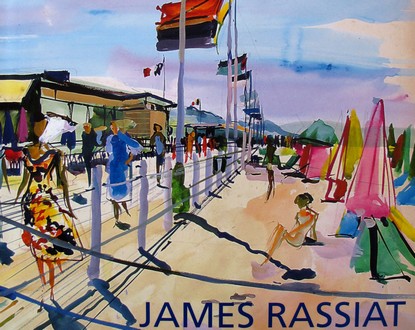
Until October 20, the Palais Carnolès Fine Arts Museum in Menton is exhibiting works by the artist James RASSIAT (1909 – 1998), a French painter who dedicated his life to painting. Today, the time has come to introduce the artist, summarized in one word: Freedom.
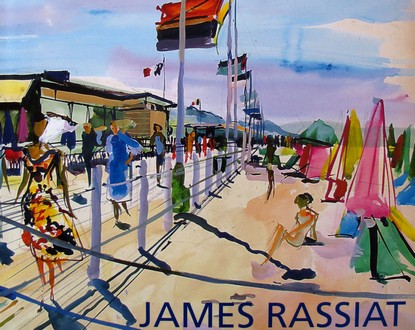 Rejecting any form of subjugation that his era might have led him to, without being naive, James Rassiat answered the call of painting with the sincerity of emotions felt during his travels in France, Europe, Africa, and Asia. Without neglecting his country (Deauville, Burgundy, Cannes, Nice, Villefranche, Arles…), his gaze turned towards the Elsewhere of gardens, palaces, and Moroccan souks, where his evolving art simplifies the profusion to convey the essential: movement and life.
Some civilizations electrified him more than others; the Maghreb, clearly, and also Sub-Saharan Africa, which he captured in a stroke, with elegance and respect, depicting women at work, the sacred bond between nature and humans, the magic emanating from masks and a sorcerer appearing behind the branches of a tree. From then on, he was no longer a Western painter indulging in exoticism but an African revealing to us the universality of forms.
Amazingly, such spontaneity, far from leading him to aimlessness, allowed him to perfect his art, which, despite his attachment to figuration, is also an implementation of pictorial writing. Which, in his bullfighting period, for example, reminds us of the beginnings of painting, and in these Chinese scenes, achieves a kind of perfection where the movement of people in their activities is intricately connected with natural space; where the writing of the painting becomes indistinguishable.
This is why the figurative character that is striking in his seascapes, often painted on the spot, sometimes in the midst of a storm, could not exclude, them too, this writing which allowed him to master the madness of the waters, steel, and, elsewhere, the crowds in squares and on beaches.
Although he did not revolutionize painting, James Rassiat traveled through the painting of his time, which he knew, followed closely without succumbing to it, without being subjugated by it: he chose the path of freedom and balance between himself and all these trends, seeking to preserve what was most precious to him: drawing and what amounts to the same: a certain idea of humankind (women and children) giving meaning to streets and landscapes regardless of the place.


