
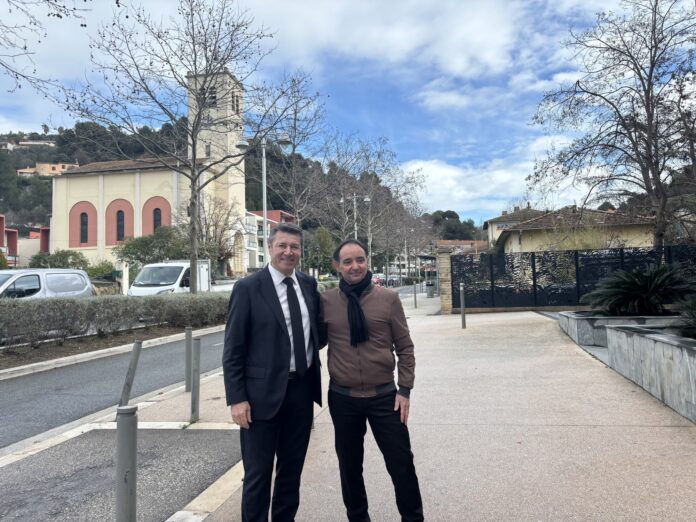
With the smell of warm bread and pastries, Christian Estrosi has chosen a familiar setting to talk about the future. On Wednesday, February 4, at 11:15 a.m., at the Ibanez Barnoin bakery in Saint-Isidore, the mayor of Nice and candidate for re-election came to defend a project he claims is deeply rooted in the daily lives of residents: proximity, mobility, security, and public facilities at the heart of his program for the neighborhood.
When Christian Estrosi speaks, he is surrounded by residents, local elected officials, and associative personalities. It is no coincidence that the Ibanez Barnoin bakery has become, for a morning, a place of political discussion. “You know my fondness for these meetings. I organize them frequently. Traditionally, I present myself as mayor, but today as a candidate,” he says right off the bat, with a smile on his face. The ambiance is set: here, no rigid and predetermined speech, but an interaction clearly claimed to be direct. “Daily life involves sharing with others.” “We must listen to them to be sure we act correctly,” he emphasizes, advocating for an approach based on field practice and local meetings “all the time, all the time, all the time.” Around him, faces nod in agreement. Saint-Isidore is not an ordinary neighborhood for the outgoing mayor. “It’s a place near to my heart, representing an identity, an authenticity,” he confides, recalling his long-standing attachment to this area of western Nice.
Christian Estrosi devotes a lot of time discussing past achievements, “with supporting figures,” he says. “Since 2008, we’ve invested 34 million euros in the neighborhood.” The mayor insists on constant action in terms of mobility, roads, public infrastructures, greening, and security. The tramway remains one of the major symbols of this evolution. “I remember those who complained when we changed the schedules,” he says, before supporting a decision he now deems widely accepted: a more regular service, more direct to the city center, aligned with the demographic reality of the neighborhood. The park-and-ride, the redevelopment of road axes, the modernization of water and sanitation networks, and the creation of local green spaces are also highlighted. “Saint-Isidore has never been neglected, quite the opposite,” he emphasizes.
The candidate plans a series of structuring projects for the future. Among the initiatives is the continuation of the geothermal network already implemented in Nice Méridia, aiming to provide the neighborhood with affordable energy independence. “At 30 meters underground, the water is 15 degrees year-round,” he says, highlighting the ecological and economic challenges. Security is also a priority. Christian Estrosi announced the acquisition of an abandoned building on Chemin de la Ginestière, to establish a new municipal police station there. Since February, two officers have been specifically assigned to this neighborhood, particularly around the schools. In terms of facilities, the project is ambitious: a new school group, a multidisciplinary health center, pétanque courts, a hall for the festival committee, and also a library-media center that has been lacking in Saint-Isidore so far. This structure could be integrated into the heritage of the future Olympic village, which will be converted into student housing, a senior residence, and a cultural center.
Local Commitment Embodied with Éric Geoffroy’s Announcement
Highlight of the morning: the formal announcement of Éric Geoffroy’s integration into the municipal list. A native of the neighborhood, involved in the association for years, and president of the festival committee, he is considered a key player on the ground. “An essential actor for the neighborhood’s animation and cohesion,” Christian Estrosi emphasizes, prompting an ovation.
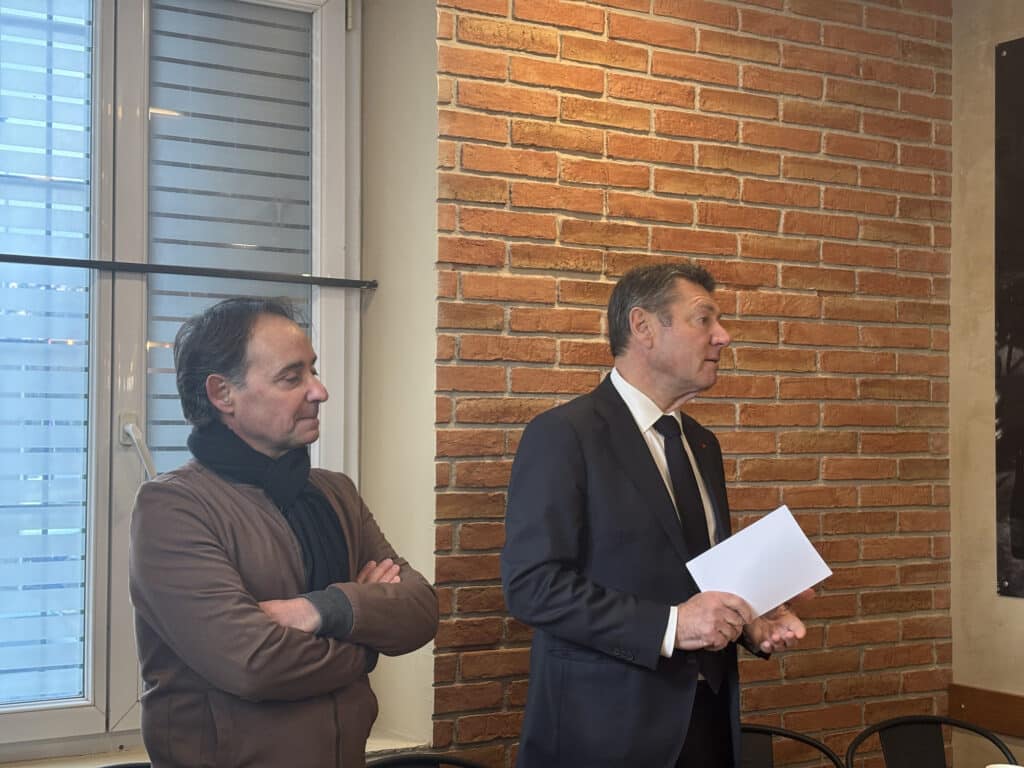
After the meeting, Christian Estrosi reveals a more personal side when speaking to some journalists. When asked about his view on the political situation, his role as mayor, and particularly about Éric Ciotti, he dismisses any controversy. “I dedicate my life to my city. The role of the mayor is to be fully present for his community. So I am present in my city every day.” He even recounts a recent anecdote, far from the alleged tensions: “I feel no individual tension. Seated side by side on the plane with Mr. Ciotti, we exchanged greetings. When the plane landed in Nice, I put on my parka and handed him his.” According to him, the important thing is elsewhere: “The municipal debate is about determining how to make life more pleasant for residents.” Statements that extend a meeting largely focused on local issues and neighborhood projects.


