
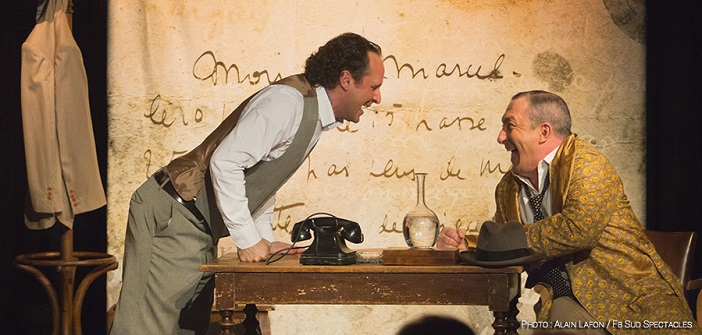
Thanks to the correspondence between Marcel Pagnol, a young playwright, and Jules Muraire, known as Raimu, an emerging star in French humor at the theater in 1929, this play will allow us to relive an underappreciated period in the world of Cinema: the beginnings of sound films and theater between the wars, and up to 1945.
In 2007, Jean-Claude Carrière and Michel Galabru brought these rare letters, some previously unpublished, to life for the first time at the Grignan Correspondence Festival. Philippe Caubère and Galabru himself would brilliantly portray the two companions on stage thereafter.
While the strong personality of Raimu is more widely known, Pagnol’s speech is rarer, as he preferred, in his own words, to “let others speak.” During this performance, once the initial moments of charm pass, we will see them affectionately confront each other.
For sixteen years, Raimu questioned everything: fees, show dates, casting. Pagnol, who met the southerner to offer him the role of Panisse, the main role in his trilogy “Marius, Fanny, César,” moderated, played for time when the other imagined himself as César, Julius … Caesar! Pagnol would modify the role for Jules.
Through their shared passion for the Dramatic Arts, they admired and respected each other. The humor that united them to better grasp their modesty and unspoken affection did not prevent magnificent anger colored with bad faith! Their quarrels were the driving force of their complicity and contributed to their creativity.
The creator of the play, Tre-Hardy, a master of theatrical correspondence, chose authentic texts, letters, and conversations to reveal to the audience the funny and tender friendship that bound the two men. Sitting at a small desk, each on either side of the stage, they exchange lines.
This is what Nicolas Pagnol wanted in this version, interpreted by Fréd Achard as a Raimu truer than life itself, boastful, vibrant, adorably insufferable, and Christian Guérin, intelligent, refined, more reserved as Pagnol, who sincerely loves his partner.
Between them, the narrator was essential, just like Jean-Pierre Darras in “My Father’s Glory” and “My Mother’s Castle” in cinema, or Pagnol himself in the trilogy. Gilles Azzopardi takes on this responsibility, putting the correspondences back into their various contexts.
Come to laugh, smile, and let yourself be moved!
Roland Haugade


