
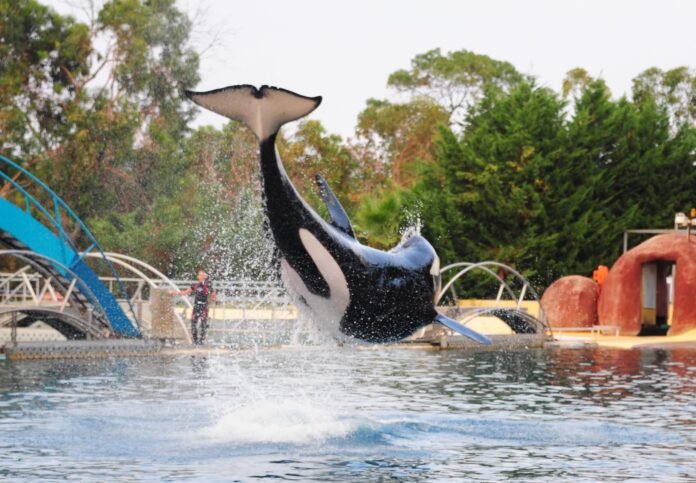
The Government’s decision on the future of the orcas and dolphins at Marineland of Antibes raises significant concern within the professional community of aquatic mammals. The European Association for Aquatic Mammals (EAAM) criticizes a decision deemed opaque, not based on a scientific contradictory debate, and warns about the possible consequences for the two orcas, Wikie and Keijo.
The announcement from the Ministry of Ecological Transition on the future of Marineland’s cetaceans marks a new step in an old case. The Government formalized its decisions after several months of technical analyses, administrative inspections, and exchanges with different stakeholders. The stated objective is based on animal welfare, safety, and compliance with the legal framework.
For the two orcas still present in Antibes, the destination is now set. Wikie and Keijo are intended to join the Whale Sanctuary Project, a marine sanctuary located in Nova Scotia, Canada. The transfer is planned for the summer of 2026. The ministry recalls that the Spanish scientific authority refused a transfer to Loro Parque in Tenerife. Continuing the exploitation of orcas for entertainment purposes is deemed incompatible with French law.
This direction provoked an immediate reaction from the European Association for Aquatic Mammals. In a statement, the EAAM expressed a “deep concern for their survival.” The ministerial announcement reportedly was received “with dismay.” The association denounces “an opaque and ideological choice.”
An absence of scientific debate denounced
The EAAM is a European professional association. For over fifty years, this entity has brought together veterinarians, biologists, ethologists, researchers, and caretakers specializing in aquatic mammals, in natural habitats or zoological institutions. The organization reminds that establishments hosting cetaceans rely on multidisciplinary teams and participate in scientific research and the protection of species in natural environments.
In its statement, the EAAM emphasizes that all legal actions taken in recent years by animal rights associations against zoological parks hosting cetaceans were dismissed. These decisions confirmed, according to the association, the compliance of establishments with regulatory and scientific frameworks in effect at the time. The EAAM also recalls that the professionals’ approach was meant to be constructive, with a willingness to engage with authorities and associations, based on verifiable facts and available scientific knowledge.
The association states that several “realistic, technically viable and immediately operational” solutions were allegedly dismissed by the authorities. These choices are said to have been motivated by a desire not to upset certain animal rights associations involved in the discussions. The EAAM believes that none of its experts, nor any recognized French orca expert, were consulted in the decision-making process. The decision is described as made “in a total absence of transparency and without any scientific contradictory debate.”
A pointed critique of the sanctuary model
The EAAM’s statement also questions the model of marine sanctuaries. The association indicates that this model presents significant limitations for cetaceans. A past experience is cited. The placement of two belugas in Iceland in 2019 is mentioned as an example of failure. After several years of announcements and calls for donations, the project is reportedly at a standstill. The animals concerned are kept in a pool under a hangar, accessible to the public for an entry fee.
According to the EAAM, this situation demonstrates that a sanctuary does not guarantee cetacean welfare. The Canadian project is described as more about communication than an operational reality. The association refers to a project announced since 2015, with no actual work started, and unresolved land and environmental constraints.
In light of this finding, the EAAM asserts that “only one coherent and responsible option remains possible” for Wikie and Keijo. The statement mentions a transfer to an accredited zoological structure, capable of meeting the real needs of these individuals. Several criteria are highlighted. A richer social life adapted to their species. Care provided by teams recognized for their expertise in animal welfare, veterinary care, and ethology. An environment suited to the orcas’ history and biological needs. Participation in concrete cetacean conservation programs in the wild.
Government decisions upheld
Despite these criticisms, the state’s position remains unchanged. The Ministry of Ecological Transition confirms that the decisions are based on DREAL inspections, scientific expertise, and the legislative framework from the 2021 law. For the dolphins, no transfer to Spain is planned. The twelve animals will temporarily remain in Antibes, pending the opening of a center supported by the ZooParc de Beauval. The current pools are considered suitable for temporary accommodation.
Mathieu Lefèvre, Deputy Minister for Ecological Transition, supports this direction. “The state acts responsibly and coherently. After examining all options, we are making the necessary decisions today to ensure the animals’ welfare. The dolphins will not go to Spain, where they could be exploited again. As for the orcas, their place is at the Nova Scotia sanctuary: it’s the only ethical, credible, and legally compliant solution. Our role is to protect these animals and lay the groundwork for an exemplary model for transition towards marine sanctuaries.”
The Marineland management, on its side, expresses a “urgent crisis” and mentions an “imminent danger to life.” The EAAM shares a strong concern but disputes the sanctuary choice. The case of the Marineland orcas continues to crystallize opposing views on animal welfare, science, and short-term feasible solutions.


