
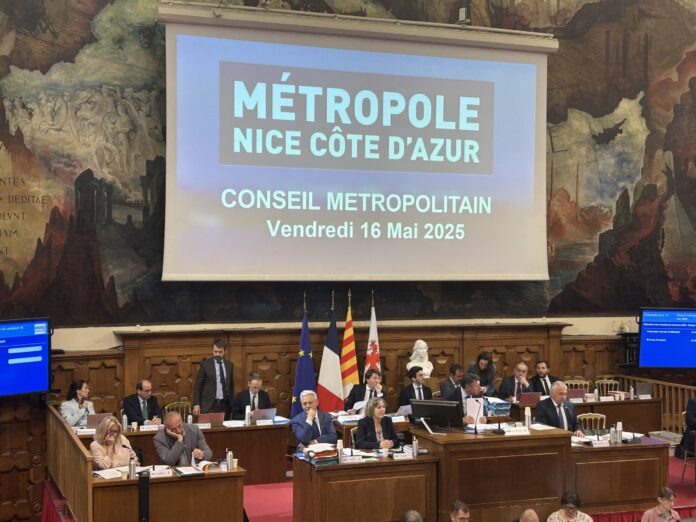
The Metropolitan Council was held this Friday, May 16, at the CUM, with a central focus on the 2024 finances and heated discussions around lines T4 and T5.
Gathered this Friday, May 16, at the Centre Universitaire Méditerranéen, the Nice Côte d’Azur Metropolitan Council approved the 2024 single financial statement, presented as a strong signal of budgetary solidity. Christian Estrosi, president of the Metropolis, hailed “a gross savings increased to 144.2 million euros”, and “a record investment level of 358 million, including the public services.” He emphasized that these results were achieved “without any tax increase, in a context of rigor and responsibility.” Anthony Borré, first deputy mayor of Nice and vice-president of the Metropolis, highlighted “a healthy trajectory allowing the Metropolis to continue to invest massively in public facilities, housing, and ecological transition.”
However, the opposition did not share this enthusiasm. Philippe Vardon (Retrouver Nice) denounced “a hidden debt” and criticized political choices deemed “disconnected from social urgencies.” The environmentalist elected officials criticized “a lack of clarity in so-called green investments” and called for “greater transparency and coherence in the Metropolis’ climate strategy.”
The future tram lines stir up the assembly
The atmosphere became particularly tense during the debates around the future T4 and T5 tramway lines. While the majority praises “a structuring project to connect the east and west of the Metropolis while strengthening territorial cohesion”, the oppositions expressed strong concerns about both the overall cost and the planned route. Philippe Vardon spoke of “trams for sparsely populated areas, while other neighborhoods are still waiting for concrete solutions.” The environmentalists lamented “the lack of real consultation with residents and the risks of concreting” linked to certain affected sectors.
Despite these tensions, the majority managed to have all the deliberations adopted. The council confirmed its intention to stay the course on major infrastructure projects, while displaying an “exemplary” budgetary management, according to Christian Estrosi.


