
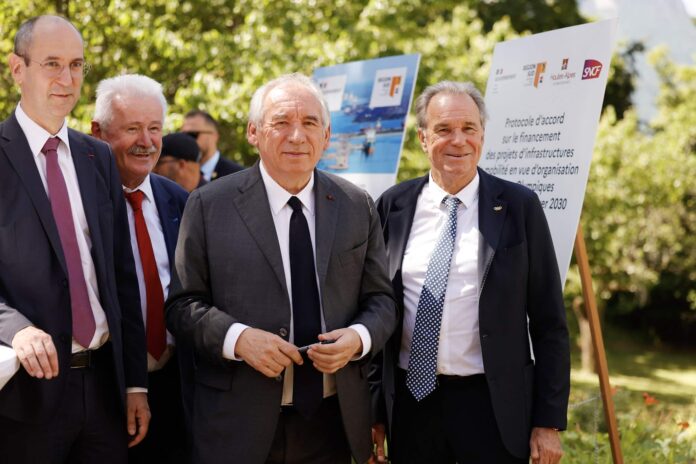
An interministerial committee meeting in Briançon on June 27 formalized a comprehensive investment plan. Objective: to modernize roads and trains in the Southern Alps for the 2030 Winter Olympic and Paralympic Games.
The 2030 Winter Olympics are providing a tangible boost to mobility in the Southern Alps. Meeting in Briançon under the chairmanship of Prime Minister François Bayrou, public stakeholders signed a funding protocol of 520 million euros. The State, the Southern Region, the Department of Hautes-Alpes, the City of Gap, the Aix-Marseille-Provence Metropolis, and SNCF Réseau are all involved in this plan.
Among the priorities: the modernization of the Marseille–Briançon railway line. This project will involve 178 million euros, equally divided between the State and the Region. The goal is to enhance the tracks, structures, stations, and crossing points. Two express round trips, nicknamed “high-speed trains,” are expected to be operational by 2030. They will supplement the local services already provided by ZOU! trains.
Trains, roads, and local transport on the agenda
The plan also includes road improvements. The 90 million euros allocated for this purpose will target several routes: the Gap bypass, the Gap–Briançon link, the section between Tallard and La Bâtie-Neuve, the crossing of La Roche-de-Rame, and the road between Briançon and Grenoble.
Other measures are expected on a local scale: reorganization of coach lines between Veynes and Briançon by 2026, creation of exchange hubs in Briançon and Manosque, and sale of transport tickets in 26 rural post offices starting in 2025.
After the meeting, several representatives spoke. The president of the Southern Region, Renaud Muselier, was pleased to see a long-awaited project come to fruition. He stated: “Thanks to the 2030 Games, the Southern Alps are changing dimensions. What we’ve been waiting for years is finally becoming possible: faster trains, safer roads, better-served valleys. It’s a useful, lasting, and awaited legacy.”
The Prime Minister, however, remains cautious regarding the budgetary aspect. He emphasizes the gradual nature of the State’s commitment, linked to calls for tenders and the upcoming finance bill. “Therefore, I put my signature on the check…but I do not put the amount,” he specified, in the margin of the announcements.
The day continued with a visit to the Fort des Trois Têtes, a site considered for housing the future Olympic village. An official session in the presence of several ministers, the president of the Auvergne-Rhône-Alpes Region, and Michel Barnier, in charge of a mission on the Olympics. The latter was humorously dubbed as “the supreme guide of the 2030 Olympics”, according to François Bayrou.
The interministerial committee concluded with a comprehensive review of the organization. Public stakeholders signed a pact aimed at controlling the expenses related to the Games. “Not one euro more,” concluded the head of government.


