
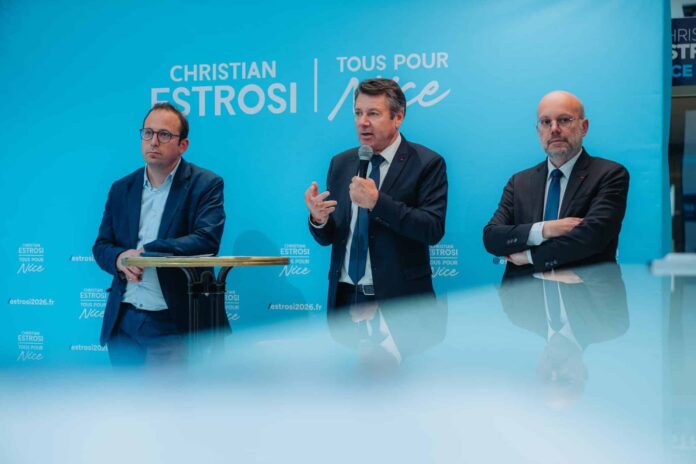
Christian Estrosi launches his 2026 municipal campaign with ten commitments to strengthen citizen participation. The outgoing mayor wants to involve Nice residents more in local decisions through consultations, referendums, and online tracking tools.
Christian Estrosi launched his campaign for the 2026 municipal elections with a set of ten commitments dedicated to citizen participation. The outgoing mayor presented this afternoon a project aimed at strengthening the role of residents in municipal choices, both in neighborhoods and in the daily management of the city.
The All for Nice candidate explains his approach at the start of his campaign: “All for Nice is not a slogan, it’s a project to ensure that every Nice resident can be more involved in their city, their neighborhood, and every public policy we implement.”
The mayor recalls the impact of the health crisis on public practices and mentions the desire, according to him, expressed by many Nice residents to participate more directly in decisions. He notes the implementation of consultative bodies, territorial councils, or a participatory platform to illustrate this dynamic.
Christian Estrosi claims to want to start this new political cycle with direct consultation: “each new mandate should be an opportunity to ask, ‘How can we do better to adapt to societal changes?’ I wanted to start my municipal campaign with the creation of a questionnaire.” Here are the ten proposals made by the candidate.
The chairmanship of the finance committee promised to an opposition member
The project presented by Christian Estrosi is based on a series of measures aimed at establishing continuous exchange between the city and its residents. Firstly, he commits to ensuring that each deputy mayor meets Nice residents twice a year to present their actions, answer questions, and publicize the conclusions of these exchanges. He will continue his neighborhood meetings.
The online participatory platform would play a central role in this setup. It would become a tool for permanent dialogue, with quick responses, a monthly video meeting with the mayor or a deputy, and transparent monitoring of local projects and initiatives. Citizen expression would also gain a new place during the Municipal Council: three questions posed by residents would be randomly selected for each session, and any proposal supported by 1,000 voters could be put to a vote by the elected officials.
Christian Estrosi also seeks to directly integrate citizens into his team. Two Nice residents who propose a project deemed relevant would join his list in an eligible position. He also wants to establish an annual day dedicated to local referendums, allowing residents to decide on local issues with the possibility of initiating a consultation themselves.
The Consultative Communal Council would see its missions expanded. Its composition would partially evolve with the entry of randomly selected members for two years, to diversify profiles and opinions. Transparency of public policies would be enhanced through the online publication of accessible indicators in areas such as security, cleanliness, mobility, culture, or solidarity. The mission letters of the deputies would also be made public.
On the financial front, the candidate plans an annual independent audit, publicly presented and annexed to the budget. The chairmanship of the Finance Committee, currently the responsibility of the one who succeeded him as mayor of Nice for a year, Philippe Pradal, would be returned to an opposition official. The participatory budget, doubled to 3 million euros per year, would allow broader funding of projects proposed by residents. Finally, municipal tenders would systematically include a consultation phase to involve Nice residents in decisions regarding development, urban furniture, or uses.
Christian Estrosi concludes his presentation by explaining his ambition: “we want to make Nice the most democratic, the most participatory, the most transparent, and the most demanding city in France towards itself.” The details of his entire program are expected to be known by the end of January.


