
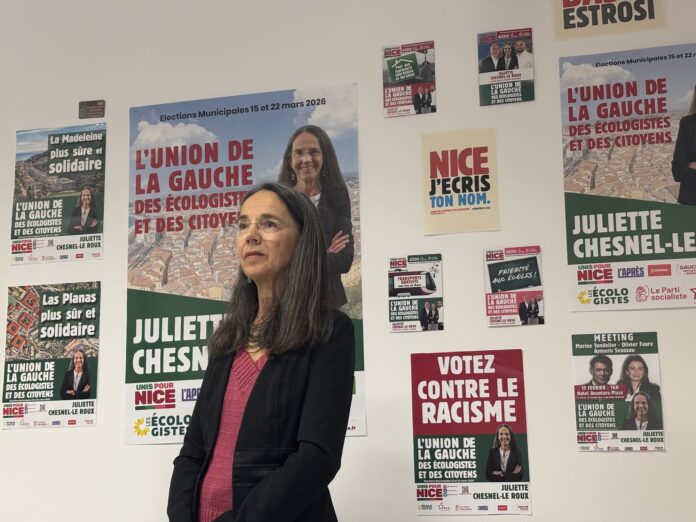
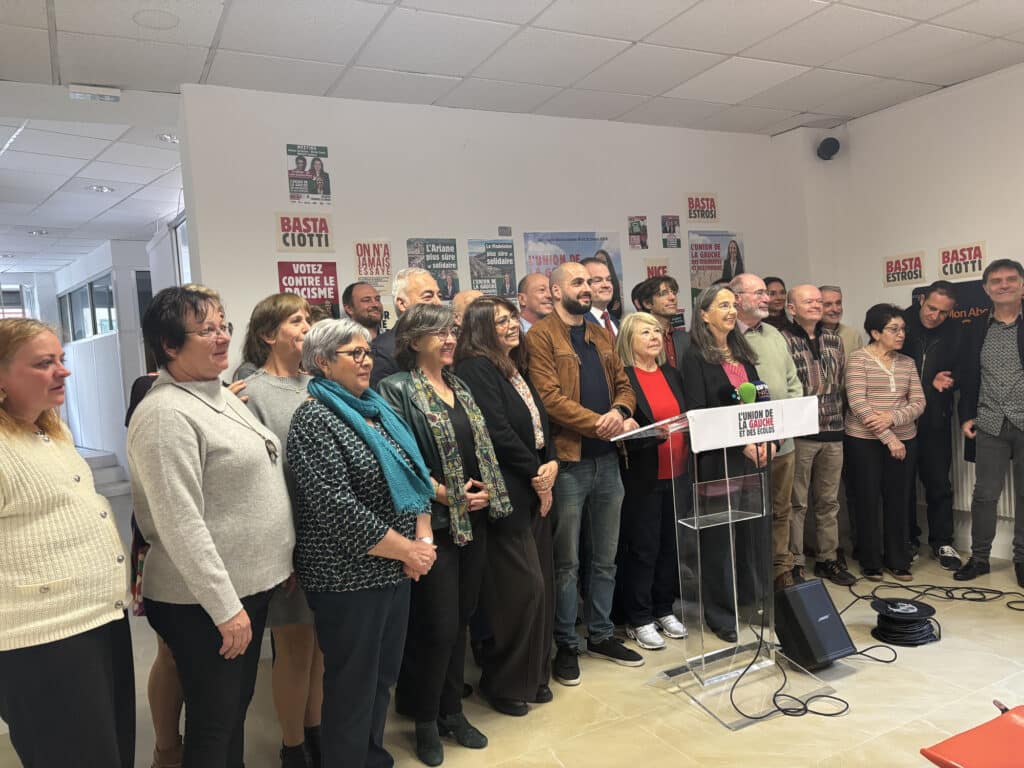
Gathered on Tuesday, February 10th at the campaign headquarters, the members of the list Unis pour Nice, led by Juliette Chesnel-Le Roux, presented their candidates and the key points of their program. A press conference marked by the desire to embody an alternative to the local right, centered around a political, civic, and programmatic union.
Right from the start, Juliette Chesnel-Le Roux sets the tone. With a touch of humor, the lead candidate declares: “I commit to starting punctually, unlike Christian Estrosi who always starts half an hour late.” A touch of humor that introduces a dense, collective, and firmly political conference. So far, three leaders have been highlighted. On this occasion, the candidate wanted to broaden the context. “Today, I wanted to discuss other candidates who illustrate the diversity of our list. Because we represent the merging of the left and ecologists.” Without revealing the full list of 69 candidates, Juliette Chesnel-Le Roux emphasizes the diversity of the team: political parties (PS, PCF, Ecologists, L’Après), trade unionists, field professionals, and association activists. “Civil society is all of us, through our activism.” Civil servants, teachers, healthcare workers, entrepreneurs, nurses, an oceanographer, or a lawyer: Unis pour Nice claims a diversity of backgrounds and skills, viewed as an asset for governance. Julien Picot, a territorial civil servant and activist in popular zones, is the first to speak, presenting suggestions on mobility. “As soon as we take office, we will implement free transportation to ensure access for all residents of Nice.” Declared aims: to increase purchasing power and improve air quality. The candidate criticizes the lack of action from the current majority in various areas. “Unlike the right of Christian Estrosi, who has promised a tramway to Ariane for over 25 years, we want its implementation without delay. The residents of Ariane are not second-class citizens.”
Security, Ethics, and Public Policies: A Different Vision of the City
Regarding security, Patrick, the former vice-president of the Region, advocates for a strategy focused on prevention and human intervention: “We wish to see more police officers on the streets and hire 50 additional mediators in the neighborhoods.” This perspective is enriched by that of Jean-Christophe Picard, the current municipal councilor, who places ethics and democratic trust at the heart of the municipal project. In response to investigations targeting the current mayor’s entourage, he warns: “We must not get used to this situation.” The Unis pour Nice group boasts of a “very ambitious” ethical code, based on “the exemplary nature of elected officials and citizen participation,” rejecting any form of excessive personalization of power. Another key focus of the program, the social and environmental policies largely shape the proposals put forth by the list. Marie-Christine Pastorelli presents a project to combat violence against women, based on three main axes: prevention, protection, and support, including specifically the establishment of a center dedicated to women. Regarding the environment, Pauline Nales highlights the urgent health situation: “In Nice, air pollution causes 500 premature deaths annually,” and envisions the protection of the Var plain as well as an ecology “that influences all city policies.” Gilles Verrier described the housing situation as “catastrophic” and it is also one of the priorities. In addition to controlling rents, limiting Airbnb-type rentals, and promoting public housing, he criticizes a municipal policy that “has favored speculators and tourism at the expense of Nice residents.” Finally, Philippe Agron advocates for a more inclusive and supportive school, where “the child is the citizen of tomorrow,” driven by the renovation of buildings, fairer pricing, and strengthening human resources.
Through these suggestions, Unis pour Nice outlines the main lines of a comprehensive municipal project that combines social justice, ecological transition, and strengthening of public services. This list aims to break the management judged as decentralized and unfair of the city by advocating for a holistic approach to combat violence against women, encompassing education, housing, and the environment. Thus, this coalition of the left and ecologists declares its determination to represent an organized, collective, and sustainable political alternative for Nice.


