
Here is the translation of the provided text into English:
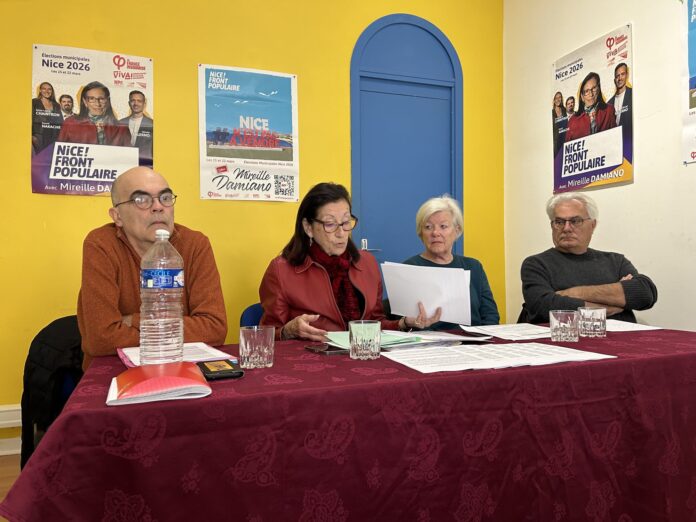
In the midst of the municipal campaign, the representatives of the Front Populaire de Nice put forward a series of proposals aimed at establishing a more active, inclusive, and genuinely participatory democracy, both at the city and metropolitan levels.
For Mireille Damiano, the observation is clear: many key issues for the city, such as transportation or overtourism, are being addressed without residents truly having a say. She points out that citizens massively complain about not being heard, a situation she describes as a “serious issue.” According to her, this increasing distance between institutions and residents fuels a “total disengagement” from local democratic life. The main cause of this crisis, she argues, lies in a system marked by “absolute opacity” and “misleading publicity.” For Mireille Damiano, this is in no way an active democracy, but a locked system, far removed from the realities experienced by the residents of Nice. “To change things, we must listen to the people of Nice,” she emphasizes.
Among the emblematic mechanisms of this loss of connection, Mireille Damiano highlights the evolution of neighborhood councils. According to her, these have “practically disappeared” to be replaced by “territory councils”. While the city previously had nine neighborhood councils, there are now only six established by the Nice municipal council. This new organization is considered deeply disconnected from the daily lives of residents. Today, Nice has 88 neighborhoods spread over six territories, a setup Mireille Damiano describes as an “absolute distancing” for most residents. She also criticizes the low activity of these entities, which “meet at a ridiculous frequency.”
The budget allocated to these councils, set at 1.5 million euros, is also deemed insufficient, even symbolic. “This top-down approach is anything but democratic,” she asserts. She also reminds that since 2008, there has been a communal consultative council with a supposed “permanent presidency,” but no reports from this council have ever been made public. Finally, she mentions the neighborhood committees, originating from older initiatives, now primarily consisting of associations, which no longer allow direct expression from residents, according to her.
A « community of destiny »
Christine Poupon, on the other hand, advocates a political vision based on the notion of a “community of destiny.” She calls for building a city of Nice that is open to the world, rejecting identity-based discrimination and the stigmatization of certain populations.
To bring this community of destiny to life, several ideas are proposed. Among them are the implementation of residential citizenship and a strengthened fight against racism and discrimination, including within the municipal council. She also stresses the need to train elected officials and municipal agents on these issues.
She advocates for a welcoming city, equipped with urban facilities adapted to people with disabilities. Creating accommodations for the homeless and exiled individuals is also among the priorities mentioned.
Random Selection and Citizen Assemblies
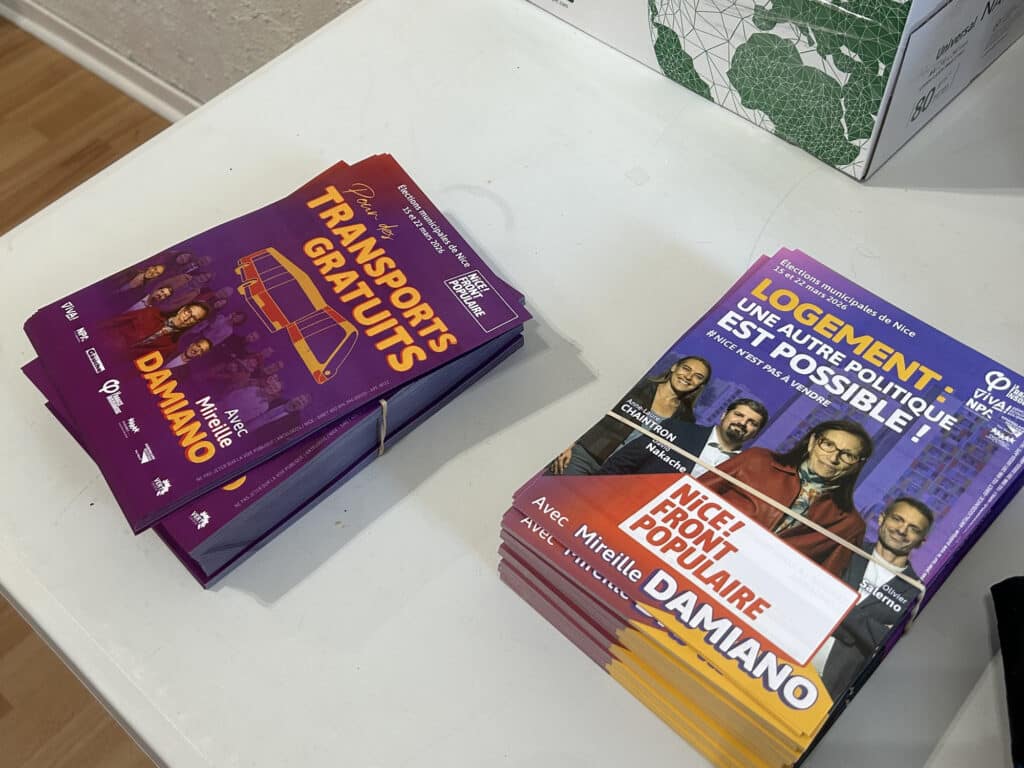
To profoundly renew democratic practices, Mireille Damiano proposes to “find a new method” based on the use of random selection. She suggests a random selection from the electoral lists to form neighborhood citizen assemblies.
These assemblies would be composed in a balanced manner, including men and women, young people aged 16 and over, “regardless of their origins,” and would function in a collegial way. She also mentions the holding of city forums to evaluate public policies, as well as the creation of a citizenship observatory, a service managed by the municipal authority. Greater involvement from the youth municipal council is also desired.
Participatory Budget and Citizen Power
The Front Populaire also advocates the implementation of a genuine participatory budget, equipped with concrete resources and based on a genuine will to act. According to them, this device must be both a process and a tool for democratic transformation. “Currently, there is no citizen power,” they claim, calling for an active role for residents.
Inspired by experiments conducted notably in South America, this participatory budget would be based on a continuous dialogue between the municipal council and local actors. The Front Populaire also proposes integrating democratic guarantees to ensure the transparency and effectiveness of the system.
Associations, Equality, and Metropolis at the Heart of the Issues
Christine Poupon finally reminds that “associations help to construct a collective voice” and that they must be further integrated into decision-making processes. She mentions the role of subsidies, particularly through the CER, and the creation of intergenerational citizen houses, intended to inform the most disadvantaged populations, promote access to culture, and encourage gatherings.
Pierre Paul Danna broadens the debate to the metropolitan scale. For him, “the metropolis is a decisive body,” but remains insufficiently addressed politically. He calls for making “the metropolis a political subject,” reflecting on the separation of executive functions, the clarification of relations with municipalities, and the effective participation of citizens in metropolitan decisions.


