
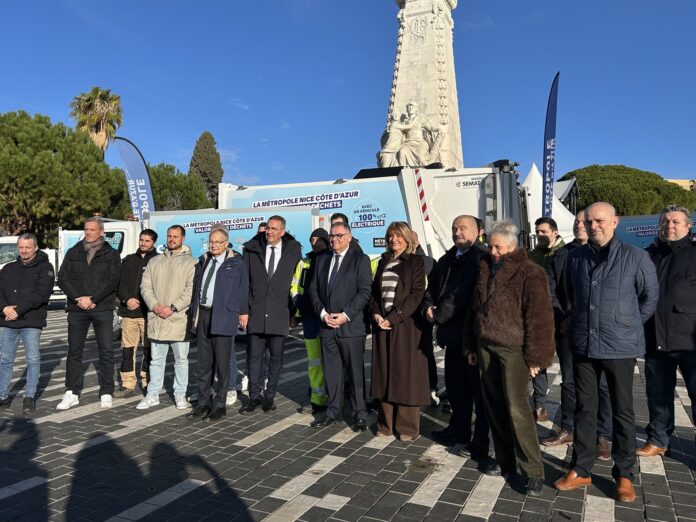
Facing climate, health, and noise challenges, the Nice Côte d’Azur Metropolis is intensifying its decarbonization policy. The goal is to drastically reduce CO₂ emissions and nuisances for residents, particularly in the city center.
The decarbonization approach undertaken by the Metropolis is part of a context of climate change described as a source of “crises” and “tragedies”. For Pierre Paul Leonelli, vice-president of the Nice Côte d’Azur Metropolis, this policy must “take precedence” in face of the environmental emergency. It is a “very strong initiative desired by Christian Estrosi”, whose objectives are partly already achieved.
Concrete actions
Among the tools implemented, the Metropolis is focusing on transforming public spaces. Where there used to be predominantly mineral areas, without trees or shaded zones, a greening policy is being implemented, alongside considerations on cooling public spaces.
Simultaneously, a major investment is dedicated to the modernization of the Ariane plant, amounting to 240 million euros. This plant will become “the European plant with the least carbon production”, thus enhancing the territory’s environmental exemplariness.
The decarbonization of the waste collection fleet began in the Old Nice area, a dense neighborhood with narrow streets, characterized by a high concentration of shops, restaurants, and therefore waste. “Decarbonizing the city center as much as possible is important,” emphasizes Pierre Paul Leonelli.
Priority has been given to an electric fleet capable of collecting cardboard, glass, household waste, and bulky items while minimizing noise. The objective is clear, to operate “silently” in a highly inhabited area.
A financial effort for a lasting benefit
The Metropolis had an aging fleet of industrial vehicles, mostly powered by fossil fuels like diesel. Renewing this fleet has become a major challenge to combat polluting and noise nuisances. “For us, it’s an essential challenge to start purchasing electric vehicles,” asserts Pierre Paul Leonelli, while acknowledging that “it comes at a cost.”
The cost of an electric truck is estimated at around 500,000 euros, compared to less than 300,000 euros for a thermal vehicle. A significant financial effort, embraced as a long-term investment. In return, the benefits are numerous: reduced CO₂ emissions, elimination of fossil fuels, 85% reduction in noise for citizens, and autonomy of about 110 kilometers.
The working conditions of collection agents are also improved. “With the new vehicles, it’s a winning ticket,” sums up Pierre Paul Leonelli.
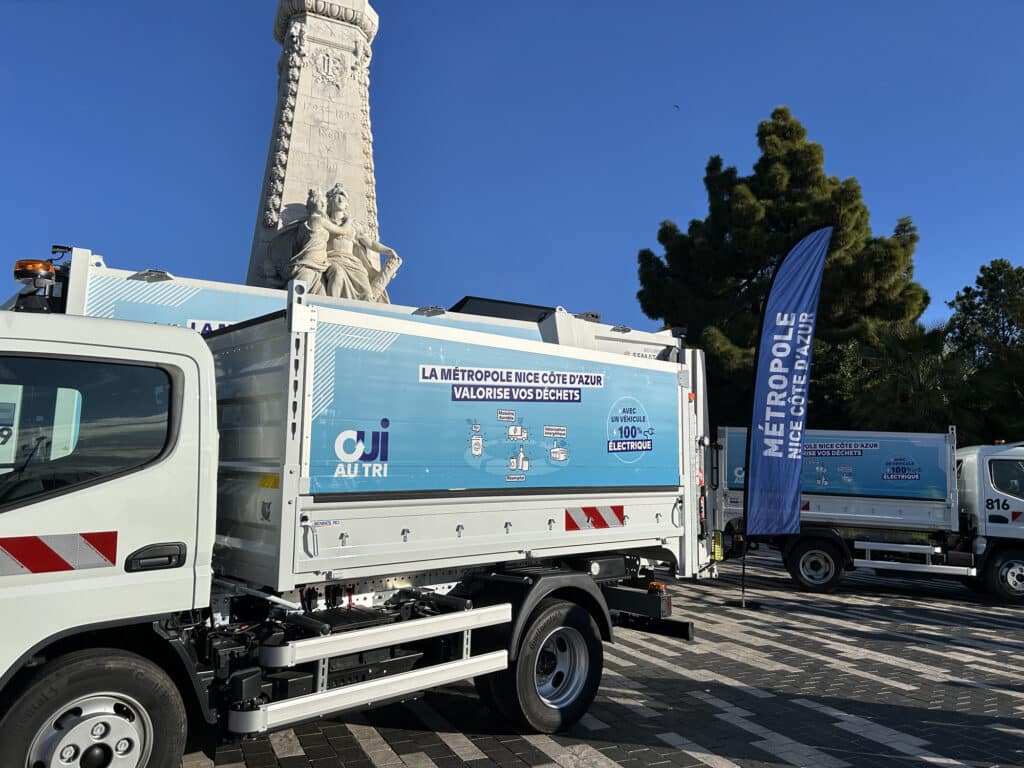
A 100% electric fleet in the city center
The Metropolis has deployed several types of electric vehicles suited to urban constraints. Electric tricycles for the collection and recycling of cardboard (bicycles equipped with small bins), fully electric flatbed trucks for collecting bulky items, and large electric dumpsters (used primarily in the city center). These vehicles allow for “100% decarbonized” and noise-free collection.
The momentum is expected to continue. By 2026, the Metropolis plans to have 27 electric flatbed trucks in circulation. In the longer term, the objective is to reach 35% clean fleet. “We are a city that is dynamic on this subject,” concludes Pierre Paul Leonelli, alongside Jean-François Ascas, director of collection, illustrating the operational commitment of the Nice Côte d’Azur Metropolis to the ecological transition.


