
Nice, Queen of Flowers
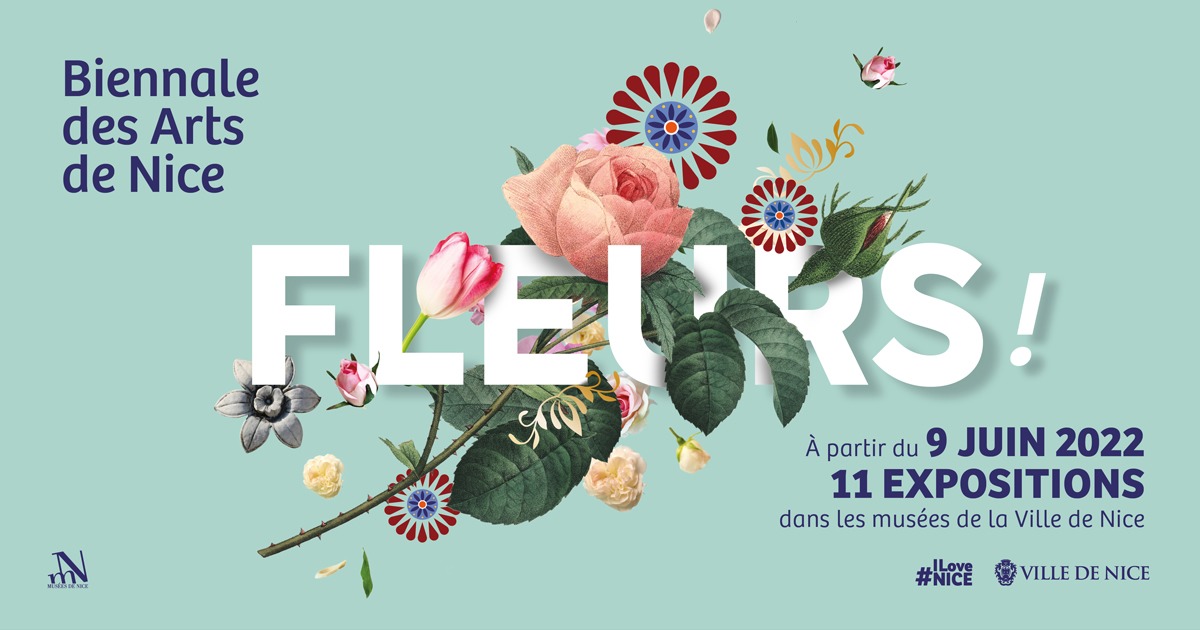
*5th edition of its kind,* the Biennale of Arts, with Mr. Jean-Jacques Aillagon, former Minister of Culture, as the General Commissioner, will celebrate *this summer and autumn* the unbreakable bond between Nice and flowers. It is part of Nice’s cultural life and helps to showcase the artistic vitality of a city that *aspires to become the European Capital of Culture in 2028.*
Nice, Queen of Flowers
11 exhibitions will be presented to the public from the Musée Masséna to the Palais Lascaris, including the Mamac, the 109, or the Museum of Fine Arts, often highlighting the connection between Heritage and Creation. This is particularly the case with the Matisse Museum, which celebrates Hockney, a creator of today, and Matisse in “A Paradise Found.” To be seen until September 19. Exhibition curator: Claudine Grammont.
The Musée Masséna explores in “Nice, Queen of Flowers,” a title that refers to “Nissa Regina de li Flou,” from the Niçoise anthem “Nissa la Bella,” the relationships between plants, flowers, and the city’s architecture, the importance of image dissemination through paintings, engravings, posters, the place of production and markets around the theme not to mention the role of flowers in popular events such as the Battles of Flowers, an opportunity to promote the Niçoise cut flower agriculture whether it is in open fields or greenhouses.
From the flowered landscapes of the Niçoise countryside to the impressive gardens of the city, over time, city officials have emphasized floral motifs for the interior and exterior decoration of buildings and private homes.
In total, nearly 250 works will be to discover, divided into 7 parts with an exceptional loan from the National Furniture Collection. To be seen until October 9. Exhibition curators: Jean-Paul Patron, Marion Duvigneau, François La-Quièze, and Jean-Pierre Barbero.
Archaeology and Flower Power
Let us mention in this Biennale the exhibition of the Natural History Museum which takes its summer quarters at the Cimiez Archaeological Museum for “Flos Vitæ” or the unveiling of an exceptional and emblematic plant palette of the region through herbariums, watercolors, lithographs, and other photographs testifying to the great richness of local biodiversity. To be seen until October 9.
Let’s also mention Power Flower at the 109 where 42 artists have been inspired by the symbolic aspects of the flower, from metamorphosis to the evolution of life, from opulence and abundance to fragility and the finiteness of life.
The flower in contemporary art is the subject of societal or environmental debates whether it is about its form evoking the female sex to the most futuristic projections. To be seen until September 3.
Ambivalence and Floral Motif in the Spotlight
Also, mention the International Museum of Naive Art which explores “the Flowers of Evil” or the representation by flowers of the feminine/masculine and ambivalence, between delight and fear. Note that a living herbarium in front of the Museum entrance will connect with about ten pieces presented thanks to a partnership with the green spaces department. Additionally, an immersive setup created by the Master ICDD (SicLab-Mediterranean) students will bridge reality and virtual. To be seen until September 19.
At the Palais Lascaris, a Baroque gem, it is the floral motif that will be in the spotlight from the architecture to the painted decor, including the furniture and ceramics of the 17th and 18th centuries. In the spacious lounges, among marquetry and gilded woods, one can discover, echoing this “flowering,” the works of Ève Pietruschi. To be seen until January 9.
Rediscovering the Museum of Fine Arts’ Works
The theme of the flower also allows the Museum of Fine Arts to rediscover the works in its collection: paintings, sculptures, graphic arts, and decorative arts from the 16th to the 20th century. Far from being purely illustrative, floral motifs are imbued with messages and symbols as in the “memento mori” of baroque vanities. All these “fireworks flowers” are to be discovered even in the crevices of marbles or in the cubist experiments of Raoul Dufy. Curated by: Johanne Lindskog and Juliette Chevée. To be seen until October 30.


