
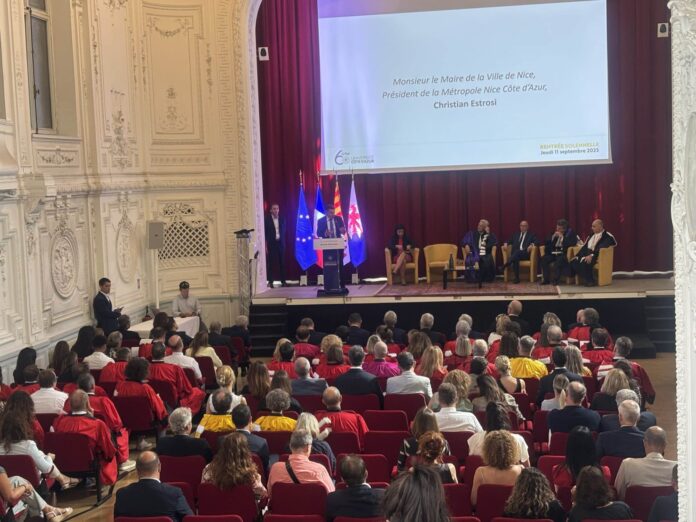
At the Château de Valrose, this Thursday, September 11, the Nice Côte d’Azur Metropolis formalized two key agreements with the University of Côte d’Azur and the Isart Digital school. Objective: to strengthen Nice’s position as a major European university metropolis, at the crossroads of innovation, digital technology, and ecological transition.
It was 10 a.m. at the Château de Valrose when Christian Estrosi, mayor of Nice and president of the Nice Côte d’Azur Metropolis, Jeanick Brisswalter, president of the University of Côte d’Azur, and Xavier Rouselle, president of Isart Digital, signed two agreements described as “a turning point” for higher education and research in the area. The member of parliament and president of the Republicans, Éric Ciotti, was also present alongside the signatories.
A Common and Ambitious Strategy
The first agreement binds the city of Nice, the metropolis, and University of Côte d’Azur. It sets priority axes: improvement of student life, development of research and innovation, support for entrepreneurship, support for environmental and societal transitions, international influence, and campus development.
The second agreement officially associates Isart Digital, ranked as the second-best video game school in the world, with the University of Côte d’Azur. The Parisian school, established in Nice since 2023 at the Innovation Hub, now becomes an associated institution of the university, thus strengthening its local presence. “Digital technology, video games and all the cultural dimensions they represent, today account for $2.8 trillion in global revenue”, noted Christian Estrosi, emphasizing the job prospects offered to students.
A Rising University
Today, the University of Côte d’Azur gathers 32,000 students and 4,000 researchers distributed across 50 laboratories. As the recipient of the Initiative of Excellence label, it is now among the world’s best universities. “We have just received this extraordinary news : entering for the first time into the top 500 universities worldwide in the Shanghai ranking ”, rejoiced Christian Estrosi.
The progression is also national: “in our ranking, we have moved from the 26th to the 11th place”, he clarified, considering that the institution now plays a central role while developing “a perfect complementarity with private institutions.”
Éric Ciotti, president of the Republicans and member of parliament for the Alpes-Maritimes, made sure to mark his presence. Smiling, he praised the “intelligence, knowledge, and hope” embodied by the university. “A territory, a city cannot have a future (…) without a powerful, strong university.”
The official recalled past departmental investments: 67 million euros for the Saint-Jean d’Angély campus, and the future Pôle Alpha dedicated to artificial intelligence. He also emphasized the pressing need for student housing: “for a university to grow beyond the quality of teaching, there must also be accommodations to welcome students.”
Finally, he highlighted the key role of the link with the economic world: “Business is life, and the university must train for the jobs of tomorrow for a different tomorrow.”
A Radiant Territory
Through these agreements, the Metropolis and its partners display the desire to consolidate the image of Nice as a major university and scientific metropolis. The partnership with Isart Digital illustrates the territory’s ability to attract world-class schools, similar to the partnership with Montreal, already initiated by the establishment.
For Christian Estrosi, the international recognition of the university as well as the entrepreneurial and digital dynamics of the territory fully contribute to the influence of Nice: “a great city of France, a great city of Europe, a great city of the world is made firstly by its researchers, its universities, and its students.”
By bringing together students, researchers, public and private institutions, the Metropolis intends to offer young generations an ecosystem of innovation and training capable of meeting the economic, technological, and climatic challenges of the 21st century.


