
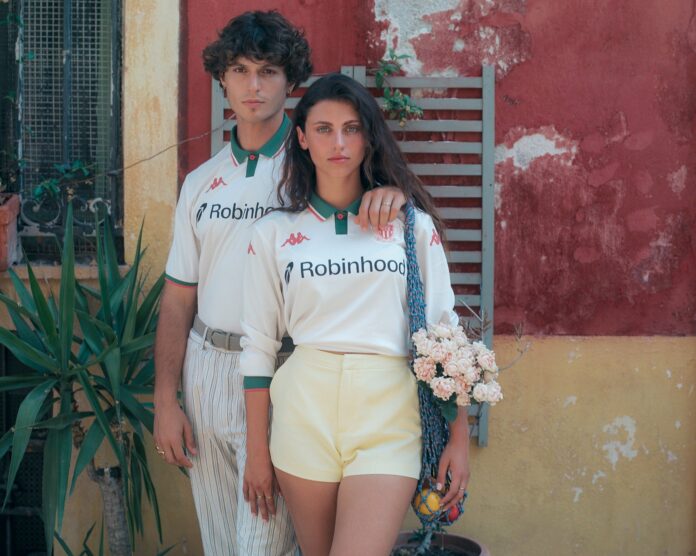
OGC Nice officially unveiled their away kit for the 2025–2026 season on Wednesday, 20 August 2025. Presented as a tribute to the colours of Vieux-Nice, the shirt has struggled to win over a section of the fanbase, already critical following the reveal of the club’s third kit.
After a leak last week in a Ligue 1 McDonald’s promotional video — in which captain Dante appeared wearing the new strip — the club moved to formalise the launch and explain its creative approach. Designed in partnership with Kappa, the kit has been named “Nice la Belle.”
According to the club’s official statement, the shirt is intended as “a tribute to the colours of Vieux-Nice” and, more broadly, to “the city itself.” The design combines white, the club’s traditional away colour, with terracotta and dark green accents. The inspiration is said to come from the façades of the old town, its colourful shutters and Mediterranean vegetation.
“Brought together, these colours become a fragment of the city in the form of a garment. As if Nice itself were worn on the shoulders,” reads the club’s presentation. The message is clear: beyond being a simple uniform, the shirt is meant to embody a direct link between the club and its territory.
However, this aesthetic choice — conceived as a gesture of attachment to the city — has not met with unanimous approval. From the moment the leak emerged, reactions highlighted a growing gap between the club’s communication strategy and the feelings of part of its supporter base. The official unveiling has done little to ease the criticism.
Supporters Voice Their Discontent
On social media, many supporters did not hide their disappointment. Comments ranged from irony to outright anger.
Issa Nissa Sieu Nissart wrote:
“Honestly, we’ve hit rock bottom! The third kit looks like Montpellier’s colours and this one looks like Monaco! But we don’t care about that — we want our identity!”
Others criticised the growing number of kit variations:
“Guys, stop this circus. There are more shirt versions than Ligue 1 players on the pitch! What’s the project? Where are we going?”
For this supporter, money spent on marketing should instead be invested in recruitment.
Kévin reacted with humour mixed with frustration:
“So next we can wear satin brown for the Old Nice olive tapenade… Seriously, this shirt is ugly and doesn’t represent Nice or its history!”
These reactions underline a recurring theme: a segment of the fanbase expects the kit to be a strong identity marker, not a tourism-driven communication tool. Pricing has also sparked debate, with shirts ranging from €85 to €120, depending on the version and personalisation.
A Controversy Following the Third Kit Reveal
Just a week earlier, OGC Nice had already presented their third kit, named “La Riviera.” Described by the club as “a tribute to the region, full of contrasts, light and colour,” it too was met with a lukewarm reception from loyal supporters.
Some reacted bluntly at the time:
“This is OGC Nice — not the Riviera Club or the Promenade des Anglais… seriously!”
Another fan lamented colours deemed too far removed from the club’s traditions:
“These colours don’t match the club’s identity at all!”
Such reactions highlight a growing divide between the club’s narrative — which emphasises showcasing the Côte d’Azur — and supporters who remain deeply attached to historic colours and sporting symbols.
That said, some fans struck a more moderate tone:
“Maybe the green refers to the pitch (yellow for ten months of the year) at the Promenade du Paillon, or the green meadows of Saint-Martin-Vésubie. But for us supporters, green is above all a colour to avoid. Let’s say the home kit is a real success, the third kit divides opinion but remains beautiful, and there’s room for improvement next year. However, listen to the supporters and don’t deny our history.”
Identity at the Heart of the Debate
The unveiling of the kits goes beyond simple aesthetics. For a club like OGC Nice, the shirt is a central element of identity. Drawing inspiration from the city and its landscapes creates an ambivalent response. On one hand, it strengthens the club’s local roots and celebrates Nice itself. On the other, some believe this approach blurs the message and distances the team from its traditional reference points.
The supporters’ backlash also reflects broader concerns about the growing role of marketing in modern football. Criticism of the proliferation of kits and design choices is often accompanied by a call to refocus on fundamentals: sporting results and a coherent identity.
For now, the club is standing by its choices and maintaining its direction. Time will tell whether these designs eventually find their place in the hearts of supporters — or remain perceived as a break from tradition.


