
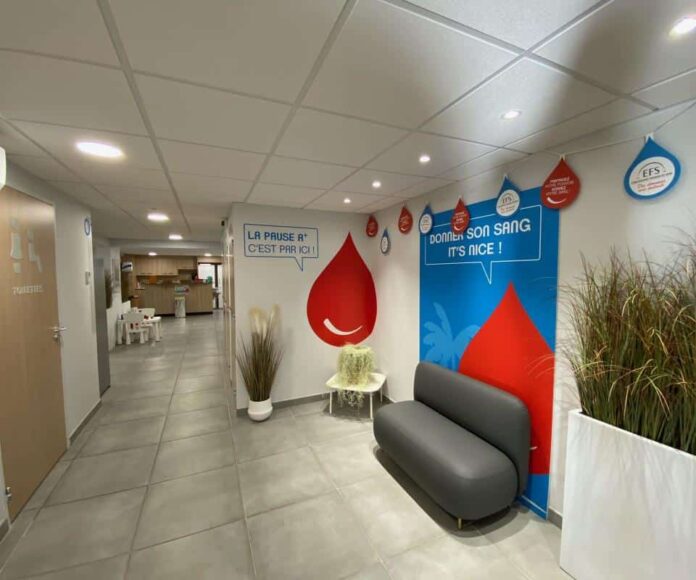
Facing the increasing medical needs, the French Blood Establishment is launching PlasmaDons. The operation aims to encourage one plasma donation per season starting in 2026. In Nice and more broadly in the Provence-Alpes-Côte d’Azur region, the announced goal is to double the number of donations in one year.
The plasma donation plays a central role in the healthcare system. This blood component is used in the manufacturing of numerous medications. These treatments address chronic or autoimmune diseases. Some have no therapeutic alternatives. Demand increases every year. The aging population plays a direct role. The development of innovative treatments further accentuates this trend.
However, plasma donation is less known than blood donation. The number of donors remains limited. This situation creates a strain on available stocks. The issue of supply becomes strategic. Access to care depends directly on this resource.
In this context, the French Blood Establishment announces the launch of PlasmaDons. This regional operation begins in 2026. The initiative targets both regular and new volunteers. The goal is based on a simple commitment: one plasma donation per season.
Plasma, a Public Health Issue
Despite these changes, plasma donation remains little identified by the general public. Plasma donors are currently fewer than blood donors. This difference affects collection capacities. Mobilizing donors thus becomes a major issue for the healthcare system.
The French Blood Establishment positions this issue within a long-term strategy. Securing collected volumes is a priority. The stated objective is based on better donation regularity.
With PlasmaDons, the French Blood Establishment wishes to instill a habit of regular donation. The principle is based on a defined frequency: one donation per season. This cadence aims to structure donor engagement throughout the year.
Currently, the number of donations is two donations per donor. The operation intends to change this dynamic. In the Provence-Alpes-Côte d’Azur region, the figures reflect this goal. The number of plasma donations must increase from 14,000 in 2025 to 28,000 in 2026.
This progression relies on several levers. Increasing the sustainably collected volumes is at the forefront. Securing plasma supply forms another axis. Recognizing donor engagement complements this approach.
The PlasmaDons operation starts immediately. Donors can make a winter donation. Appointments are available at the Maison du don de Nice. The address is 3 rue Galléan. Registration is done online through the French Blood Establishment’s website.
This local mobilization is part of a regional dynamic. The Provence-Alpes-Côte d’Azur region is among the areas involved in the operation. Doubling donations is a stated objective for 2026.
A Local Action in Nice
The Maison du don de Nice plays a central role in this campaign. The site welcomes donors throughout the year. Appointments allow the organization of plasma collections in a medicalized setting.
Alongside the PlasmaDons operation, the Maison du don de Nice offers a cultural program. From January 5 to February 7, a photographic exhibition is presented to the public. The exhibition is titled “Oiseaux de passage”. Photographer Lionel Bansard presents this series.
The exhibition features “a series of photographs capturing ephemeral moments and scenes caught on the fly.” Admission is free. The exhibition is open to the public according to the usual hours of the Maison du don.
An opening reception is also announced. The event will take place on Thursday, January 15 at 5:30 PM. Access is open to everyone.
This program reflects an aim for the venue to be more open. The Maison du don de Nice thus ties plasma donation to cultural access. This approach aims to strengthen the connection with the local public.
With PlasmaDons, the French Blood Establishment enters a new phase in mobilizing donors.


