
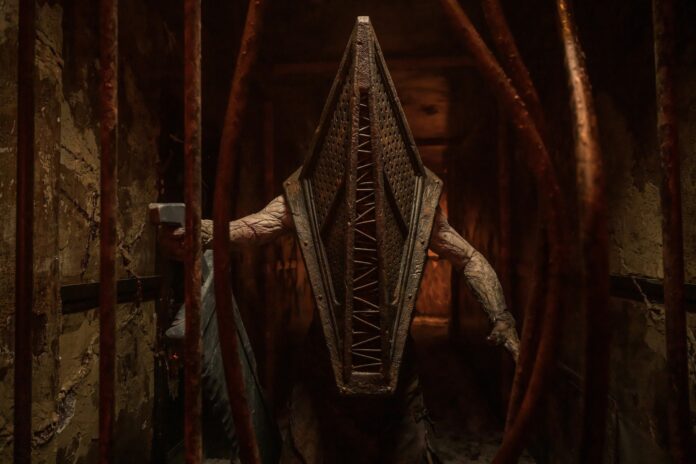
Twenty years after the first film, the French director dives back into the cult universe of Silent Hill with a work conceived not as a classic horror film, but rather as a disturbing and melancholic experience. Present at the Nice premiere, Christophe Gans extensively explained his approach.
Presented as a preview on Sunday, January 25, at 4 pm at the Mégarama in Nice, Return to Silent Hill was screened in the presence of its director Christophe Gans, who took part in a Q&A session after the screening. It was a rich exchange, focused on the time that has passed since the first film and the unique nature of the horror presented.
Asked about the nearly twenty years of waiting before this return to Silent Hill, Christophe Gans placed his first film in the context of early 2000s horror cinema. In 2006, the genre was dominated by jump scares, home footage, and torture porn popularized by franchises like Saw. Silent Hill already stood out by betting on a ghost town designed as a character in its own right, with an unstable and ever-changing parallel dimension.
At the time, directly adapting Silent Hill 2 would have represented a too complex challenge. The game relies heavily on the subjectivity and troubled psyche of its protagonist, in addition to wandering through a trap-town. Thus, the choice was made for a more “sensible” adaptation of the first installment, primarily focused on portraying the town. In the meantime, despite a mixed critical reception at its release, the film has become cult. “It never disappeared,” the director emphasizes, reminding that it remained a constant reference for fans.
Christophe Gans: “It’s a nightmare film”
Another question posed during the exchange: “I wasn’t scared, is that a problem, doctor?” To which Christophe Gans responds unequivocally. Return to Silent Hill was never intended as a film aiming for immediate fear. “It’s not a horror film, it’s a nightmare film,” he explains. The goal is not to provoke jumps, but to create lasting unease, a sense of discomfort that settles in gradually.
The director claims a deeply dreamlike approach, immersing the viewer in the psyche of a character who has shaped this universe to protect themselves from an unbearable truth. Melancholy, sadness, and depression make up the emotional core of the film. A vision faithful to the spirit of the games, where horror slowly seeps in rather than imposing itself directly.
A sensibility that fans themselves ardently defend during debates organized throughout France. According to Christophe Gans, their main concern is not the absence of monsters or shocking scenes, but the potential disappearance of the melancholic atmosphere that defines the identity of Silent Hill. An expectation to which the director says he is particularly attentive… suspense…
More than a film intended to frighten, Return to Silent Hill is presented as an inner experience, a waking nightmare, rather than a sleeping dream, that lingers well beyond the screening. A work that does not seek to startle, but to leave an uncomfortable, triste, and profoundly human imprint, remaining true to the soul of Silent Hill?


