
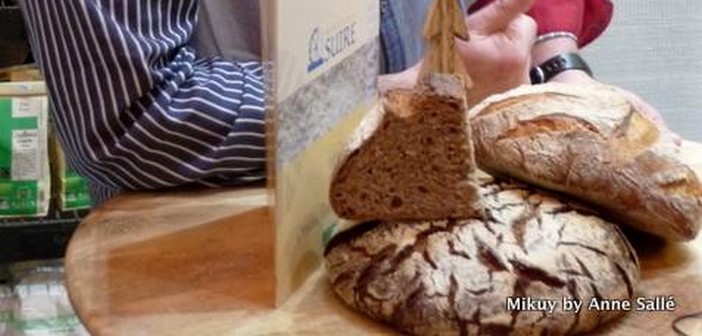
It was at Mama Baker, the organic epicurean bakery on Rue Lépante in Nice, that I discussed it with Harold Taillefer…
Harold Taillefer is a sales representative for Minoterie Suire, which has specialized in organic flours since 1979. Located in Loire-Atlantique, the mill processes wheat—mainly French—on granite stone mills, a method that preserves the nutritional value of the wheat germ: 11 for wheat and 3 for other grains, rye, kamut, buckwheat, and spelt.
“In organic wheat, there are no pesticides, and it’s all the more important because people eat more bread with bran today,” he explains.
As the demand for organic products continues to grow, he reaffirms the importance of bread in the diet, a staple and the cheapest product in the industry.
When discussing gluten, he warns against a “trend effect” and rehabilitates its role: “it’s important not to confuse intolerance with allergies. People with celiac disease represent at most 2% of the population. The body needs gluten, and the diets we see emerging can lead to serious nutritional deficiencies.”
Favor organic sourdough bread
The best balance is offered by bread made with natural sourdough: “there is a breakdown of glutens—proteins that the sourdough feeds on—and digestion is facilitated. And natural sourdough also means better preservation.”
Still, one should not have too much gluten. Yet, it’s added to industrial breads. Take the time to check the labels. “The industry has shorter production processes and needs better developments,” explains Harold Taillefer. “In organic products, gluten can also be added; some millers do so. But the bakery profession is a standalone craft. It’s up to the baker to give strength back to the dough.”


