
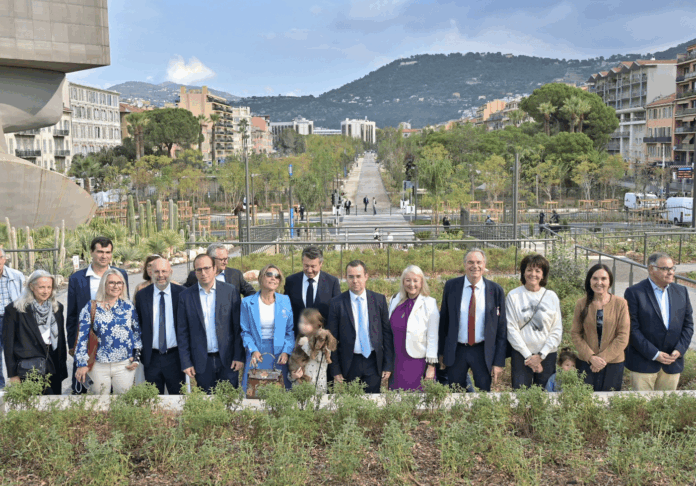
After three years of work, the second part of the Promenade du Paillon was inaugurated this Saturday, October 18, in Nice. Eight hectares of urban forest are now added to the green corridor, in a project that is both praised and criticized.
The transformation of the center of Nice continues. This Saturday, October 18, 2025, the city council inaugurated the second phase of the Promenade du Paillon. An eight-hectare space now extends from the Bourgada to the Palais des Expositions. The project, launched in 2022, marks the end of a long program of greening the city center.
Christian Estrosi, mayor of Nice, was present alongside Laurent Hottiaux, prefect of the Alpes-Maritimes, and Renaud Muselier, president of the South Region. The event attracted many locals from Nice who came to discover the new “urban forest.”
Urban planner Alexandre Chemetoff, the originator of the project, reimagined the space where the Nice National Theatre and the Acropolis Palace once stood. He explains: “the fact that these two buildings are gone has opened up perspectives and created connections from east to west on an artificial ground, on which we have reconstructed a natural soil where different gardens will grow. When you move from one end to the other, you pass through several atmospheres.”
His approach moves away from symmetrical forms and rigid lines. He describes a “coherent” composition, made of brick floors, white limestone, and pergolas, without altering the urban furniture.
A regional ambition for a greener city
The South Region contributed more than 33 million euros to the financing of the project, out of a total cost of 94 million. For Renaud Muselier, president of the Provence-Alpes-Côte d’Azur Region, “this project is the perfect example of what we are doing throughout the South Region, for greener cities, more peaceful, always serving the residents and their quality of life.”
The park’s extension now brings the total area of the green corridor to 20 hectares. According to the Region, it will have 2,500 trees planted and a rainwater recovery system to irrigate the gardens. Local authorities estimate an annual reduction of CO₂ emissions by about 1,740 tons and an improvement in air quality.
The project is part of the “Our Territories First” 2023-2027 program, which also supports the T5 tram line, the Nice-Saint-Laurent-du-Var cable car, and the renovation of the Museum of Modern Art and the Nucéra Library.
The Nice city council highlights a long-term vision. Christian Estrosi declares that this extension is part of “the continuation of Nice’s metamorphosis into a garden city contributing to its inscription by UNESCO on the World Heritage List.”
Between satisfaction and political criticism
The project’s ecological success does not end local political tensions. The opposition denounces the overall cost of the project and its electoral scope.
Julien Picot, departmental secretary of the PCF 06, believes: “Christian Estrosi orchestrates a media operation with precise staging, animations, and a grand buffet financed by public funds. It is unacceptable because, once again, public space, institutional communication, and public funds are used to serve the political interests and personal promotion of one man.”
Robert Injey, a member of the VIVA! collective and therefore of Nice Front Populaire, adds: “the mayor is going to inaugurate, with much fanfare, and a true excess of means is deployed for this initiative. Advertising inserts, luminous supports, lampposts, billboards, tramway… All possible supports are used excessively. An incredible arrangement, unprecedented, for the inauguration of a garden on a concrete slab which will have cost the trifling sum of 100 million euros (excluding the destruction of the TNN and Acropolis).”
Juliette Chesnel-Le Roux, candidate of the left-wing union, also criticizes the financial choice: “the cost of the Acropolis destruction plays in financial terms, in terms of fine particle pollution, and in terms of economic impacts on resources due to the absence of a Congress Palace that will have to be rebuilt anyway.”
An urban forest on a slab
Alexandre Chemetoff, founder of the Bureau des paysages, chose to mix olive trees, Aleppo pines, holm oaks, and exotic species like jacarandas or magnolias. In time, more than 5,000 trees will be planted. The irrigation will rely on a rainwater recovery system with a capacity of 2,500 m³, equivalent to an Olympic-sized swimming pool.
For the residents of Nice, this expanded promenade becomes a new breathing space. Between sea and hills, the green corridor now connects the city center to its northern districts. While some see it as a step toward a more sustainable city, others remind that urban policy is not limited to greenery.
NicePremium is a free, independent local news outlet.
Help us keep going by supporting our work from €5 per month.


