
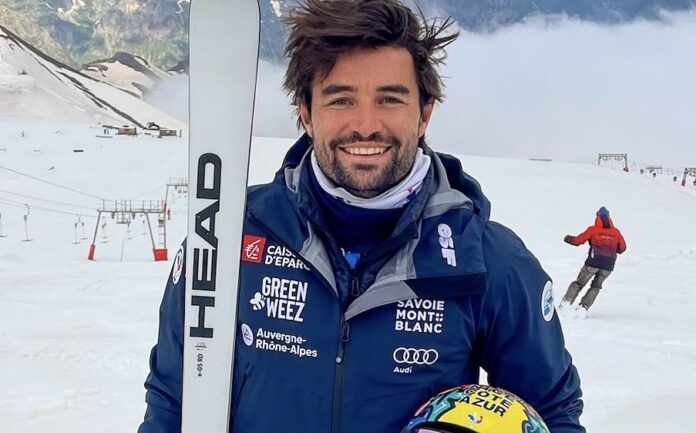
Back from his American tour, the Nice skier Matthieu Bailet returned for a few days to the mountains where he grew up. This gave him time to assess his not-so-ideal start to the season before resuming competition this weekend in Val Gardena.
At 29, Matthieu Bailet is in the “golden age” of his career. Driven by the desire to compete with the best, the Nice skier is experiencing a season start far from his standards. Hampered by his end of last season, the athlete from the Maritime Alps has to deal with very high starting bib numbers in the early races. As a result, a 34th place in the Super-G at Copper Mountain at the season’s opening, followed by a disappointing 53rd place in the downhill at Beaver Creek in very difficult conditions, did not allow him to score his first points of the season. Upon his return home, Matthieu Bailet took a moment to give us an initial assessment of his season start and look ahead to the Olympic Games in Milan-Cortina in February 2026.
The start of the season hasn’t been great. How do you feel today?
“It’s true, the start of the season hasn’t been great. I feel good today, but I want more. I’m not where I want to be. I want to race, work, have opportunities to establish my ranking, improve, move forward, and quickly return to these first races.”
You often started with high bib numbers, which doesn’t help with performance…
“The bib number is something very important for us. We see it today in the races that took place in Val d’Isère, Saint-Moritz, etc., for both women and men. It’s not just about the performance level. You also need to move up in the rankings, start with good bib numbers to have better conditions, etc. A complicated season like mine last year impacts this new season. There are very few sports where you find this. So, I’m restarting with high bib numbers. In these first races, the opportunity to achieve a big result with high bib numbers was almost nil.”
There are still reasons for satisfaction, with that 3rd time during the downhill training in Beaver Creek
“Yes, exactly. And then, we analyze a bit more deeply than that. There are lots of good things. That’s what today creates this little frustration and this desire for more. In terms of skiing, there is a lot better than where I am today. In the Beaver Creek downhill, there was no chance. The athletes starting a bit later, who make the biggest comebacks, finish 35th, 37th due to very difficult conditions. Now, the goal is to head to Val Gardena, really hoping that the conditions allow, with a slightly higher bib number, if there’s good skiing, to make a strong impression at the front.”
Do your performances in the early season races worry you in anticipation of the Olympics?
“No, I think worry is clearly not the right word. Worry doesn’t bring anything in the pursuit of performance. The only thing I can do as an athlete, as a professional skier, is to focus on my skiing, on my action plan, and try to do my best skiing. As for results, we’ll do the math once we’ve crossed the finish line. Before the races, it’s not always easy, mentally. The goal is to ignore it and focus as much as possible on performance.”
What are the points of improvement to work on for the upcoming races?
“Here, we’ve seen that we need a bit more precision with the equipment. It’s an extremely important dimension in our disciplines. Concretely, it’s the Formula 1 of winter sports. There are so many factors to consider and the level is pushing so high that it’s no longer enough. When you see athletes who regularly win in different conditions, you can’t imagine all the right choices needed for that. The second point is to try to find some relaxation in my skiing during competitions. There’s clearly still a slight impact from last season. Whether we like it or not, it’s the first time in my entire career where I’ve had a lack of confidence related to what I experienced at the end of last season. It’s much better now, but I still don’t feel completely free on my skis.”
Does the fact that it’s an Olympic year subconsciously hold you back a bit in the World Cup races?
“Not at all. I even have trouble understanding it that way. The Games are a huge motivation. We’re in a sport where it’s complicated to do that. Because finally, our selection depends on current results. It’s not because someone was world champion last year that they’re automatically qualified for the Games. We have to prove ourselves during the season and then peak at the Olympics.”
You often mention the pleasure of being “on the edge” during races. How do you manage fear and adrenaline in those moments?
“Well, it’s very funny. Just the first approach, from the outside, there’s the idea of always being on the edge. In fact, it’s not at all about looking for being on the edge. What we want is to push the limit and try to be as fast as possible. This means that sometimes we fall off the edge.
The dimension of stress and fear are two different things. Stress can be an expectation, which can be personal or external. Fear, in fact, we touch it in our sport, especially in speed disciplines, because we know, even if we don’t necessarily think about it, that there is clearly a risk. But not a risk of injuring a knee. When there’s a fall and the athlete has a torn ACL, it’s actually okay. Of course, we are affected by this fear. I think it’s something very personal. Everyone manages it differently. As for me, I’ve tended to use it and feel alive when it affects me. It’s also one of the reasons why I chose downhill and Super-G relatively young. This dimension of first succeeding in surviving a course before trying to win it.”
What is your ritual before each race to put yourself in the zone and prepare for the best performance?
“Often, I get up relatively early, with a first passive warm-up and some mobility exercises in the morning. After that, we follow a usual routine of breakfast, we leave, take the first lift. It’s very pleasant to leave early enough to do one or two runs just after dawn, when we’re not fully in race mode, when there’s no one on the slopes and they open just for us to warm up. For me, the switch is when we do the course inspection. Preparing tactical choices, we look a little at the conditions and, from that moment on, a certain bubble starts to form. And that’s where, as the start approaches, I talk less and less. It starts about an hour and a half before my start. I tend to put on music and head to the start. Last physical warm-up, then after that, it’s time to get the last bits of information and it’s time to set off.”
How will your upcoming days be organized until the next competition week in Val Gardena and up to the Olympics, where you’ll be racing on a track you particularly enjoy in Bormio?
“It’s a track for which I have a lot of love. But pure love, meaning that I’ve experienced some of my best results there and also some of my biggest crashes. So, it’s a rather unique affection and I can’t wait to have the opportunity to race there. But we won’t race there this year over the holidays since that’s where our Olympics will take place. We’ll go to Livigno between Christmas and New Year, a track we’ve never raced on.
As for the program, I did my last physical training session today (the interview was conducted last Saturday, Editor’s note), and my last ski training yesterday (Friday) at Isola 2000. Now, it’s rest this afternoon, packing up, and leave tomorrow (Sunday). We have a first unofficial training day in Giant Slalom or Super-G this Tuesday, and the first official downhill training on Wednesday.”
What can we wish for you for the rest of the season, then?
“To succeed in expressing myself on skis as I’m capable of doing in certain parts, to enjoy myself, and especially to free myself. Because if I feel free and manage to create speed as I’m capable of, it can lead to very beautiful results. And it will lead to very beautiful results, we hope.”
NicePremium is a free, independent local news outlet.
Help us keep going by supporting our work from €5 per month.


