
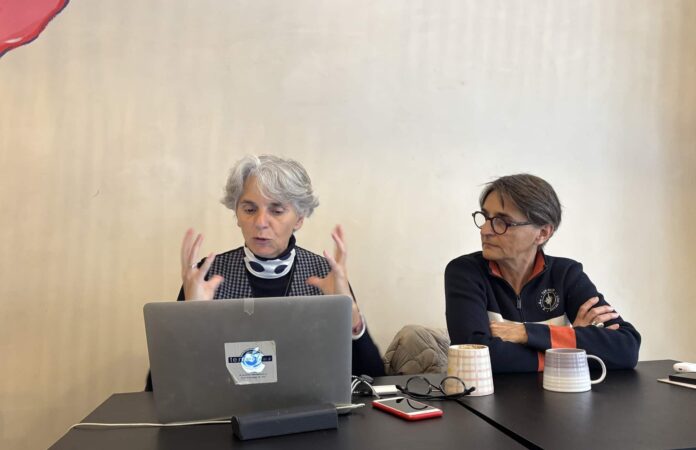
During a press conference held this Friday, Hélène Granouillac, head of the “Vivre Nice” list, unveiled the main points of her program for the 2026 municipal elections. Housing, mobility, security, and ecological transition are at the heart of the movement’s priorities.
In front of the press, the leader presented a project structured around four axes: economy, climate transition, security, and well-being. The head of the movement aims to build “an economy of well-being and a harmonious coexistence.”
Housing as a Priority
Hélène Granouillac placed housing at the center of the project, criticizing apartment overcrowding and access difficulties, especially for students. “Nice is the city in France with the highest rate of overcrowding,” the candidate reminded, highlighting the consequences on health and education. To address this issue, the head of the list proposes to transform vacant offices into housing, especially for students, in collaboration with the Crous, and to strengthen controls on holiday rentals.
According to the leader, “the 90 days are not respected” (the maximum duration allowed for holiday rentals in Nice, Editor’s Note), with some owners renting out for up to six to eight months a year, justifying a firmer municipal intervention to regulate these practices.
The candidate also wishes to regulate the construction of secondary residences, considering that “the water issue must be addressed”, in a context of water stress.
Among the key measures is the transformation of the Auvare barracks into a “village of crafts and transition” […] “It will be a place where skills are taught and passed on,” specified the leader, seeing this project as a lever to support the local economy.
Mobility and Security
On transportation, Hélène Granouillac advocates a policy based on the development of buses, trams, and bike lanes, while rejecting total free rides. “Nothing is free; there are staff and equipment to maintain,” the leader reminded. However, the president of Terre Bleue proposes a “one-euro fare” for students and low-income individuals.
The goal is to develop bike lanes and park-and-ride facilities, with light vehicles available for individuals and deliveries, and to revive local production of clean vehicles. She also plans for one Sunday per month reserved for cyclists and pedestrians on the Quai des États-Unis.
Regarding security, the Vivre Nice leader wishes to strengthen the human presence in neighborhoods through proximity brigades. For the opposition councilor, “security is not limited to cameras; it also involves prevention and dialogue.”
Education, Sport, and Equality
The program includes greening schoolyards and improving the school environment. The leader aims to create “a protective environment for children”, with more trees and green spaces. The development of a “walking bus” and the improvement of sidewalks are also part of the project.
On issues of equality, Hélène Granouillac presented her project “Nice, City of Women”, accompanied by a plan to combat violence. The leader of the group Vivre Nice recalls that “femicides increase by 40% during heat waves” and proposes a “Vigilant Plan against Violence” aimed at preventing intra-family and sexual violence.
This plan includes measures to improve thermal conditions in public housing and a particular focus on residents’ security, while integrating the well-being dimension related to the climate transition.
The candidate also proposes to transform the former Foch police station into a home for young working women, with rents “around 500 or 600 euros.”
Environment and Tourism
On the ecological plan, the leader wants to strengthen green corridors and protect the coastline. A financial contribution from tourists for waste management, with a “one-euro contribution”, is also considered. The former tourist office could become a “house of the people”, aimed at encouraging exchanges between residents and tourists.
The leader also proposes to organize three to four days a year of “Dolce Nissa”, to encourage the entire population to disconnect from screens, particularly those under 15 but also adults.
NicePremium is a free, independent local news outlet.
Help us keep going by supporting our work from €5 per month.


