
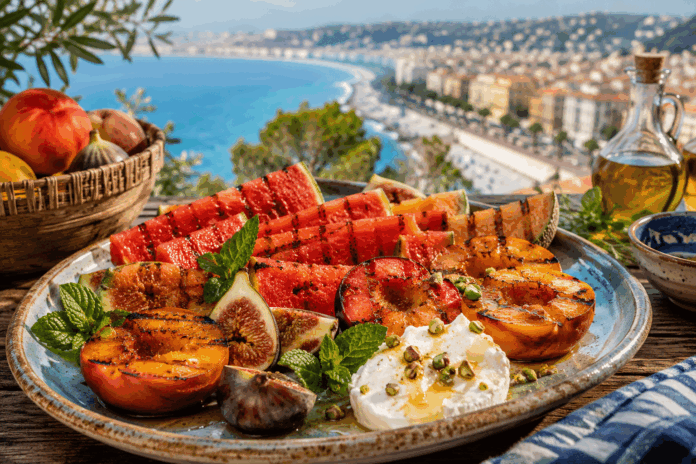
In Nice, summer is also cooked outdoors.
On a terrace, in a garden or around a plancha, seasonal fruits lend themselves particularly well to quick cooking that concentrates their flavors and brings a slight grilled note.
Peaches, nectarines, apricots, figs, melon or watermelon: in the middle of August, Nice’s markets offer numerous possibilities for transforming a very simple fruit into an appetizer, a side dish or a dessert.
No need for complicated technique. A few minutes of heat, a good product and a well-chosen accompaniment are often enough.
When fruits go on the grill
Under the effect of intense heat, the fruit’s surface colors, some of its water evaporates and its flavors become more concentrated.
The texture also evolves: the outside becomes slightly marked while the inside becomes more tender.
The result obviously depends on the fruit, its ripeness and the cooking method. A fig will react very differently from a slice of watermelon or a peach.
That’s also what makes the exercise interesting.
Barbecue, plancha or cast iron skillet can all work, provided you work on a surface that is very hot and clean.
Which fruits to choose in August?
August remains one of the great months for summer fruits.
At the stalls of Cours Saleya or the Libération market, peaches, nectarines, apricots, figs, melons and watermelons offer many possibilities.
The peach and nectarine
Cut in half and pitted, they are among the easiest fruits to grill.
Place them for a few minutes flesh-side down on a hot surface, just long enough to mark them and soften them slightly.
They work very well with a drizzle of honey, a few thyme leaves or lightly toasted almonds.
For a dessert version, they can be accompanied by a scoop of orange blossom ice cream or plain yogurt.
The apricot
The apricot brings more acidity.
It lends itself particularly well to sweet-savory combinations: fresh sheep’s cheese, ricotta, honey or some aromatic herbs.
Choose ripe fruits but still firm enough that they retain their shape during cooking.
The fig
The fig requires very little time.
Cut in half, it can simply be placed for a few moments on the grill or plancha.
Its sweetness pairs as well with pistachios and honey as with a more pronounced cheese.
A grilled fig with a little blue cheese or goat cheese can thus become a nice summer appetizer rather than a dessert.
The watermelon
Watermelon is probably the most surprising.
A sufficiently thick slice can withstand short cooking over high heat. The heat changes its texture and gives it a slightly grilled note that works particularly well in savory preparations.
With feta, mint, a few drops of lemon and a pinch of sumac, it becomes a very fresh appetizer despite its time on the grill.
The melon
Melon can also be seared quickly.
Cut into wedges or thick slices, it works as well with burrata as with dry ham, a few basil leaves or simply a little olive oil and pepper.
Cooking should be brief: the goal is to mark the surface without turning the fruit into compote.
Choose ripe fruits, but not too ripe
This is probably the most important advice.
A very ripe fruit is delicious raw but can become difficult to handle on a grill. With heat, its flesh risks falling apart quickly.
For grilled fruits, it’s better to choose peaches, nectarines, apricots or figs that have reached maturity but are still firm.
Cooking will do the rest.
A hot and clean surface
Before placing the fruits, the grill or plancha must be sufficiently hot.
A clean surface also limits sticking and prevents fruits from taking on the flavors of fish, meat or marinades cooked just before.
Depending on the fruit and equipment used, you can lightly oil the grill or apply a thin film of neutral oil to the fruit.
There is no single rule: the key is to avoid excess fat and keep the fruit’s taste in the foreground.
Short cooking time
Fruits generally don’t need prolonged cooking.
A few minutes are often enough to get grill marks and a more tender texture.
It’s better to watch the cooking directly rather than rely on a universal time: a small fig can be ready very quickly, while a thick slice of melon or watermelon will take more time.
Visual cues are the best guide.
The surface should be marked without the fruit losing its structure entirely.
Five simple combinations to try
Grilled fruits lend themselves particularly well to contrasts.
Grilled peach, orange blossom ice cream and almonds
The sweetness of the warm fruit meets the freshness of the ice cream, with sliced almonds for crunch.
Grilled fig, fresh goat cheese and pistachios
A touch of honey can complete the combination without masking the fig’s flavor.
Grilled apricot, sheep’s cheese and thyme
A simple combination of acidity, creaminess and Mediterranean flavor.
Grilled watermelon, feta, mint and sumac
To be served as an appetizer, with a few drops of olive oil and possibly a little lemon.
Grilled melon, burrata and basil
A mix of temperatures and textures particularly suited to summer evenings.
Seasonal fruits before the recipe
The appeal of this type of cooking lies precisely in its simplicity.
The fewer ingredients a recipe has, the more important the choice of fruit becomes.
In Nice, the best starting point often remains the market.
Cours Saleya allows you to browse the stalls in the heart of the old town, while the Libération market offers a different atmosphere, very popular with locals and fresh produce enthusiasts.
Rather than arriving with a completely fixed recipe, you can also do the opposite: look at the available fruits, check their ripeness and then decide what will go on the grill that evening.
Local products: be precise
Choosing seasonal fruits and, when possible, from local producers helps support the region’s supply chains and prioritize products suited to the time of year.
However, shortcuts must be avoided.
A fruit sold at a Nice market is not necessarily produced in the surrounding area, nor is a local product automatically synonymous with minimal environmental impact.
The simplest approach is to ask the seller or producer about the origin.
This conversation is actually part of the pleasure of the market.
Grilled fruit, between dessert and savory dish
This is probably what makes this technique interesting: it partly erases the boundary between sweet and savory.
A peach can become dessert with honey and ice cream, then an appetizer with fresh cheese and some herbs.
Fig can accompany goat cheese, watermelon a feta, melon a burrata.
Cooking simply adds another dimension to the product without imposing a specific direction.
And in a Mediterranean cuisine where fruits, cheeses, olive oil and aromatic herbs easily meet, these combinations naturally find their place.
Nice’s summer on a very simple plate
A peach, a few figs or a slice of melon, a few minutes of heat and a well-chosen accompaniment: there’s really not much needed to turn August’s fruits into a summer dessert or appetizer.
No need to multiply ingredients or look for spectacular effects.
The fruit should remain at the center.
And in Nice, the best starting point may be the simplest one: go to the market in the morning, see what the season offers and decide the menu from there.
NicePremium is a free, independent local news outlet.
Help us keep going by supporting our work from €5 per month.


