
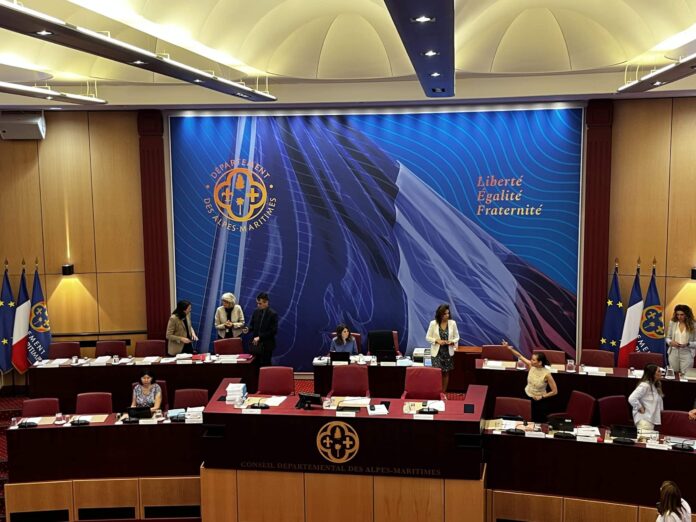
The Departmental Council of the Alpes-Maritimes has voted on a 2026 budget of 1.65 billion euros. The president of the department, Charles Ange Ginesy, spoke after the adoption to highlight the chosen budgetary options and a stark opposition within the departmental assembly.
The 2026 departmental budget was adopted during the last plenary session of the Departmental Council of the Alpes-Maritimes. This adoption occurred in a nationally unstable context. In an op-ed, Charles Ange Ginesy, president of the department, described a France “at a standstill, lacking both budget and direction.”
The overall budget amount reached 1.65 billion euros, which is about 60 million euros more compared to the 2025 fiscal year. This budget was presented as a public service budget. The president of the department stated: “our community has voted for a 2026 budget that combines responsibility and ambition.”
An envelope of 245 million euros was allocated to investment. This amount represented an increase of 15 million euros compared to the year 2025. This direction was associated with continued departmental debt reduction. No tax increase was voted.
Charles Ange Ginesy asserted that this budget aimed “to offer the people of the Alpes-Maritimes a more resilient, more united, and more innovative department.” These objectives were presented as structuring for departmental action.
Departmental projects rejected by supporters of Christian Estrosi
The budget vote led to marked opposition. The councilors close to Christian Estrosi, sitting on the Departmental Council, rejected all budgetary deliberations. This position was criticized by the president of the department, who said he was “shocked” by this comprehensive rejection.
The presidential speech highlighted the lack of support for all the projects included in the budget. No project received the approval of the opposition group. This behavior was described as “systematic obstruction, without arguments or counter-proposals.”
Several specific projects were mentioned. The opposition concerned the construction of middle schools. The refusal also applied to the commissioning of a new high-tech radar capable of predicting rainfall intensities at the neighborhood level. The launch of a Departmental Supervision Center serving rural municipalities was also rejected.
The financing of firefighters was among the contested points. The development of healthcare services in the valleys was mentioned. The renovation of several public and associative nursing homes was also involved. The creation of spaces in autonomous residences and the opening of a third Departmental House of the First 1,000 Days were cited. Support for farmers and welfare benefit recipients completed this list.
Charles Ange Ginesy insisted on the non-partisan nature of these projects. The president stated that these subjects bore “no particular political connotation.” The common denominator mentioned was the improvement of the quality of life for the department’s residents.
A degraded political climate
The speech also referred to the local political context. Charles Ange Ginesy mentioned “postures in place a few months before the municipal elections.” This situation was presented as enduring. The president recalled that this opposition did not stem from the budgetary session.
A broader critique of the departmental political functioning was made. The president lamented a constant search for controversy. This attitude was contrasted with an approach focused on working for the benefit of the people of the Alpes-Maritimes.
The departmental majority was presented as consistent in its support for structuring projects. The president recalled support provided to several projects in Nice. The tramway, the access road to the freeway, and the multimodal hub were cited as recent examples.
This political stance was defined by the expression of “departmental patriotism.” This notion was described as a compass of general interest. The speech called for moving beyond electoral logic.
The end of the intervention addressed an internal issue within the Republicans. The president of the Alpes-Maritimes department declared he could not accept that the party’s statutes be “trampled on” to support the mayor of Nice. The lack of debate in the Departmental Nomination Committee and then in the National Committee was criticized.
The speech concluded with a more general reflection. Charles Ange Ginesy stated that “restoring confidence in politics” required coherence and clarity. The systematic rejection of departmental projects was presented as incomprehensible to citizens. The president concluded with this sentence: “our compatriots no longer understand this way of practicing politics!”


