
History tells us…
Pericles was a prominent and influential statesman in Athens during the city’s golden age.
He also distinguished himself in the promotion of the arts. He initiated the construction of most of the structures still present today.
Thus, Pericles managed to lead a remarkably effective prestige policy. These monumental projects provided work for all the craft guilds as well as for the poor, reinforcing his social policies.
Pericles promoted a popular social policy. It allowed everyone to participate in democracy.
Sometimes presented as the father of democracy, sometimes as a populist demagogue, and sometimes as a monarch ruling over consenting masses, Pericles is hailed as the ideal archetype for the struggle for participatory democracy and civic pride.
However, in The Peloponnesian War, the historian Thucydides writes about Pericles: “In theory, the people were sovereign, but in reality, the State was governed by the first citizen of the city.”
In these times…
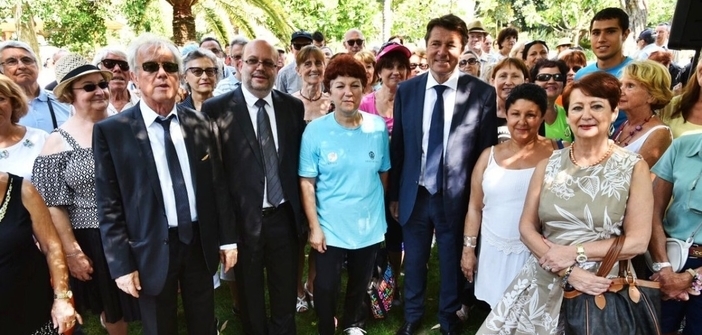
The Assises of Proximity Act I in 2012 allowed the emergence of 100 proposals made by more than 500 representatives of the population, drawn from neighborhood committees and merchants’ associations.
Upon returning to the position of Mayor of Nice, Christian Estrosi embarked on a vast grassroots democracy operation (previously termed “from below” before the expression faded) to “encourage involvement in the life of the city and to shape, together, the future of Nice.”
In practice, this involves five series of new measures in the areas of animation, information, neighborhood beautification, democracy, and citizen participation.
What are the major objectives?
Increasingly lively neighborhoods, a “culture and heritage” charter, more accessible information, enhanced quality of life with more security, and a new traffic and parking plan.
The Mayor of Nice also announced “a new democracy” through a participatory project.
Firstly, the meetings of the nine neighborhood councils will be open to all citizens (based on the model of the Greek agora where everyone could speak and express themselves).
Moreover, a questionnaire addressing expectations will be sent to all residents, and the responses will be synthesized into a specification for the municipality.
It is evident that Christian Estrosi has ambitions for Nice, and they are not negligible: “that our city retains its rank, that it be one of the most pleasant cities to live in the world, that it be the one that has succeeded in minimizing urban nuisances so that we can peacefully enjoy our exceptional living environment.”


