
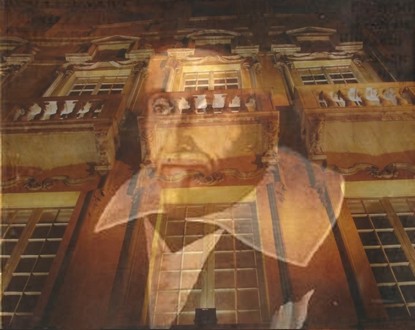
Our good city of Nice was the center of a very important Commandery of the Order. Indeed, the special relationship between the Order and the city experienced exceptional circumstances from its foundation, and even more particularly after the fall of Jerusalem, the Holy Land, the East, and the island of Rhodes where the Order had settled.
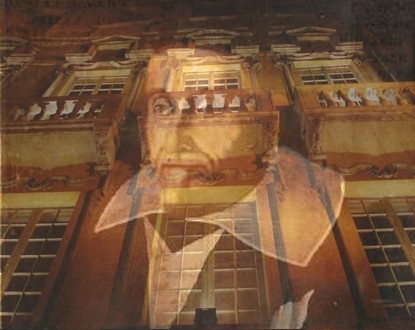 The Grand Master Jean-Paul Lascaris lived in the prestigious family palace on rue Droite in Old Nice, a true undisputed gem of “Baroque” Art, which became a museum after its acquisition by the city of Nice.
It was after the loss of Rhodes that the Grand Master, Philippe de l’Isle Adams, and all his Knights returned to Nice, where they received the hospitality of the Duke of Savoy, and where they stayed from 1527 until their departure for the island of Malta in 1529. The island of Malta was ceded to them by Charles V, a great protector of the Knights of the Order and a perpetual enemy of the King of France.
This departure for the island of Malta does not at all mean the disappearance of the Commanderies of Nice and its County. Let us not forget that along with Savoy and Chambéry, Piedmont, Turin, and the County of Nice formed a buffer state between France and all the small Italian states.
The Savoyard alliances were of great importance, and the only access our country of yore had to the sea was Nice, or more precisely Villefranche sur Mer, where the Order’s galleys were stationed.
Moreover, in 1523 the facilities at Villefranche sur Mer were improved; it is also in the Darse of Villefranche that maintenance, arming, and construction of other galleys took place.
Only the Carrack, the Grand Master’s ship, was anchored in front of the small port of Nice. (The Carrack is a ship of 1,000 to 1,500 tons, particularly well-equipped).
Let us recall here that long after the Order’s departure for Malta in 1529, Nice was besieged in 1543 by the French armies and the Turks of Suleiman the Magnificent. This alliance caused a real scandal among all the Christians of Europe. This siege was repelled, and the attackers were defeated by the besieged Niçois, commanded by Knight De Balbi de Quis.
Many Knights from the Niçoise nobility distinguished themselves both on land and at sea from the founding of the Order and for several centuries.
Jean-Paul Lascaris is described as intelligent and austere, well-educated, and very religious. Orphaned at 12, he began as an administrator for grain (agriculture, as we would say today!). Subsequently, he became prior of Saint Gilles, a very important town at the time, and bailiff of Manosque, always expressing himself in the Provençal language. On the death of the Grand Master Antoine de Paule, on June 11, 1636, being Seneschal in Malta, he was elected the 57th Grand Master of the Order.
Jean-Paul Lascaris remains quite unpopular nowadays in the Maltese memory, having left the impression of a contrary and obstinate sovereign, a rather unsympathetic character. Even today, in Malta, it is said of a person rarely inclined to smile, “Aquéu a lou moure coume Lascaris” meaning “that one, he has a face like Lascaris.”
In any case, his reign and his magisterium were among the most important the Order had known, if only because they spanned 21 years. Although already very old for his time – he was 76 years old in 1636 – Jean-Paul Lascaris was in robust health and demonstrated very exceptional energy.
Throughout his reign, the threats of a Turkish attack were always present, as Turkish covetousness over the island of Malta was constantly relevant. Consequently, Jean-Paul Lascaris meticulously pursued his predecessors’ work by completing the belt of fortifications around Valletta, the capital, and its grand harbor. To the south of the capital, other walls were built, while the protection of three cities was ensured to the east. These considerable works proved very costly.
Jean-Paul Lascaris had to resort to two enormous loans. In Valletta, he made improvements to Fort Saint-Elme and a new outer enclosure doubling the first. The pier was enlarged, and a quay path was established by piercing the rock with a tunnel completed in 1687. The Order’s navy was enriched in 1652 with a new galley, offered by the Grand Master. Its maintenance and arming were ensured by the income of the “Lascaris foundation” (which owned property as far as Sicily and also in Rome), richly endowed by the Prior of Capua and Pierre Lascaris.
Various expeditions were launched against the corsairs of Tripoli and Algerians. At the request of Venice, besieged by the Turkish fleet, 20 merchant ships were captured by the Order, as well as the renegade Ibrahim Rais. The most brilliant undertaking was carried out in 1639 against Tunis with the capture of 6 ships. But also on August 25, 1640, the fleets of Venice and the Order were victorious over the Turks in Tenedos and in the Dardanelles where 7,000 Christians were freed.
Let us also mention Candia, in Crete, which was besieged for 21 years by the Ottomans. The longest siege in all of history. The Venetians, then masters of the island, were very quickly aided by the Order.
Later, followed by assistance from troops from all over Europe as well as from the Grand Master of the Teutonic Order.
The most unexpected event of the Grand Magisterium of Jean-Paul Lascaris is the acquisition by the Order in 1653 of the islands of Saint-Christophe and Sainte-Croix in the Caribbean.
One of the major concerns during the reign of Jean-Paul Lascaris was to provide grain to the population of Malta, thanks to supplies from Sicily. Jean-Paul Lascaris even had to buy grain with his own money, thus demonstrating great charity.
He was far less fortunate in the serious conflict that opposed the population to the Jesuits, which erupted during Carnival, with the Maltese population dressing up and ridiculing the Jesuit clergy. The rebellion did not spare the Grand Master, who was preparing to expel the Jesuits from Malta, but who was disavowed by Pope Urban VII.
In 1643, in the small port of the island of Marsamxett, Jean-Paul Lascaris built the Lazaret. Malta owes him the first printing press installed in the Magistral Palace in 1650, with the later construction of a large public library. He also had a bowling alley built, reserved for ball games, which he vigorously encouraged the Knights to practice.
The Grand Master Lascaris did not forget his ties with Nice and its region. He bought mills and ovens and offered these facilities to a new Commandery in Lucéram.
Until 1738, his great-nephews and great-great-nephews, owners of the Lascaris Palace, were holders and usufructuaries of this Commandery.
In 1642, he entrusted his nephew, the Marshal of Camp Jean-Baptiste Lascaris, with bringing to the Saint-Réparate Cathedral of Nice the relics of Saint Vincent Martyr, enclosed in a beautifully carved ebony and silver reliquary.
The parish church of Castellar also benefited from the generosity of Jean-Paul Lascaris, as did other members of his family.
After his death, on August 14, 1657, at the very venerable age of 97, a mausoleum was erected by the Knights of his lineage and the Order, in the Conventual Church of the Knights, now Co-Cathedral of Saint John the Baptist in Valletta.
In his memory, we keep documents, portraits, marbles, liturgical garments, prints, coins. Among others, we mention the shield engraved with his name and coat of arms, adorned on one side with his blazon and that of Malta, and on the other side with the representation of Saint John the Baptist.
His Palace on rue Droite in Old Nice, listed as a historical monument since 1946, was sold during the Revolution and divided into apartments in the 19th century.
The Palace was repurchased by the city in 1943 and opened to the public in 1965 after a long and meticulous restoration. The Palace, whose visit is free, like all municipal museums, constitutes a unique testimony, the most luxurious, magnificently preserved, a pure Baroque marvel. Access to the floors is via a monumental staircase adorned with frescoes, closed by galleries of arcades. The master’s floor, decorated with precious Flemish tapestries, presents period furniture, ceramics, etc., as well as an astonishing private chapel.
Note that the Lascaris museum is not dedicated to the Grand Master nor to his family, but houses Arts and popular traditions, including a fabulous collection of ancient musical instruments, permanently displayed, which is the 2nd most important after that of the music museum in Paris, far ahead of Milan, Vienna, and London.
A street bears the name of Lascaris in Nice, in glory of the entire family, with its Admirals, Grand Chamberlains, Lords, Counts, officers of the Sardinian and Savoyard Armies…
The Duke of Savoy, Charles Emmanuel, son of Emmanuel Philibert, who, among other things, built the Citadel of Villefranche sur Mer, said that “the Lascaris were the most prestigious and the most important family of the County of Nice.”
Let us therefore pay a well-deserved tribute to the Niçoise Grand Master of the Order, Jean-Paul Lascaris, his magisterium of 21 years, without forgetting his predecessors and his successors: all dedicated their energy and their lives to their cause, they toiled and suffered in their battles, often losing their best Knights.
by Zacharie Van Goey


