
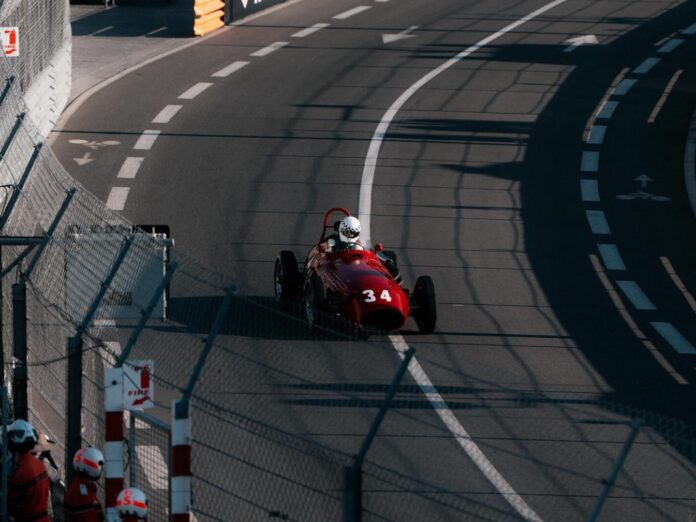
On the mythical track of the Principality, the Monaco Historic Grand Prix offered a day out of time. Between the roar of vintage engines, the enthusiasm of the crowd, and a tribute to the history of the discipline, the event reminded us why Monaco remains one of the must-see temples of motorsport.
Monaco, a legendary circuit at the heart of automotive history
It’s hard to dissociate Monaco from motor racing. Nestled between sea and mountain, the Principality has established itself over the decades as one of the most iconic circuits in Formula 1. Its tight turns, omnipresent barriers, and urban layout make it a unique challenge, where some of the greatest moments in sport have been written. Home to Scuderia Ferrari and Monegasque driver Charles Leclerc, Monaco maintains an intimate connection with competition, blending prestige, tradition, and sporting excellence.
A day marked by eras
This heritage was once again showcased during the final day of the Historic Grand Prix, marked by a succession of races tracing several decades of automotive evolution. From the early hours of the morning, series followed one another, from pre-war single-seaters to 1980s Formula 1 cars.
The dense program allowed a journey through eras: from front-engine cars built before 1961 (Series A2), to pre-war models and voiturettes (Series A1), to more modern single-seaters from the 1970s and 1980s (Series D to G). Among them, Series F (1977-1980) stood out for its particularly high pace, approaching today’s Formula 1 standards.
A timeless auditory and visual atmosphere
Beyond performance, it was a true sensory experience that prevailed. The sound of old engines, more raw and mechanical, contrasted with today’s sounds. The characteristic smell of these vintage machines lingered in the air, reinforcing the impression of a journey back in time.
Despite a gray sky, the crowd, numerous, remained present throughout the day, buoyed by a warm and passionate atmosphere. At the end of each race, the public stood to applaud the drivers, in a collective surge of respect and admiration. The commentators punctuated the races with anecdotes about the eras crossed, adding a cultural dimension to the event.
Between mastery and unforeseen events on the track
While the day unfolded without major incident, it was not without its share of surprises. The age of the vehicles led to several mechanical issues quickly addressed, while four collisions were reported, with no physical consequences for the drivers.
These unforeseen events remind us of the complexity of driving these machines from another time. Though slower than today’s single-seaters, they require nonetheless a great precision and constant commitment. Differences with modern Formula 1 are evident in the sound, rhythm, and profile of the drivers, often from another generation, but still driven by the same passion.
Ferrari honored in a parade steeped in nostalgia
Alongside the races, the Ferrari gala further enriched this immersion in history. Conceived as a true parade, it honored iconic models of the Italian brand, each representing an era of motorsport.
The atmosphere, more elegant and imbued with nostalgia, contrasted with the intensity of the races. This moment highlighted the legacy of Ferrari, deeply linked to Monaco, and its central role in the evolution of the discipline.
A meeting between memory and passion
Throughout the day, the Historic Grand Prix established itself as much more than just a competition. It is a memory meeting, where enthusiasts, curious spectators, and lovers of beautiful machines come together to celebrate a shared heritage.
In the streets of Monaco, the past continues to roll, reminding us that the history of motorsport is not just to be observed: it is lived, to the rhythm of engines of yesteryear.
NicePremium is a free, independent local news outlet.
Help us keep going by supporting our work from €5 per month.


