
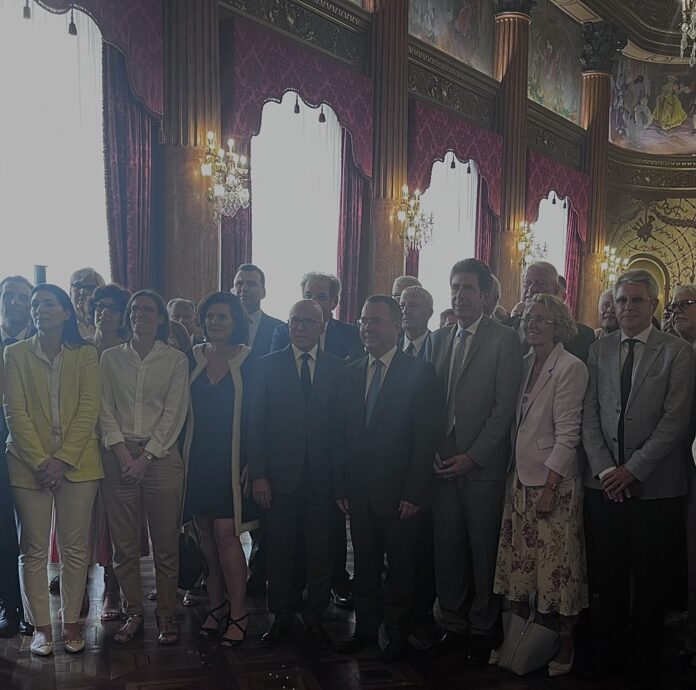
A ceremony was organized this Thursday at the Palace of Savoyard Kings to mark the departure of Laurent Hottiaux, prefect of the Alpes-Maritimes. Appointed prefect of the Pays de la Loire Region and prefect of Loire-Atlantique, he leaves his position on Friday. This ceremony was an opportunity for him to take stock of his achievements.
The Palace of Savoyard Kings hosted a ceremony on Thursday, July 16 for Laurent Hottiaux, prefect of the Alpes-Maritimes. After fourteen months in office, he is leaving the Nice prefecture. On June 24, he was appointed prefect of the Pays de la Loire Region and prefect of Loire-Atlantique in Cabinet meeting.
With the agreement of the Interior Minister, his appointment was deferred so he could organize and attend the July 14 ceremonies, as part of the commemoration of the ten-year anniversary of the 2016 attack.
His successor and former prefect of the Pyrénées-Atlantiques, Jean-Marie Girier, will take office heading the department on Monday, July 27.
The reception hall hosted a ceremony bringing together numerous political figures and professionals working in security and health. After extensively thanking the prefectural team and his family, the state representative received the prefecture medal, a traditional sign of distinction and honor.
This meeting was an opportunity for him to undertake a retrospective of his fourteen months in office, not without emotion.
A rather favorable assessment
“I was very happy in the Alpes-Maritimes, but I am extremely honored by this appointment to a major regional prefecture with five departments and nearly four million inhabitants,” assured the senior official.
Many actions were undertaken by the prefectural authority, particularly regarding security, housing, and environmental issues. Laurent Hottiaux mentioned a strong commitment from the State on these “future issues.” In early July, he presented the departmental housing recovery plan. “This issue is a real brake on the attractiveness of our beautiful department,” the prefect recalled with conviction.
He also mentioned the importance of the transport issue, admitting that “this subject was ultimately quite little addressed.” It appears that this issue is rarely brought to the forefront in the news. “I worked for months to ensure we could have a coherent transport plan in the Alpes-Maritimes and we achieved it,” declared the state representative.
His successor should resume work on the highway issue. He revealed that considerable work had been done to prepare for improving and smoothing traffic flow. In the fall, a meeting will be organized regarding road issues.
The question of climate change marked the prefecture’s action. Laurent Hottiaux stated he had “tackled this issue head-on,” particularly by chairing the first departmental climate COP in 2025.
Furthermore, he assured that he continued his predecessor’s work, notably on the sensitive issue of water. “I implemented a new water restriction measure on July 10, but beyond restrictions, we took structural measures, by making urban development conditional on the availability of our water resources.” He also acknowledged having committed resources through water agencies regarding forests. “An issue we don’t talk about enough; we have an extremely rich department and they are in danger.”
Finally, the prefect confirmed his desire to protect the maritime public domain. “With all the teams and the Departmental Directorate of Territories and the Sea, I will ensure we take firm positions on protecting the maritime public domain.” Furthermore, he proudly claimed more regulated management of cruises and their disembarkation.
However, the senior official nuanced this by acknowledging that there is no total consensus on tourism, transport, and especially environmental questions.
Battles far from over
“I am inevitably leaving with regrets and mixed feelings because we initiated many things,” confided Laurent Hottiaux, with emotion.
The security challenges were an absolute priority for the Alpes-Maritimes prefecture, particularly in its fight against drug trafficking and radicalization. By placing security as an essential element, a significant number of dealing points were dismantled and traffickers incarcerated. “I believe we have won decisive battles but we have not won the war,” admitted the senior official. He heavily emphasized the importance of continuity in fighting these traffics, which continue to regenerate.
For the state representative, the other sensitive point is the question of climate change. This issue is of burning relevance with heat wave plans and numerous forest fires. “This is an issue we struggle to address, which is why the role of the State is essential in this area, outside crisis situations,” he stated.
This climate emergency is a true daily struggle for adaptation, but also for its recognition. “We can say that in the Alpes-Maritimes, there are somewhat climate-skeptical positions. Climate change is not a political problem, it is a matter of science,” lamented the prefect.
He repeatedly affirmed the department’s lag in this awareness. The sidelining of this issue would be due to territorial, political, and institutional divisions between the territories comprising the Alpes-Maritimes. Yet climate change requires greater unity.
Thus, he recommended action, anticipation, and adaptation. Yet the prefectural authority acknowledged that this issue had not been taken seriously enough: “when I took office, this issue was not at the heart of the agenda in our department.” Although he acknowledged that a large majority of elected officials are aware of this environmental problem, he admitted the existence of a paradox: that of the Alpes-Maritimes’ place in an extremely sensitive zone subject to a cumulation of natural risks.
The department’s organization remains insufficient to address these issues, but nonetheless, Laurent Hottiaux is not pessimistic.
NicePremium is a free, independent local news outlet.
Help us keep going by supporting our work from €5 per month.


