
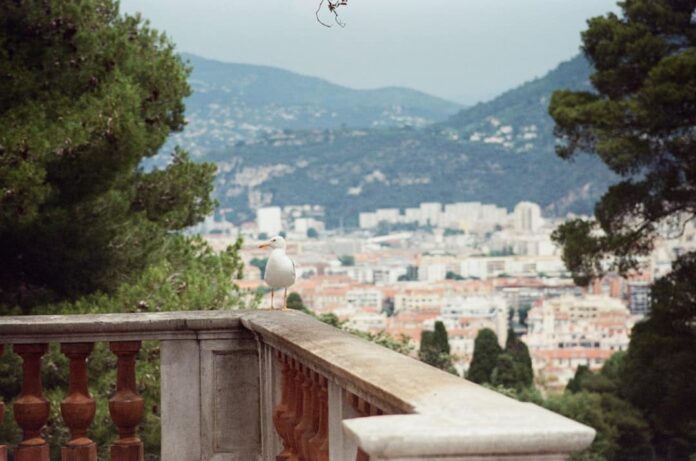
In Nice as throughout the Riviera, the terrace is no longer merely an extension of the living room: it becomes the living heart of the home. Inspired by the Mediterranean tradition of the Andalusian patio and by contemporary biophilia research, residents of the Côte d’Azur are transforming their outdoor spaces into true hanging gardens. Between Provençal ceramics, aromatic plants and natural rattan furniture, an aesthetic of the outdoors asserts itself with renewed elegance.
Biophilia, the guiding thread of outdoor decoration
The concept of biophilia — this natural inclination of human beings to surround themselves with living things — has largely overflowed from interiors to settle on terraces. American biologist Edward O. Wilson, who theorized this need in his work Biophilia published in 1984, had anticipated a trend that 21st century design has only amplified. Today, interior architects and landscape designers are using it to rethink every square centimeter of our urban outdoor spaces.
On the heights of Cimiez or in the streets of old Nice, terraces are playing the card of vegetation density: dwarf fig trees in planters, rosemary trimmed into balls, climbing bougainvilleas in carmine hues. This approach recalls the Hanging Gardens of Babylon in its ambition, but is rooted in a climatic reality that the Nice coastline naturally favors with its 300 days of sunshine per year.
Five flagship trends for the Mediterranean terrace in 2026
1. Revisited terra cotta tiling
Terra cotta tiling, a direct legacy of Nice and Provençal architecture, is experiencing a spectacular resurgence. Portuguese manufacturers from the Alentejo region and ceramic artisans from Salernes, a Var village renowned for its earthenware, offer XXL formats that give small terraces an impression of space and warmth. Associated with white grout and natural fiber rugs of jute or sisal, these tiles anchor the décor in sought-after regional authenticity.
2. Natural rattan furniture and responsible teak
After years of synthetic resin, natural rattan is making a strong comeback. Houses like Rotin Design or the outdoor lines of Danish manufacturer Cane-line offer collections inspired by colonial verandas revisited with Nordic sobriety. Teak, meanwhile, remains essential provided you prioritize FSC certifications guaranteeing sustainable forest management — an increasingly widespread requirement among Nice buyers sensitive to ecology.
3. Aromatic plants in pots: beauty and utility combined
Large green basil, lemon thyme, ‘Hidcote’ lavender, Moroccan mint, common rosemary: the Nice terrace is also an olfactory pantry. Renowned British landscape designer Dan Pearson, known for his naturalistic garden compositions, has long defended the idea of a porous boundary between ornamental and productive gardens. On the balconies of Promenade du Paillon or the Port district, this philosophy takes on full meaning in carefully arranged planters according to permaculture principles.
4. Soft and warm lighting
Outdoor lighting is undergoing a quiet revolution. Gone are the cheap garlands: in 2026, preference goes to brushed brass lanterns, streamlined solar luminaires and candles in hand-blown glass candle holders. The French brand Fermob, based in Burgundy and whose colorful collections have conquered terraces around the world, offers rechargeable LED lamps that perfectly accompany summer evenings without harming natural darkness — a growing environmental issue on the Mediterranean coast.
5. High-performance outdoor textiles
Sunbrella fabric cushions, Dralon canvas curtains, woven polypropylene rugs: technical textiles have reached a level of sophistication that now allows them to rival natural materials in terms of aesthetics. The Spanish company Gandia Blasco, a pioneer of outdoor design since the 1940s, dresses numerous Riviera terraces with its collections featuring geometric patterns inspired by Victor Vasarely‘s kinetic art.
Inspiration from historical Mediterranean gardens
To find inspiration, there’s no need to look far. The Villa Ephrussi de Rothschild in Saint-Jean-Cap-Ferrat, with its nine themed gardens overlooking the sea, offers a masterful lesson in landscape design in a Mediterranean setting. Water features, pergolas covered with old roses, French parterres mixed with exotic species: so many ideas that can be transposed, on a smaller scale, to a Nice terrace facing south.
Even closer, the gardens of Villa Arson in Nice, a property of the National Center for Plastic Arts, illustrate how contemporary art and vegetation can dialogue in an urban context. The slope, the view, the slanting evening light: so many parameters that Mediterranean terrace designers must learn to master, as the architects of the Belle Époque villas that still line the Nice waterfront had done.
Small spaces, big ambitions: the reinvented Nice balcony
Not everyone has the luxury of a hundred square meter terrace on the heights of Gairaut. For Haussmannian apartments in downtown or studios in Libération, a balcony of just a few square meters must be treated with almost architectural rigor. The principle of less is more dear to Ludwig Mies van der Rohe finds here a concrete application: a single well-chosen planter, a teak stool, a hanging lantern. The effect is often more elegant than an accumulation of disparate objects.
Admirers of the Japanese wabi-sabi movement — this art of accepting imperfection and the patina of time — will appreciate unglazed stoneware pots, wooden planks grayed by sea salt, plants with imperfect but living silhouettes. An aesthetic that resonates particularly well with the golden and slightly iodized light of Nice afternoons.
Natural materials and sobriety: a sustainable way of living
Beyond aesthetics, the Mediterranean terrace of 2026 is also thought of in terms of sustainability. Rainwater harvesting, composting in bins, choice of drought-resistant plants such as agaves, euphorbias or lavenders: practices advocated by committed landscape designers and relayed by reference works such as The Dry Garden by Beth Chatto, a British figure in ecological gardening whose methods are today studied in all European landscape schools.
On the Côte d’Azur, where summer water restrictions are an increasingly pressing reality, these approaches cease to be activist options to become practical necessities. The Nice terrace of tomorrow will be beautiful, but it will also be resilient.
Conclusion: the terrace, Nice’s new living room
Whether it overlooks the Bay of Angels, the ochre roofs of the old town or the parasol pines of the hinterland, the Nice terrace is experiencing a true renaissance. Between Mediterranean heritage, contemporary sophistication and ecological awareness, it embodies better than any other space the sweetness of life specific to the Côte d’Azur. It’s up to you to take advantage of it — one plant, one cushion, one lantern at a time.
NicePremium is a free, independent local news outlet.
Help us keep going by supporting our work from €5 per month.


