
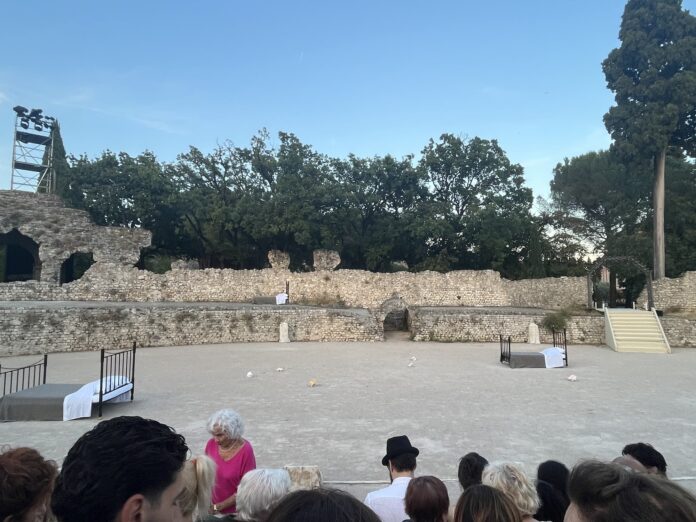
On Tuesday, June 16, at the Cimiez Arenas, actress Elise Clary embodied the voice of Véronique Olmi’s tragic novel. Written in 2001, Seaside is a heartbreaking novel that won her the Alain-Fournier Prize, and which prompted the director of the National Theater of Nice, Muriel Mayette Holtz, to seize it to make it the flagship show of the 2026 Festival of Tragedies from June 16 to 18.
The story of a modern tragedy
At the Cimiez Arenas amphitheater, under the spotlights, the performance began around 9 p.m. On stage, Élise Clary becomes a single mother who takes her two sons, Stan and Kevin, to see the sea for the first time.
Behind this journey lies a woman in great precarity, exhausted, on the brink of the abyss.
We quickly learn that these holidays will not go as planned. The text advances in waves, holds back, oppresses, forces us to face what we would prefer to avoid. Among the details of daily life, a forgotten lollipop, counted coins, the fear of missing the bus stop, while the irreparable looms.
Because gradually, we understand that the fate of her sons is sealed by this sea that they will see for the last time. An inexorable moment that imposes itself, killed in their sleep, in a shabby hotel.
A setting that accompanies perfectly
The Cimiez Arenas admirably embrace the story.
Progressively drowned by the night, the amphitheater reveals itself to be six places in one : a bed, a space evoking the beach covered with shells, a chair for the café scene, then a second bed, and on the upper level, a door drawn by light bulbs and green and purple lights, before the last bed, the final one.
Each transition is accompanied by music that is both gentle and anxiety-inducing which, step by step, predicts the drama.
The interplay of shadows and light intensifies until the denouement, as if the mother is gradually engulfed by her own thoughts.
A remarkable acting performance
The piece rests entirely on a monologue, tinged with humor against a backdrop of eternal despair. No dialogue, no partner. Élise Clary finds herself alone facing the Arenas audience.
Dressed in black, a color that seems to darken as the performance progresses, she transmits her emotions with shocking fluidity, through voice as much as through body.
She trembles when evoking her children, clings to the bed bars to signify a cry of pain, curls up under the weight of her thoughts, dances before anxiety reclaims its hold on her face.
The looks she addresses to the audience, from the front, from the back, from the side, say what words can no longer convey: sometimes she makes us witnesses, sometimes she flees from us, as if even looking at us became too heavy to bear.
We are no longer spectators. We are there, in this shabby hotel room, with her.

An audience captivated by the performance
Leaving the Arenas, Randy and Kenny, who came on the advice of a friend, sum up the experience in a single word: “intensity“. “At first, I was empathetic towards the character, and at the end I was […] really angry at her,” Randy confides.
Kenny adds: “She loves her children, but she is aware that she cannot love them properly. So she kills them […] so as not to make them suffer.”
As for the staging, it clearly made an impression. Kenny praises “the play of levels” and these “simple but effective things,” while Randy retains the image of “the staircase with the lighting effects” as a fair ground, a detail that testifies to the intelligence of the scenography.
A spectator in turn immediately invokes the myth of Medea. But where the ancient figure acts out of revenge, here she acts out of exhaustion. “It’s a contemporary tragedy that evokes the fate of single mothers who don’t even have a husband to take revenge on,” she analyzes.
For her, infanticide becomes “the ultimate gift” that the mother can still offer her children, sheltering them “from shame, the cold” that she knows she will reduce them to by the fact that she can no longer manage the situation alone.
A reading that resonates all the more because she speaks from experience: “It so happens that in my life I had periods where I raised my children alone. So inevitably, it speaks to me.”

An unforgettable performance blessed with an actress and a heartbreaking text within the framework of the Festival of Tragedies. There are two more evenings to experience it, so see you on June 17 and 18 at 9 p.m. at the Cimiez Arenas.
NicePremium is a free, independent local news outlet.
Help us keep going by supporting our work from €5 per month.


